Kimchi and Weight Loss: What the Science Actually Says
Kimchi appears in weight loss conversations more and more frequently. Social media posts claim it burns fat. Health blogs call it a superfood for metabolism. Diet plans list it as a must-eat food for anyone trying to lose weight.
But what does the science actually say?
The honest answer is more nuanced than the headlines suggest.
What Research Exists on Kimchi and Weight Loss
Several studies have examined the relationship between kimchi consumption and markers related to body weight and metabolic health.
Some research has found associations between regular kimchi consumption and lower body mass index (BMI) or improved metabolic markers in certain populations. A frequently cited study published in the journal Nutrition Research found that fermented kimchi was associated with changes in body fat percentage and fasting blood glucose compared to fresh kimchi in a small group of participants.
However, these studies have important limitations. Most involve small sample sizes. Many are observational rather than interventional. And the effects observed are typically modest and influenced by the overall dietary pattern rather than kimchi alone.
It is also important to distinguish between correlation and causation. People who eat kimchi regularly tend to eat traditional Korean meals, which are generally high in vegetables, moderate in protein, and lower in processed foods compared to typical Western diets. The kimchi itself may not be the primary factor — the overall diet may be.
The Fermentation Angle: Probiotics and Metabolism
One reason kimchi attracts attention in weight loss research is its status as a fermented food containing live lactic acid bacteria.
There is growing scientific interest in the relationship between the gut microbiome and metabolic health. Some research suggests that gut microbial composition may influence energy extraction from food, fat storage signaling, and inflammatory responses related to obesity.
Fermented foods like kimchi can introduce live microorganisms into the digestive system. Whether those organisms establish themselves in the gut, and whether their presence meaningfully affects body weight in humans, remains an active area of investigation.
The evidence is interesting but far from conclusive. Claiming that kimchi probiotics directly cause weight loss overstates what current research supports.
Capsaicin and Thermogenesis
Kimchi contains gochugaru (Korean red pepper flakes), which provides capsaicin — the compound responsible for the sensation of heat in chili peppers.
Capsaicin has been studied for its potential thermogenic effects — the idea that it may slightly increase energy expenditure or fat oxidation. Some studies have found small, measurable effects on metabolic rate after capsaicin consumption.
However, the amounts of capsaicin in a typical serving of kimchi are relatively small compared to the doses used in most research studies. The practical impact on daily calorie expenditure is likely minimal.
Fiber and Satiety
A more straightforward mechanism connects kimchi to weight management: it is a low-calorie, high-fiber food.
A typical serving of kimchi contains roughly 15 to 25 calories. The vegetables provide dietary fiber, which can contribute to feelings of fullness. Eating a fiber-rich, low-calorie side dish alongside a meal may reduce overall calorie intake simply by taking up space and providing texture and flavor satisfaction.
This is not unique to kimchi. Any low-calorie vegetable side dish could serve a similar function. But kimchi has the advantage of being intensely flavored — a small amount provides significant taste satisfaction, which may reduce the need for higher-calorie flavor sources.
The Sodium Factor
Any discussion of kimchi and health needs to address sodium.
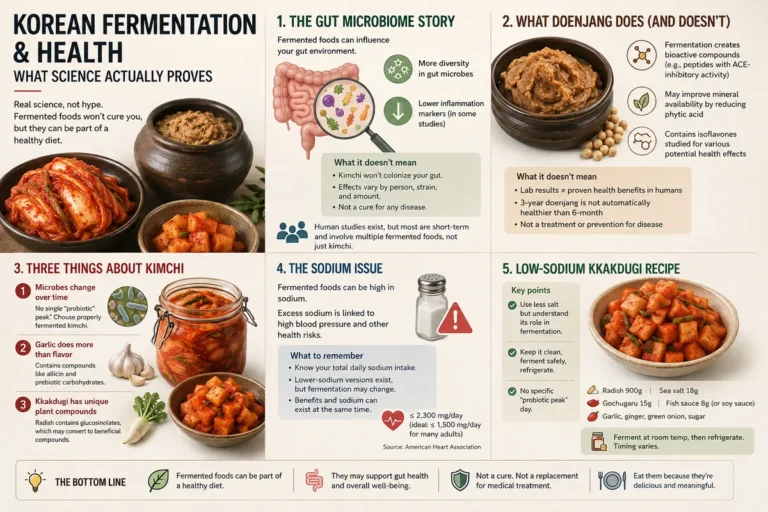
Kimchi is a salt-fermented food. A typical serving can contain 300 to 800 mg of sodium depending on the recipe and serving size. For someone eating kimchi with multiple meals daily, sodium intake can accumulate significantly.
High sodium intake is associated with elevated blood pressure in some individuals. The WHO recommends limiting sodium intake to less than 2,000 mg per day. If kimchi is a regular part of your diet, it is worth being aware of how much you are consuming.
This does not mean kimchi is unhealthy. It means that consuming large quantities solely for a perceived weight loss benefit — while ignoring the sodium content — is not a well-informed approach.
What We Can and Cannot Say
Based on current evidence:
Kimchi is a low-calorie, nutrient-dense, fermented vegetable food. Including it as part of a balanced diet is reasonable and consistent with healthy eating patterns.
There is some preliminary research suggesting associations between fermented food consumption and metabolic health markers. This research is interesting but not sufficient to make clinical claims.
Kimchi is not a weight loss drug. It does not burn fat. It does not replace exercise, calorie management, or medical guidance for people with obesity or metabolic conditions.
The most accurate statement is simple: kimchi is food. Good food. But food.
This content is for informational purposes only and is not medical advice.