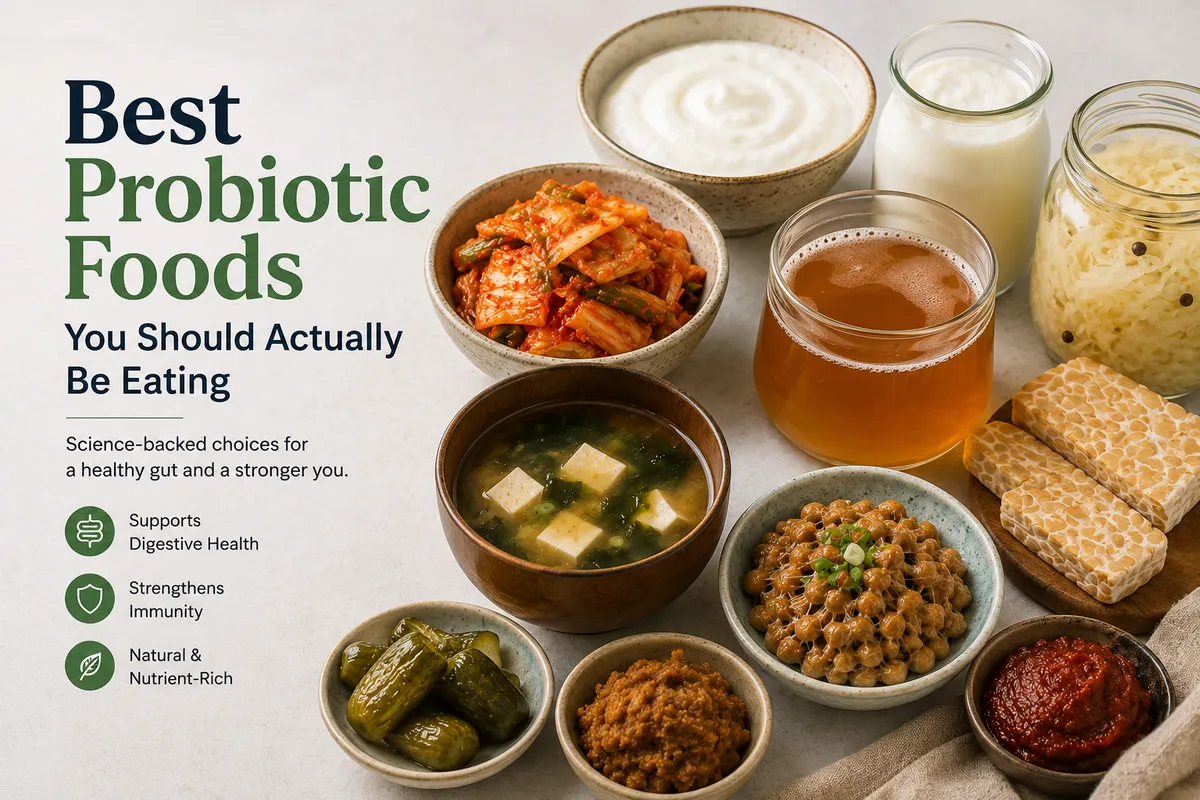
Best Probiotic Foods You Should Actually Be Eating
Most lists of probiotic foods recycle the same five items and call it science. Yogurt, kimchi, sauerkraut, repeat. The problem isn’t that those foods lack probiotics — they don’t. The problem is that not all fermented foods contain live cultures by the time they reach your mouth, and almost no one talks about which strains actually survive your stomach acid long enough to do anything useful.
Let’s fix that.
Not All Fermented Foods Are Probiotic
Fermentation and probiotics overlap, but they’re not the same thing. Fermentation is a metabolic process where microorganisms break down sugars. Probiotics are live microorganisms that confer a health benefit when consumed in adequate amounts — that’s the FAO/WHO definition, later refined by an international expert panel (Hill et al., 2014), and it matters.
Beer is fermented. So is bread. Neither contains live cultures you’d want to count on. Soy sauce ferments for months, but pasteurization kills everything before bottling. Pickles made with vinegar never fermented at all — they’re just acidified cucumbers.
The distinction comes down to one question: are the microbes still alive when you eat it?
Even when a food does contain live microbes, counts vary widely between products, fall during storage, and survival through the stomach differs by strain. Most generic “live culture” claims on packaging don’t specify strains or amounts at all.
Here’s what actually delivers.
Tier 1: The Heavy Hitters
Kimchi (traditional, unpasteurized)
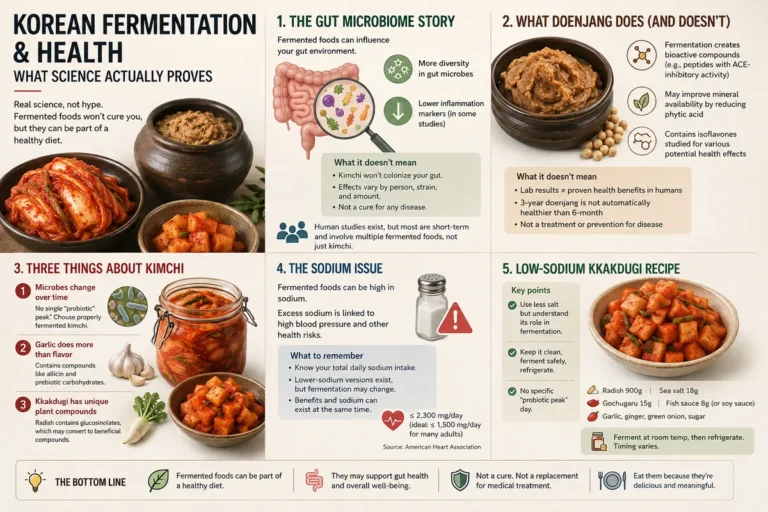
Korean kimchi — specifically baechu kimchi made with napa cabbage, salt, garlic, ginger, and gochugaru — hosts a lively, changing community of lactic acid bacteria. Sequencing studies consistently find it dominated by Leuconostoc, Weissella, and Lactobacillus-group species such as L. sakei, with the exact mix depending on recipe, temperature, and age.
What makes kimchi unusual is that its microbial population shifts as it ages. Fresh kimchi (1-2 weeks) is dominated by Leuconostoc. Aged kimchi (3+ months) shifts toward Lactobacillus. Each stage offers different metabolic byproducts — younger kimchi produces more CO2 and has a lighter tang, while aged kimchi generates deeper organic acids.
Buy it refrigerated and unpasteurized. If it’s shelf-stable, the cultures are dead.
Kefir
Kefir beats yogurt on strain diversity by a wide margin. While most commercial yogurts contain 2-3 strains (typically Lactobacillus bulgaricus and Streptococcus thermophilus), kefir made from traditional grains can harbor dozens of different species of bacteria and yeast. A 2016 review in Frontiers in Microbiology (Bourrie et al.) describes this complexity and summarizes research on kefir’s potential health effects, while noting that much of that evidence comes from animal and laboratory studies.
The kefir grains themselves are a SCOBY — a symbiotic culture of bacteria and yeast held together by a polysaccharide matrix called kefiran. You can’t manufacture this synthetically. Commercial kefir uses starter cultures that approximate the original but rarely match the complexity of grain-fermented kefir.
Tip most people miss: water kefir and milk kefir are entirely different ecosystems. Water kefir grains are translucent and feed on sugar water. Milk kefir grains are opaque and feed on lactose. They’re not interchangeable.
Natto
The Japanese soybean product fermented by Bacillus subtilis var. natto is one of the few foods where the probiotic strain is a spore-former. Spore-forming bacteria survive stomach acid far better than most Lactobacillus strains — a much larger share can reach the intestine.
Natto also contains nattokinase, a fibrinolytic enzyme that some research (Sumi et al., 1987, published in Experientia) suggests may support healthy blood circulation. It’s the only common food source of this enzyme. The taste is polarizing — slimy, pungent, and aggressively funky. Most Westerners struggle with it initially.
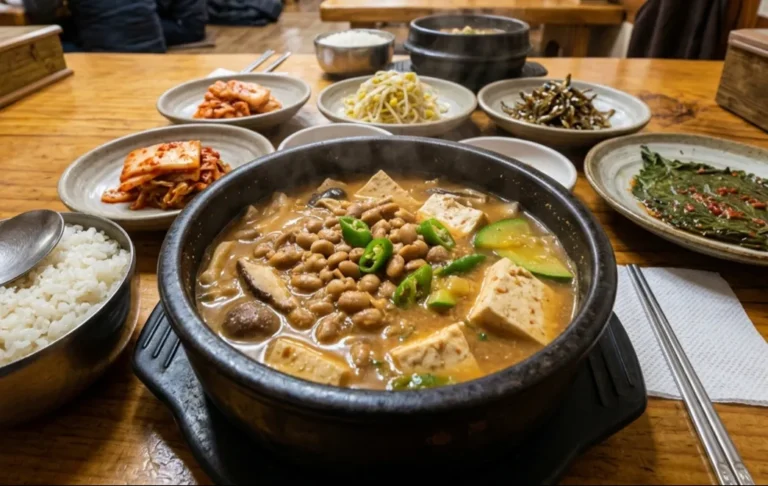
Korean cheonggukjang uses the same Bacillus subtilis species but with a different fermentation protocol. It ferments for 2-3 days versus natto’s roughly 24 hours, producing a stronger ammonia smell and different metabolite profile.
Tier 2: Reliable but Less Diverse
Sauerkraut (raw, refrigerated)
Properly fermented sauerkraut — cabbage + salt + time, nothing else — contains Lactobacillus plantarum, one of the most studied probiotic strains. Specific L. plantarum strains have been tested for irritable bowel syndrome — a randomized trial of L. plantarum 299v reported symptom improvement (Ducrotté et al., 2012) — but that was a defined supplement strain, not sauerkraut.
The catch: most supermarket sauerkraut is pasteurized. Dead. Look for the refrigerated section, not the shelf-stable aisle. If the ingredient list includes vinegar, it was never fermented.
Live counts in raw sauerkraut vary a lot from batch to batch and fall as it ages, so unlike a capsule you rarely know how many live bacteria you are actually getting.
Miso
Miso paste ferments anywhere from 2 months to 3 years depending on variety. White miso (shiro) ferments shortest and tastes mildest. Red miso (aka) ferments longest and carries the deepest umami. The primary organism is Aspergillus oryzae (koji mold), which breaks down soy proteins during fermentation, but lactic acid bacteria colonize during the aging phase.
Here’s what most people get wrong: miso soup kills the probiotics if you boil it. Add miso paste after removing the pot from heat. Stir it into warm broth — not boiling. That preserves the live cultures.
Large Japanese cohort studies have linked frequent miso soup with some favorable outcomes — one study of more than 21,000 women found an association with lower breast cancer risk (Yamamoto et al., 2003) — but these are observational associations, and other dietary and lifestyle factors likely contribute.
Yogurt (with caveats)
Yogurt makes every probiotic list, but most commercial yogurt is a mediocre probiotic source. The base cultures (L. bulgaricus and S. thermophilus) don’t survive gastric transit well. The yogurts worth eating are those with added strains — L. acidophilus, B. lactis, L. rhamnosus — listed on the label.
Sugar is the other problem. Many flavored yogurts contain 20-25g of added sugar per serving. That’s not a health food. Plain, unsweetened yogurt with explicitly named additional strains is the only version worth recommending.
Greek yogurt has more protein due to straining but not necessarily more probiotics. The straining process removes some of the whey where bacteria reside.
Three Things You Probably Didn’t Know
1. Variety may matter as much as dose. In a 2021 Stanford trial published in Cell (Wastyk et al.), adults who steadily increased fermented foods over about ten weeks showed higher gut microbiome diversity and lower levels of several inflammatory markers, while a high-fiber diet did not raise diversity over the same period. It was a small study, but it is one of the better human experiments on fermented foods.
2. The food around the bacteria matters. Researchers think the surrounding food — plant fiber, fat, or protein — can buffer bacteria against stomach acid. How much this differs between vegetable and dairy ferments has not been settled.
3. Timing matters. Consuming probiotic foods with a meal — especially one containing some fat — improves bacterial survival through the stomach. The food buffers the gastric acid. Taking probiotics on an empty stomach exposes them to the harshest pH environment. In a laboratory model of the human upper digestive tract, Tompkins et al. (2011) found bacterial survival was best when the probiotic was given with or shortly before a meal containing some fat.
The Practical Ranking
No controlled study ranks these foods head to head, so treat this as an informed rule of thumb rather than a scientific ranking:
- Kimchi (unpasteurized, refrigerated) — highest strain diversity, plant-matrix protection
- Kefir (grain-fermented) — exceptional strain count, good gastric survival
- Natto / Cheonggukjang — spore-forming bacteria, near-perfect acid survival
- Sauerkraut (raw) — strong L. plantarum delivery, fiber-protected
- Miso (unpasteurized, not boiled) — diverse aging-phase bacteria
- Yogurt (plain, multi-strain) — baseline option, weakest gastric survival
The best approach isn’t picking one. It’s rotating through several. Different foods carry different strains, and your gut responds to variety.
References
- Hill C, et al. (2014). The International Scientific Association for Probiotics and Prebiotics consensus statement on the scope and appropriate use of the term probiotic. Nature Reviews Gastroenterology & Hepatology, 11, 506–514. doi:10.1038/nrgastro.2014.66
- Wastyk HC, et al. (2021). Gut-microbiota-targeted diets modulate human immune status. Cell, 184, 4137–4153. PubMed
- Bourrie BCT, Willing BP, Cotter PD. (2016). The microbiota and health promoting characteristics of the fermented beverage kefir. Frontiers in Microbiology, 7, 647. PubMed
- Ducrotté P, Sawant P, Jayanthi V. (2012). Clinical trial: Lactobacillus plantarum 299v (DSM 9843) improves symptoms of irritable bowel syndrome. World Journal of Gastroenterology, 18(30), 4012–4018. PubMed
- Yamamoto S, et al. (2003). Soy, isoflavones, and breast cancer risk in Japan. Journal of the National Cancer Institute, 95(12), 906–913. PubMed
- Tompkins TA, Mainville I, Arcand Y. (2011). The impact of meals on a probiotic during transit through a model of the human upper gastrointestinal tract. Beneficial Microbes, 2(4), 295–303. PubMed
This content is for informational purposes only and is not medical advice.