Alcoholic Fermentation: The Science of Makgeolli and How Rice Becomes Alcohol
Alcoholic fermentation is the process by which yeasts convert sugars into ethanol and carbon dioxide. It is the foundation of every alcoholic beverage humans have ever made — beer, wine, cider, sake, and Korean makgeolli.
But makgeolli is not just another example of alcoholic fermentation. It demonstrates a version of the process that is more complex, more microbially diverse, and more dependent on traditional fermentation technology than almost any other alcoholic drink in the world.
Understanding how makgeolli is made means understanding alcoholic fermentation at a deeper level than most people ever encounter.
What Is Alcoholic Fermentation?
Alcoholic fermentation is an anaerobic metabolic process in which yeasts — primarily Saccharomyces cerevisiae and related species — convert simple sugars (glucose, fructose) into ethanol (drinking alcohol) and carbon dioxide (CO2).
The basic equation is straightforward: glucose → ethanol + carbon dioxide + energy (ATP).
This process does not require oxygen. In fact, most alcoholic fermentation occurs in low-oxygen or oxygen-free environments. The yeasts use fermentation as an alternative energy pathway when aerobic respiration is not available.
In wine, the sugars come directly from grapes. In beer, malted barley provides the sugars. In cider, apples. The yeast eats the sugar and produces alcohol. The concept is simple.
Makgeolli complicates this picture in an important way.
The Problem: Rice Has No Sugar
This is the fundamental challenge that makes rice-based alcoholic fermentation different from grape- or grain-malt-based fermentation.
Rice is almost entirely starch. Starch is a long chain of glucose molecules bonded together. Yeasts cannot break those bonds. They can only ferment free glucose — individual sugar molecules floating in solution.
So before alcoholic fermentation can begin, something has to break the starch down into sugar.
In Western brewing (beer), this is solved by malting — germinating barley to activate its own amylase enzymes, which convert starch to sugar during the mashing process. The sugar-rich liquid (wort) is then fermented by yeast in a separate step.
In East Asian brewing, the solution is different. Molds produce the enzymes instead of the grain itself. And in traditional Korean brewing, those molds come from nuruk.
Parallel Saccharification: Alcoholic Fermentation and Starch Breakdown at the Same Time
This is the concept that makes makgeolli fermentation distinctive, and it is one of the most elegant solutions in all of food science.
In makgeolli production, starch breakdown and alcoholic fermentation happen simultaneously, in the same vessel. This is called parallel saccharification and fermentation.
Here is what happens:
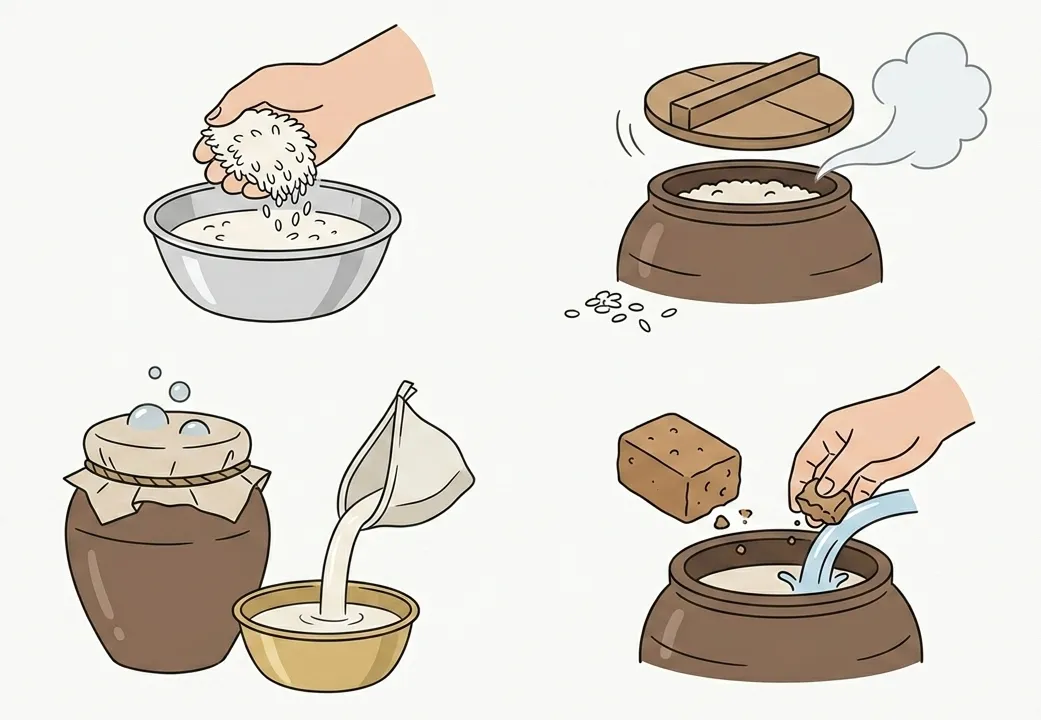
Cooked rice is mixed with crushed nuruk and water. The mold enzymes in the nuruk — amylases and glucoamylases produced by Aspergillus and Rhizopus species — begin breaking rice starch into glucose. At the same time, yeasts present in the nuruk begin converting that glucose into ethanol.
The two processes run in parallel. Sugar is being produced and consumed simultaneously. The glucose concentration in the mash never gets very high at any single moment because the yeasts are consuming it almost as fast as the enzymes are producing it.
This has two important consequences for the alcoholic fermentation:
First, higher alcohol potential. Because the yeasts are never hit with a massive sugar load all at once, they can work steadily over a longer period. Traditional makgeolli and yakju can reach 12 to 18 percent alcohol by volume — higher than most beers and comparable to wine — precisely because the gradual sugar supply keeps the yeasts productive without overwhelming them.
Second, more complex flavor. Because enzymatic starch breakdown, yeast fermentation, and lactic acid bacteria activity are all happening at the same time, the metabolic products of each process interact with each other throughout fermentation. The final flavor carries the fingerprint of this entire overlapping system — not just simple alcohol.
Nuruk: The Multi-Organism Starter
The key difference between makgeolli and other rice-based alcoholic beverages — particularly Japanese sake — is the starter.
Sake uses koji — steamed rice inoculated with a pure culture of Aspergillus oryzae. The koji provides enzymes. A separate, selected yeast culture is then added for the alcoholic fermentation. The process is controlled and relatively predictable.
Makgeolli uses nuruk — a cake of crushed wheat (sometimes rice or barley) that has been naturally fermented by environmental microorganisms. Traditional nuruk contains not one organism but a community: multiple mold species (Aspergillus, Rhizopus, Mucor), multiple yeast species, and lactic acid bacteria.
Everything enters the fermentation vessel together. The molds provide enzymes. The yeasts perform alcoholic fermentation. The lactic acid bacteria produce organic acids that contribute sourness and complexity. No organism is added separately. The community was built during the nuruk-making process itself.
This means that every nuruk is slightly different. Different environments produce different microbial communities. Different microbial communities produce different enzyme profiles, different yeast populations, and different flavor compounds. This is why traditional makgeolli from different brewers, regions, and seasons can taste noticeably different — even when the rice and water are similar.
What Happens During Makgeolli Fermentation
A typical makgeolli fermentation unfolds over roughly seven to fourteen days, though the exact timeline depends on temperature, nuruk quality, and the brewer’s preferences.
Day 1-2: The nuruk enzymes begin breaking down rice starch. The mash becomes sweeter as glucose accumulates. Some CO2 production begins as yeasts start working. The mixture begins to bubble.
Day 3-5: Alcoholic fermentation accelerates. CO2 production is vigorous. The mash is actively bubbling. Lactic acid bacteria produce organic acids, contributing a mild sourness. The aroma shifts from sweet and grainy to more complex — fruity esters from yeast metabolism, slight tang from lactic acid.
Day 5-10: Alcohol concentration rises. Sugar availability decreases as the starch is consumed. Fermentation begins to slow. The flavor becomes drier as sugars are converted to alcohol. The sourness from lactic acid becomes more noticeable relative to the diminishing sweetness.
Day 10-14: Fermentation nears completion. The mash settles. The liquid clarifies slightly, though traditional makgeolli remains unfiltered and cloudy — the suspended rice solids and yeast cells are part of the product.
At this point, the makgeolli can be strained through a coarse cloth, diluted with water if desired, and consumed. Traditional makgeolli is a living, unpasteurized beverage that continues to change after it is made.
Why Makgeolli Tastes Different From Beer and Wine
The flavor profile of makgeolli is the direct result of its fermentation process.
Beer undergoes malting (enzyme production in the grain itself), mashing (starch-to-sugar conversion), and then yeast fermentation. The process is sequential and controlled. Hops add bitterness. The result is relatively clean and predictable.
Wine starts with fruit sugar. No starch conversion is needed. Yeast fermentation is the primary transformation. The grape variety and terroir dominate the flavor.
Makgeolli undergoes simultaneous starch conversion, alcoholic fermentation, and lactic acid fermentation — all driven by a mixed microbial community from nuruk. The result is a beverage that is simultaneously sweet (from residual glucose), sour (from lactic acid), slightly bitter (from grain compounds), and alcoholic (from yeast fermentation). No other common alcoholic beverage combines all four of these flavor dimensions in the same way.
The milky, cloudy appearance comes from suspended rice particles and yeast cells. The slight carbonation comes from residual CO2 production. The complexity comes from the overlapping metabolic processes that are unique to nuruk-based parallel saccharification.
Alcoholic Fermentation Beyond Makgeolli
Understanding alcoholic fermentation through the lens of makgeolli illuminates the broader category.
All alcoholic fermentation requires sugar. If the raw material contains sugar (grapes, honey, fruit), yeasts can ferment it directly. If the raw material is starch (rice, barley, corn), the starch must first be converted to sugar — either by malting, by mold enzymes, or by acid hydrolysis.
The organism determines the product. Saccharomyces cerevisiae is the most common fermenting yeast, but different strains produce different ratios of ethanol, esters, higher alcohols, and other flavor compounds. Wild yeasts (non-Saccharomyces species) contribute additional complexity in some traditional fermentations.
Temperature shapes the outcome. Cooler fermentation temperatures generally produce cleaner, more delicate flavors. Warmer temperatures produce more esters and higher alcohols — which can be perceived as fruity or harsh depending on the degree. Traditional Korean brewing was managed by seasonal timing rather than thermometers, with winter and early spring considered ideal.
Alcoholic fermentation produces more than just alcohol. Yeasts generate hundreds of metabolic byproducts during fermentation — esters (fruity aromas), higher alcohols (warming, sometimes harsh), organic acids, aldehydes, and sulfur compounds. The balance of these compounds, not just the ethanol content, determines how a beverage tastes and smells.
The Fermentation That Built a Cuisine
Alcoholic fermentation is one of the oldest human technologies. Evidence of fermented beverages dates back at least 9,000 years, and the practice likely predates agriculture itself.
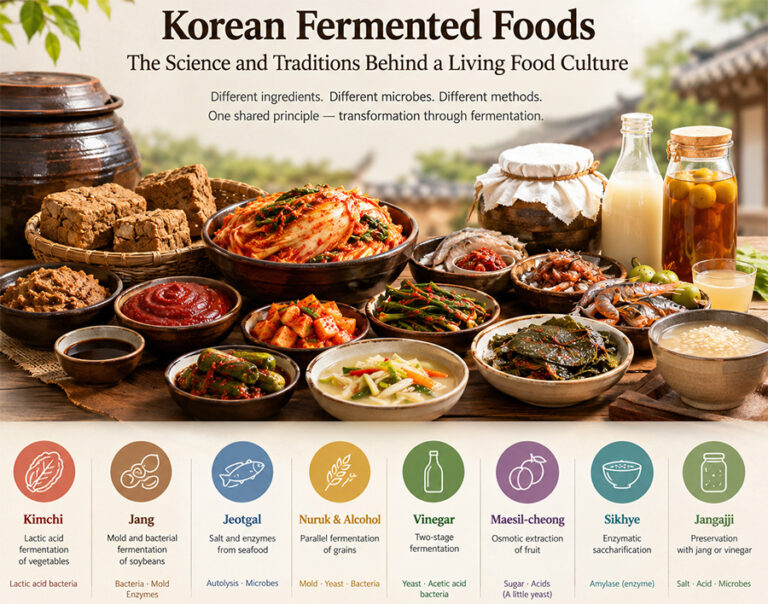
In Korea, alcoholic fermentation through nuruk is not just a brewing technique. It is a fermentation tradition that connects directly to the broader Korean fermentation ecosystem. The same molds that appear in nuruk — Aspergillus, Rhizopus — also appear in meju, the starter for doenjang and ganjang. The lactic acid bacteria that contribute sourness to makgeolli are relatives of the bacteria that drive kimchi fermentation.
Korean fermentation is not a set of isolated techniques. It is an interconnected system — and alcoholic fermentation through nuruk is one of its foundational pillars.
The next time you drink a glass of makgeolli, you are tasting the result of parallel saccharification, multi-organism fermentation, and thousands of years of accumulated knowledge about how to turn rice into something extraordinary.
That is alcoholic fermentation at its most complex and most human.
This content is for informational purposes only and is not medical advice.