Korean Fermented Foods Explained: The Science and Traditions Behind Kimchi, Doenjang, Gochujang, and More
Korean cuisine is built on fermentation.
This is not a metaphor. It is a structural fact.
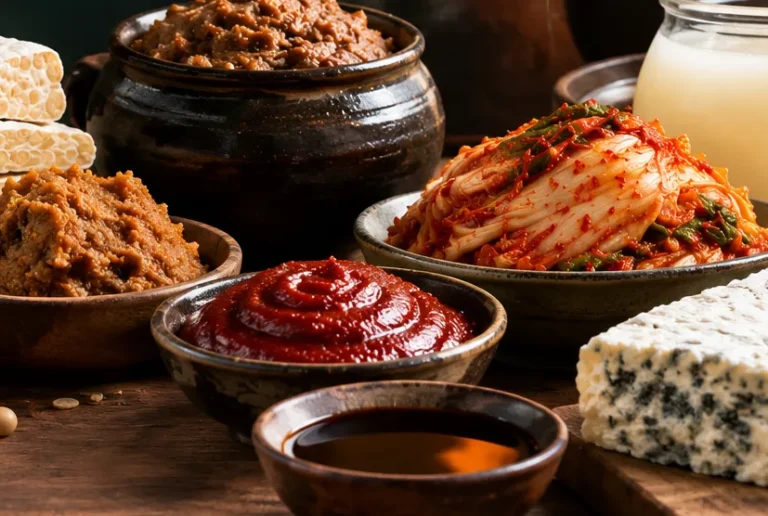
The flavors that define Korean food — the sourness of aged kimchi, the deep umami of doenjang, the layered heat of gochujang, the concentrated savoriness of jeotgal — are not created by cooking techniques or spice combinations alone. They are created by microorganisms, enzymes, salt, and time.
Nearly every meal in a traditional Korean household includes at least one fermented food. Often several. A bowl of rice might be accompanied by baechu kimchi, a dish of seasoned vegetables dressed with ganjang, a stew deepened with doenjang, and a small dish of jeotgal eaten in tiny amounts for its intense flavor.
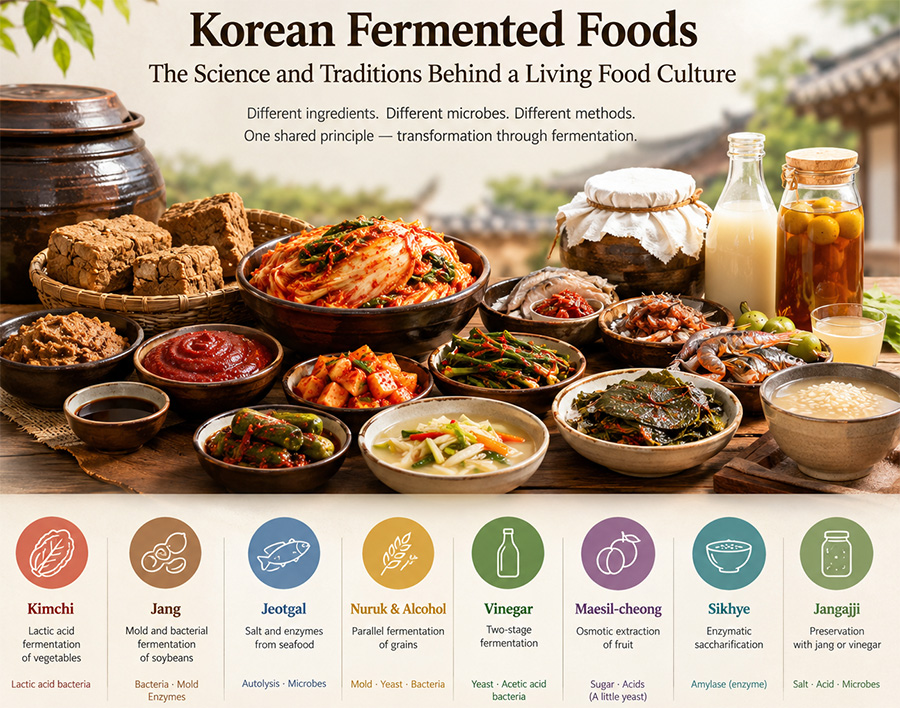
What makes Korean fermentation distinctive is not any single product. It is the breadth of the system — the number of different fermentation strategies applied to different raw materials, each producing a different result through a different microbial and enzymatic pathway.
This guide introduces the major categories. Each represents a different approach to the same fundamental question: how do you use microorganisms and enzymes to transform perishable ingredients into something more flavorful, more durable, and more nutritionally complex than what you started with?
Kimchi: Lactic Acid Fermentation of Vegetables
Kimchi is the most internationally recognized Korean fermented food, but it is not one product. It is a category.
Hundreds of documented varieties exist, varying by vegetable, region, season, and household tradition. The Korean Ministry of Agriculture, Food and Rural Affairs and the World Institute of Kimchi have cataloged extensive regional variations, though the exact count depends on how varieties are defined and classified.
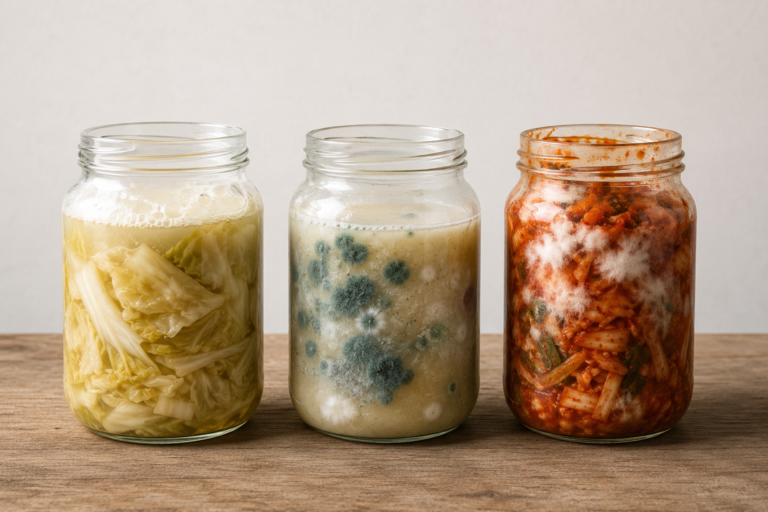
What unites them is the underlying fermentation mechanism: lactic acid bacteria metabolize carbohydrates in salted vegetables and produce organic acids that lower the pH, preserve the food, and generate the characteristic sour, complex flavor.
The microbial community in kimchi is not fixed. It changes according to salt concentration, temperature, oxygen availability, ingredient composition, and fermentation duration. In many cases, early fermentation is characterized by the activity of Leuconostoc mesenteroides and Weissella species, while Lactobacillus species such as L. sakei and L. plantarum may become more prominent as acidity increases. But this succession is not a rigid sequence — it is an ecological process shaped by the specific conditions of each batch.
Baechu kimchi, made from napa cabbage, is the most widely consumed variety. The cabbage is salted, coated with a paste of gochugaru, garlic, ginger, and often jeotgal or fish sauce, and packed into containers for fermentation.
But kimchi extends far beyond baechu.
Kkakdugi uses cubed radish. Pa kimchi ferments green onions, whose sulfur compounds undergo transformation during fermentation. Oi sobagi stuffs cucumbers and ferments in hours rather than weeks. Baek kimchi eliminates gochugaru entirely, producing a mild, clean fermentation flavor without heat. Nabak kimchi and dongchimi are water-based kimchis that ferment in liquid brine rather than paste. Mukeunji is baechu kimchi aged for months or years until its chemistry and flavor are fundamentally different from the fresh version.
Chonggak kimchi uses small ponytail radishes. Gat kimchi ferments mustard greens. Yeolmu kimchi uses young summer radishes. Buchu kimchi ferments garlic chives. Bossam kimchi wraps ingredients in whole cabbage leaves.
Each variety uses the same fundamental mechanism — salt, lactic acid bacteria, anaerobic conditions — but the starting ingredients, salt concentration, temperature, and fermentation duration produce different microbial communities and different flavor outcomes.
The seasonal tradition of kimjang — the large-scale communal preparation of kimchi in late autumn for winter storage — was inscribed on the UNESCO Intangible Cultural Heritage list in 2013, recognized not as a recipe but as a social practice of knowledge transmission and cooperative labor.
Jang: Korea’s Fermented Seasoning Tradition
If kimchi is the most visible Korean fermented food, jang is the most fundamental.
Jang refers to a family of fermented seasoning products — doenjang, ganjang, gochujang, and their variants — that form the flavor backbone of Korean cuisine. While soybeans are central to most jang products, the category is broader than soybean fermentation alone. Gochujang, for example, involves grain, chili, malt, and meju in a fermentation where enzymatic starch conversion, protein hydrolysis, and microbial activity all contribute simultaneously.
What connects jang products is not a single raw material but a shared cultural and fermentation tradition — one that uses meju, salt, time, and the interaction of molds, bacteria, and enzymes to produce concentrated seasoning pastes and liquids.
The fermentation of doenjang and ganjang begins with meju, blocks of cooked soybeans that are shaped, dried, and allowed to ferment with wild microorganisms over weeks. The microbiology of meju is complex. Bacillus subtilis colonizes the interior and produces proteases that begin breaking down soy proteins. Aspergillus and other mold species colonize the surface and produce amylases and additional proteases. The exact microbial community varies by region, environment, and production method.
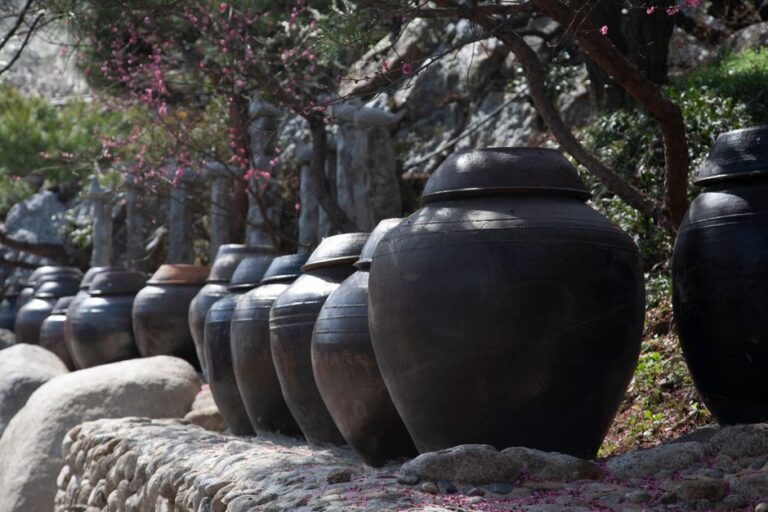
When meju is submerged in salt brine and aged for months in onggi, two products emerge simultaneously. The liquid becomes ganjang — Korean soy sauce. The remaining solids become doenjang — fermented soybean paste. This dual-product system is one of the defining features of Korean jang culture.
Joseon ganjang, also called guk ganjang, is the traditional soy sauce from this process — light in color, intensely salty, and carrying the earthy complexity of wild fermentation. It is used primarily in soups and seasoned vegetable dishes.
Doenjang continues to develop during aging. The enzymatic breakdown of soy proteins into free amino acids — particularly glutamic acid — produces the deep umami that defines Korean stews and soups.
Gochujang adds another dimension. Glutinous rice, meju powder, gochugaru, malt, and salt are combined and fermented for months. The malt enzymes convert rice starch into sugars, producing the natural sweetness that characterizes gochujang. Simultaneously, the meju contributes protein-derived umami, and the gochugaru provides capsaicin heat. The result is a paste that carries sweetness, sourness, umami, and heat in a single ingredient — a complexity that emerges from the interaction of grain fermentation, soybean fermentation, and chili together.
Cheonggukjang takes a different path entirely. Rather than the months-long process of doenjang, cheonggukjang ferments cooked soybeans with Bacillus subtilis in just two to three days. The rapid proteolysis produces intense umami, a sticky polyglutamic acid texture, and the strong ammonia smell that makes cheonggukjang one of the most challenging fermented foods for newcomers. Korean cheonggukjang and Japanese natto use the same bacterial species but differ in fermentation time, method, and culinary application.
Other jang variants include makjang, a regional Gyeongsang-style soybean paste with a shorter fermentation period, and chunjang, a black bean paste connected to Chinese fermented paste traditions that became the defining ingredient of Korean jajangmyeon.
In 2024, Korea’s jang-making culture was inscribed on the UNESCO Intangible Cultural Heritage list.
Jeotgal: Salt, Enzymes, and Microorganisms in Fermented Seafood
Jeotgal is one of the most complex fermented food categories in Korean cuisine, and its fermentation involves multiple overlapping mechanisms.
When raw seafood — shrimp, anchovy, squid, pollock roe, oysters, or other marine organisms — is packed in high concentrations of salt, typically 20 to 30 percent by weight, the high salinity suppresses most bacterial activity. But the seafood’s own internal enzymes — proteases, peptidases, lipases — remain active. These enzymes break down proteins into free amino acids and fats into fatty acids over weeks and months.
This autolytic process is central to jeotgal production, but it is not the only process at work.
Salt-tolerant microorganisms also participate. Research has identified halophilic bacteria, including Halobacterium and Tetragenococcus halophilus, as well as halotolerant lactic acid bacteria such as Lactobacillus sakei, in various jeotgal products. These organisms contribute additional enzymes, organic acids, and volatile compounds that influence the aroma and complexity of the final product. The relative contribution of autolysis and microbial activity varies depending on salt concentration, temperature, duration, and the specific type of jeotgal.
The product is rich in glutamic acid, the compound responsible for umami. Paired with inosinic acid, also present in fermented seafood, the umami effect is synergistic — the perceived intensity is multiplied beyond what either compound produces alone.
Saeujeot, fermented small shrimp, is the most common jeotgal used in kimchi production. Myeongran-jeot ferments pollock roe into a delicacy with eggs that pop individually against the tongue. Ojingeo-jeot ferments squid into a chewy, savory banchan. Changran-jeot, made from pollock intestines, is among the most intensely flavored varieties.
Aekjeot — the fully liquid fish sauce — is what results when the process reaches completion and the solid matter has largely dissolved. Myeolchi-aekjeot (anchovy fish sauce) and kkanari-aekjeot (sand lance fish sauce) are the most common varieties.
Korean eoganjang, the peninsula’s fish sauce tradition, predates written records. The Samguk Sagi, compiled in 1145, records salted fermented seafood among ceremonial gifts during the Silla dynasty in the seventh century.
Geography has always shaped jeotgal culture. The West Sea coast produces saeujeot. The East Sea coast produces myeongran-jeot. The South Sea coast is known for myeolchi-jeot and galchi-jeot. Each variety reflects the local catch, climate, and culinary traditions of its region.
Fermented Beverages: Nuruk and the Parallel Fermentation of Rice
Korean traditional alcoholic beverages — makgeolli, cheongju, yakju, and traditional distilled soju — depend on nuruk, a fermentation starter fundamentally different from Japanese koji in its production philosophy.
Nuruk is a disc of crushed grain — usually wheat — that has been moistened, pressed, and left to ferment spontaneously with wild microorganisms. No cultures are added. The resulting cake contains a complex community of molds (Aspergillus, Rhizopus, Mucor), wild yeasts (Saccharomyces and Pichia species), and bacteria (Lactobacillus, Bacillus). Researchers have documented over 100 distinct microbial species in a single nuruk sample.
This wild diversity is the defining characteristic that distinguishes nuruk from koji. Modern koji production typically uses controlled Aspergillus oryzae cultures, though traditional koji-making methods and strain selection have varied historically. The practical difference is that nuruk-based beverages tend to carry rougher, more complex, and more variable flavor profiles than those made with standardized koji cultures.
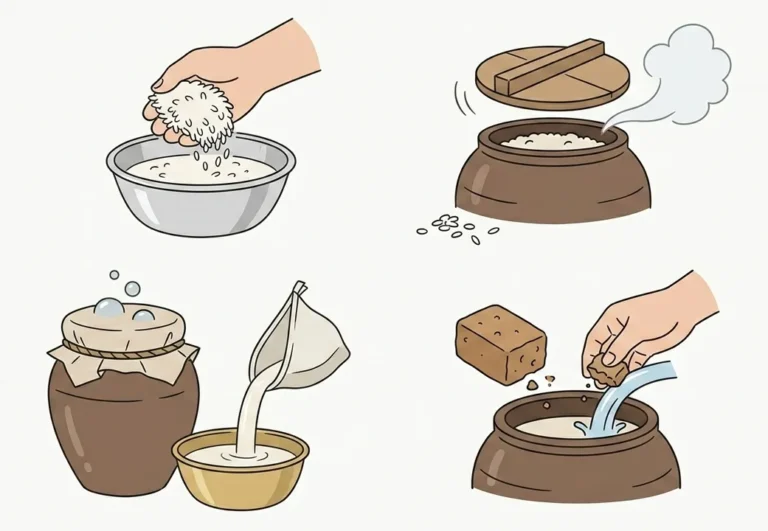
When nuruk is combined with cooked rice and water, a process called parallel fermentation occurs. The mold enzymes break down rice starch into sugars (saccharification) while the yeasts simultaneously convert those sugars into alcohol. This occurs in the same vessel at the same time — unlike Western brewing, where malting and fermentation are typically separate stages.
Makgeolli, the milky, lightly sparkling rice wine, is the most widely consumed product of this process. Cheongju is a clearer, more refined version. Traditional soju is distilled from these fermented bases.
The Joseon dynasty tradition of gayangjoo — household brewing — meant that each family’s nuruk carried a unique microbial signature shaped by local environmental conditions. Regional liquors like Andong soju, Igangju, and Munbaeju developed distinctive characters partly because their nuruk reflected different microbial terroirs.
Vinegar: The Second Fermentation
Korean vinegar production follows the same two-stage logic found in vinegar traditions worldwide, but applies it to Korean fermented bases.
The first stage is alcoholic fermentation — yeasts convert sugars into ethanol. The second stage is acetic acid fermentation — Acetobacter bacteria oxidize ethanol into acetic acid in the presence of oxygen.
What makes Korean vinegar distinctive is the starting material. Traditional Korean vinegars begin with makgeolli, fruit wines, or grain-based ferments that already carry complex flavor profiles from their own fermentation. Persimmon vinegar, brown rice vinegar, and makgeolli vinegar each carry the aromatic signature of their source ferment into the final product.
The fermentation is slow. Traditional Korean vinegar production can take months, during which the acetic acid bacteria gradually convert alcohol into acid while additional chemical reactions develop the vinegar’s aroma and depth.
Jangajji: Preservation Through Jang
Jangajji is a category of preserved vegetables and other ingredients that are transformed by submersion in ganjang, doenjang, gochujang, or vinegar.
Unlike kimchi, which relies on lactic acid bacteria to generate its own acidity, jangajji depends on the antimicrobial environment of the jang itself — the high salt, the existing acidity, the fermentation-derived compounds — to preserve and transform the submerged ingredients.
Garlic, sesame leaves, peppers, radish, and perilla leaves are among the most common jangajji ingredients. Over weeks of submersion, the vegetables absorb the umami and salt of the jang while their own cellular structures soften and change.
Jangajji is less studied than kimchi or jang, but it represents another expression of the same underlying principle: using the products of one fermentation to drive or enable another.
Maesil-cheong: Sugar-Driven Extraction
Maesil-cheong — green plum syrup — is widely called a “fruit enzyme” in Korean popular culture. The scientific reality is different.
When green plums are layered with sugar in a jar and left for months, osmotic pressure draws moisture from the fruit. The sugar creates an environment of very low water activity that inhibits most microbial growth. What occurs is primarily osmotic extraction — the sugar pulls liquid, flavor compounds, and organic acids from the fruit tissue.
Some microbial fermentation may occur, particularly if the sugar concentration is insufficient to fully suppress yeast activity. But the dominant process is not enzymatic or microbial fermentation in the way that kimchi or doenjang fermentation is. It is a sugar-mediated extraction.
The resulting syrup is used as a sweetener, a flavoring agent in cooking, and a base for diluted drinks. Its flavor is complex because it carries the organic acids — primarily citric and malic acid — and aromatic compounds of the green plum, concentrated by the extraction process.
This distinction matters for a site dedicated to fermentation science. Calling maesil-cheong a fermented food without qualification conflates two different processes. Understanding what it actually is — and what it is not — is part of understanding what fermentation means.
Sikhye: Enzymatic Grain Transformation
Sikhye, a traditional sweet rice beverage, occupies an interesting position in Korean food culture.
It is made by combining cooked rice with yeotgireum — malt water made from barley malt. The amylase enzymes in the malt convert the rice starch into maltose and glucose, producing the distinctive sweetness of the drink. Individual rice grains float to the surface as their starch content is consumed by the enzymes.
Sikhye is technically an enzymatic transformation rather than a microbial fermentation — the enzymes do the work, not living microorganisms reproducing and metabolizing. But the process is closely related to the saccharification step in nuruk-based brewing, where mold enzymes similarly convert grain starch into fermentable sugars.
Including sikhye in a discussion of Korean fermented foods is useful precisely because it raises the question: where does enzymatic transformation end and fermentation begin? The boundary is not always sharp, and Korean food culture includes products that sit at various points along that spectrum.
The System, Not the Individual Product
What makes Korean fermentation remarkable is not any single food.
It is the system.
Lactic acid bacteria ferment vegetables into kimchi. Molds and bacteria ferment soybeans and grains into jang. Autolytic enzymes and salt-tolerant microorganisms transform seafood into jeotgal. Wild microbial communities in nuruk enable parallel fermentation of grain into alcohol. Acetic acid bacteria convert that alcohol into vinegar. Sugar extracts compounds from fruit. Malt enzymes convert starch into sweetness.
Each category uses a different mechanism. Each produces different metabolites, different flavors, different textures, different nutritional profiles.
But they share a common principle.
Raw ingredients, placed in carefully managed environments, are transformed by biological activity into something that did not exist before. The transformation is not random. It is shaped by salt concentration, temperature, oxygen availability, microbial community composition, substrate chemistry, and time.
Korean food culture developed these systems through centuries of observation, practice, and accumulated knowledge — long before the microorganisms involved were identified or named.
The science confirms what the tradition already knew.
Time, microorganisms, and enzymes, given the right conditions, can build extraordinary complexity from simple ingredients.
This content is for informational purposes only and is not medical advice.