Fruit Fermentation: What Korean Maesil-cheong Reveals About Fermenting Fruit With Sugar
Every Korean household has a jar of something dark and syrupy tucked in a cabinet. Maybe it’s three months old. Maybe it’s been there since 2019. Nobody remembers exactly when it was made, but everybody reaches for it when cooking.
That’s maesil-cheong — green plum syrup. In Korea, people call it an “enzyme,” hyoso. The word gets thrown around loosely. Health food stores sell bottled “enzyme drinks.” Instagram feeds show rows of glass jars filled with fruit and sugar. The reality is simpler and more interesting than the marketing suggests.
Maesil-cheong is one example of a much broader practice: fruit fermentation using sugar as the primary medium. Understanding what actually happens inside that jar connects to the science of fermentation in ways that most recipes and health claims never explain.
What Is Fruit Fermentation?
Fruit fermentation is any process in which microorganisms transform the sugars, acids, and other compounds in fruit into new substances — typically organic acids, alcohols, and aromatic compounds.
The most familiar example is wine: yeasts convert grape sugar into ethanol. But fruit fermentation is a much broader category than winemaking. It includes vinegar production (where acetic acid bacteria convert fruit alcohol into acetic acid), lacto-fermented fruit preserves, and the sugar-extracted fruit syrups that Korean cuisine calls “enzymes.”
What all of these share is that microorganisms are doing work on a fruit substrate. The fruit changes. The flavor changes. New compounds appear that did not exist in the raw fruit. That is fermentation.
What Actually Happens Inside the Jar
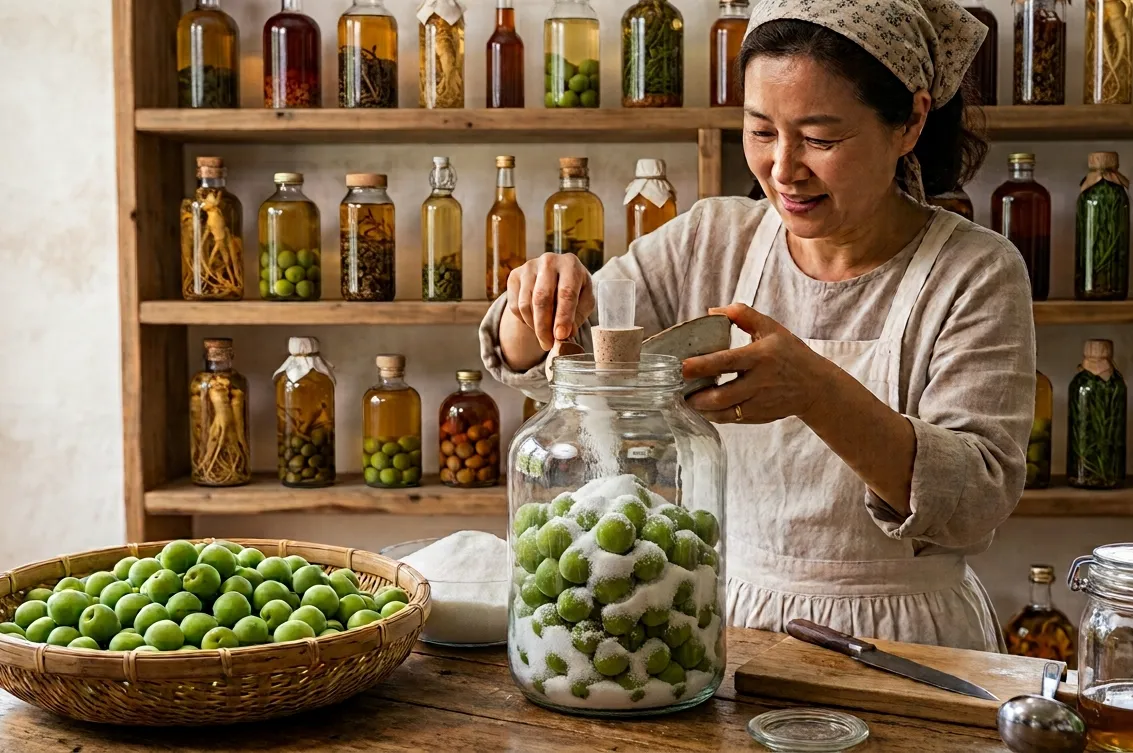
The process of making maesil-cheong is deceptively simple. Green plums are packed in a jar with an equal weight of sugar and left at room temperature for about 100 days. No starter culture. No temperature control. No special equipment.
During those 100 days, several things happen simultaneously.
Osmosis. The sugar draws moisture out of the plums through their cell walls. Within the first week, the plums shrink and wrinkle as their juice mixes with the dissolving sugar. This creates a concentrated syrup that is inhospitable to most harmful bacteria. The sugar acts as a preservative — the same principle behind jams and honey.
Enzymatic breakdown. The plums contain natural enzymes — pectinase, amylase, protease — that remain active in the sugar solution. These enzymes break down the fruit’s pectin, starches, and proteins into simpler compounds. This is where the Korean term “enzyme” comes from. The enzymes are real. They are doing real work. But they are the plum’s own enzymes, not something magical created by the process.
Microbial fermentation. This is the part most “enzyme” enthusiasts either do not know or do not mention. Wild yeasts present on the fruit’s skin begin converting sugars into small amounts of alcohol and carbon dioxide. Lactic acid bacteria may also contribute. The bubbles you see rising in the jar during the first few weeks are carbon dioxide from yeast activity. This is genuine fermentation, driven by the same types of microorganisms that make wine and kimchi.
Research analyzing homemade maesil-cheong at various stages has confirmed the presence of both yeast-driven alcoholic fermentation and bacterial organic acid production. The final product contains measurable levels of ethanol, lactic acid, acetic acid, and citric acid. It is not just sugar water with plum flavor. It is a mildly fermented fruit extract.
The Fruit Fermentation Process: Why Sugar Changes Everything
What makes Korean-style fruit fermentation different from winemaking or vinegar production is the role of sugar.
In wine, sugar is the fuel. Yeasts consume it and produce alcohol. The goal is to convert as much sugar as possible into ethanol.
In maesil-cheong, sugar is both fuel and preservative. The high sugar concentration (roughly 50 percent of the total weight) creates an environment where most microorganisms cannot thrive. Only osmotolerant yeasts and certain bacteria can function. This limits the fermentation to a slow, mild process rather than the vigorous fermentation you see in winemaking.
The result is a product that sits between a preserve and a ferment. The sugar preserves the fruit compounds. The fermentation adds complexity — organic acids, aromatic esters, and other metabolites that plain sugar syrup does not contain. This dual character is what makes maesil-cheong useful as a cooking ingredient in ways that plain sugar is not.
Fruit Fermentation Recipes: Beyond Plums
Maesil is the most common Korean fruit fermentation, but the same technique works with almost any fruit. Each fruit brings different enzymes, different sugars, and different wild microorganisms on its skin. The fermentation profile changes accordingly.
Pineapple. Ferments faster than plum because pineapple contains bromelain, a powerful protease. The result is tangier and more aggressively fizzy during fermentation. Useful as a meat tenderizer in marinades.
Fig. Produces a darker, richer syrup with a honey-like depth. Figs are high in natural sugars, so the fermentation tends to be more active. Some people reduce the sugar ratio to 0.7:1 instead of the standard 1:1.
Citrus (yuzu, tangerine, lemon). Gives a bright, sharp syrup. The high citric acid content means it ferments more slowly since the environment is already acidic. Works well in drinks and dressings.
Mulberry. Less common but prized in rural Korea. The color is striking — deep purple, almost black after a few months. It stains everything it touches.
The 1:1 fruit-to-sugar ratio works as a reliable baseline for most fruits. Going below 1:1 risks mold and off-flavors because the sugar concentration is not high enough to suppress harmful microorganisms. Going above 1:1 produces a cloyingly sweet result that is hard to use in cooking.
How to Make Maesil-cheong
Ingredients:
Green plums (maesil) 2 kg — firm, unripe, no soft spots
White sugar 2 kg (1:1 ratio by weight)
Equipment:
Glass jar, 5-liter capacity minimum
Breathable cover (cheesecloth secured with a rubber band — not an airtight lid)
Process:
Wash the plums and dry them completely. Remove the small stem nub at the top of each plum with a toothpick. This spot traps moisture and can become a mold entry point.
Layer plums and sugar alternately in the jar. Start with sugar on the bottom. End with a thick sugar layer on top. This top layer is a protective cap — any plum exposed above the sugar line can develop mold.
Cover with cheesecloth, not a sealed lid. Fermentation produces carbon dioxide. A sealed jar can build dangerous pressure.
Within two to three days, liquid pools at the bottom as sugar pulls juice from the plums. Stir once daily for the first two weeks with a clean, dry wooden spoon to ensure all sugar dissolves and all plums stay submerged.
After about three months, strain out the plums. The liquid is your maesil-cheong. Transfer to clean bottles. It keeps for years — some Korean families have maesil-cheong that is five or ten years old. Like good balsamic vinegar, it gets more complex with age.
The strained plums are not waste. Blend them into a paste for marinades, or dry them slowly in a low oven for chewy fruit candy. In rural Korea, leftover plums get added to soju for a quick infused liquor.
How Koreans Actually Use Fruit Fermentation Products
In marinades: A tablespoon of maesil-cheong in bulgogi or galbi marinade does what plain sugar cannot. The organic acids from fermentation tenderize meat slightly while the complex sweetness blends with soy sauce and garlic better than white sugar does.
In kimchi: Some households add a splash when making kimchi paste. The mild acidity gives a head start to fermentation and the sweetness balances the fish sauce.
As a drink: Two tablespoons in a glass of cold sparkling water makes a refreshing summer drink. It tastes like a less-sweet, more complex lemonade.
In salad dressings: Mix with soy sauce, sesame oil, and rice vinegar for a Korean-style dressing with depth beyond what sugar alone provides.
In stews: A small spoonful in doenjang jjigae or kimchi jjigae rounds out sharp flavors without making the stew noticeably sweet.
The key understanding: maesil-cheong is a flavor tool. The fermentation gives it organic acids and aromatic compounds that plain sugar syrup does not have. That is why Korean cooks reach for the jar instead of the sugar bowl.
The “Enzyme” Label: Misleading but Not Wrong
Korean health culture uses “enzyme” (hyoso) to describe any fruit-and-sugar fermentation. Strictly speaking, this is inaccurate. The end product is not an enzyme. It is a syrup containing organic acids, residual fruit enzymes, sugars, and fermentation byproducts.
But the label is not entirely baseless either. The fruit’s own digestive enzymes do survive in the syrup, at least partially. Research has measured protease and lipase activity in aged maesil-cheong and found detectable enzyme activity even after 12 months of storage. Whether these enzymes survive stomach acid and actually aid digestion is a different question — and one that has not been conclusively answered by peer-reviewed research.
The honest summary: maesil-cheong is a sugar-preserved, mildly fermented fruit extract with some residual enzyme activity. It is not a miracle health food. It is not useless either. It is a genuinely useful cooking ingredient that happens to also be a mild fermentation product.
Fruit Fermentation and Health: What We Can Say
The organic acids in maesil-cheong — citric acid, malic acid, lactic acid — may support digestion in the same general way that any acidic food can. Some research has found antioxidant activity and antimicrobial properties in maesil extract under laboratory conditions. These are in vitro results — observed in test tubes, not in human bodies. The gap between laboratory activity and real health benefit is significant.
What is more defensible: maesil-cheong is a source of organic acids and polyphenols from the fruit. Consumed as part of a varied diet, it contributes beneficial compounds. Consumed in the quantities most people actually use — a tablespoon here and there in cooking — the health impact is probably minimal.
It is not medicine. It is a good ingredient that brings something to the table that plain sugar does not.
Fruit Fermentation in the Bigger Picture
Korean-style fruit fermentation connects to the broader world of fermentation in ways that are easy to miss.
The osmotic extraction is the same principle used in salt-based fermentations like kimchi — a solute (sugar or salt) draws water from cells, changing the environment and selecting for specific microorganisms.
The wild yeast fermentation is the same process that produces wine, cider, and makgeolli — though at a much lower intensity because the high sugar concentration limits microbial activity.
The enzymatic breakdown parallels what happens in doenjang and fish sauce production — enzymes breaking large molecules into smaller, more flavorful ones over time.
Maesil-cheong is not usually discussed alongside these other fermented foods. But it should be. It demonstrates osmosis, enzymatic hydrolysis, and microbial fermentation all happening simultaneously in a single jar. That makes it one of the most instructive fermentation products you can make at home — and one of the simplest.
Two ingredients. One jar. A hundred days. And the fruit that comes out is not the fruit that went in.
This content is for informational purposes only and is not medical advice.