Mukeunji: Aged Kimchi That Ferments for Months — Science, Flavor, and How to Use It
Kimchi doesn’t stop changing when you put it in the refrigerator.
Cold temperatures slow fermentation, but they don’t necessarily stop the biological and chemical processes that shape kimchi over time. As the months pass, the kimchi becomes increasingly sour, its texture softens, and its flavor moves from fresh and bright toward something deeper, sharper, and more complex.
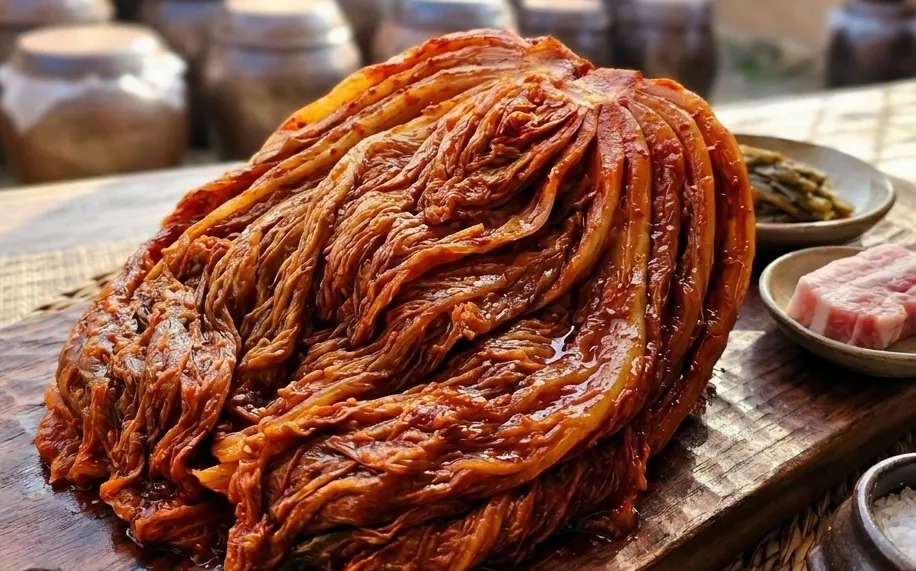
Eventually, you have mukeunji (묵은지) — long-fermented, aged kimchi.
Mukeunji is not a completely different type of kimchi. It is better understood as kimchi that has been allowed to mature for a much longer period, under controlled storage conditions. The exact point at which kimchi is called mukeunji is not determined by one universal number of months. Temperature, salt concentration, ingredients, storage conditions, and the original kimchi recipe all influence how quickly it matures.
What makes mukeunji fascinating is not simply that it becomes “more fermented.”
It is that time changes the entire chemical and sensory character of the food.
Mukeunji (묵은지, sometimes written mugunji) is Korean cabbage kimchi that has been left to ferment for at least six months, and often one to three years, until it turns deeply sour, soft, and dark. It is not spoiled kimchi and it is not a separate recipe. It is ordinary kimchi that was given far more time.
What Happens During Long Kimchi Fermentation?
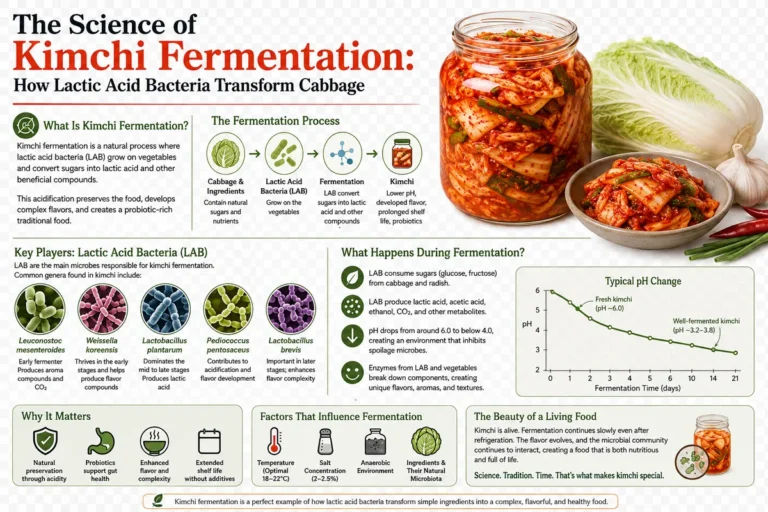
Kimchi fermentation is driven primarily by lactic acid bacteria (LAB). But it isn’t a simple story in which one bacterium replaces another.
During the early stages of fermentation, bacteria from groups such as Leuconostoc and Weissella are often prominent. As acidity increases and the environment changes, more acid-tolerant bacteria, including species of Lactobacillus, become increasingly important.
The exact succession varies with temperature, salt concentration, ingredients, and fermentation conditions. There is no single microbial timeline that applies to every batch of kimchi.
One thing does remain consistent: as lactic acid bacteria metabolize carbohydrates, they produce organic acids and other compounds that gradually lower the pH.
That increasing acidity changes the environment inside the kimchi.
Microorganisms that are less tolerant of acid become less competitive, while acid-tolerant lactic acid bacteria are better able to persist. Over time, the microbial community becomes simpler and more specialized, although it does not necessarily become a single bacterial species.
This is why long-fermented kimchi tastes so different from freshly made kimchi.
The fermentation has changed the chemical environment of the entire food.
The Flavor Changes With Time
Fresh kimchi has a combination of vegetable freshness, garlic, ginger, chili, sweetness, saltiness, and relatively mild acidity.
As fermentation progresses, that balance shifts.
Organic acids become more prominent. Sugars are consumed or transformed. Aroma compounds change. The cabbage gradually loses some of its original crispness, while the overall flavor becomes more concentrated and mature.
Protein-containing ingredients such as fermented seafood and other seasonings also contribute nitrogen-containing compounds and amino acids to the evolving flavor profile.
Among these compounds is glutamic acid, one of the major contributors to umami perception.
Recent research on mukeunji has found changes in amino acids and other metabolites associated with its characteristic sensory profile, including compounds related to umami. Importantly, these changes are influenced not only by time but also by the microorganisms involved and the conditions under which the kimchi is fermented.
So mukeunji is not simply “sour kimchi.”
It is kimchi whose flavor system has been reshaped by prolonged fermentation.
Why Does Mukeunji Work So Well With Pork?
This is where fermentation becomes especially obvious at the dinner table.
Samgyeopsal is rich in fat. Mukeunji is acidic, intensely flavored, and relatively low in fat.
That creates a powerful sensory contrast.
The acidity doesn’t literally “break down the fat coating your palate,” as is sometimes claimed. Instead, the sharp acidity and intense fermented flavors help counterbalance the richness of fatty pork, making the next bite feel less heavy.
There is also another interesting interaction.
Glutamate-rich foods can produce a stronger perception of umami when combined with foods containing inosinate, which is naturally present in meat. This is known as umami synergy.
That is one reason why fermented foods and meat can taste exceptionally good together.
The effect isn’t unique to Korean cuisine. But Korean cooking makes particularly extensive use of this principle through combinations such as kimchi with pork, doenjang with meat, and fermented seafood with savory dishes.
Why Grilling Mukeunji Changes It Again
Put mukeunji directly onto a hot grill and fermentation is no longer the only process shaping its flavor.
Heat changes the kimchi again.
Some of the water evaporates. Acidity becomes more concentrated relative to the remaining solids. Sugars and other compounds undergo thermal reactions, creating new aromas and browned flavors.
Depending on the temperature and composition of the kimchi, both caramelization and Maillard-type browning reactions can contribute to the final flavor.
The result is something very different from raw kimchi:
sour from fermentation, savory from aging, sweet and browned from heat, and smoky from the grill.
This is one of the simplest demonstrations of how fermentation creates a foundation that later cooking processes can build upon.
Mukeunji in Jjigae
Mukeunji becomes even more interesting when it is cooked.
Fresh kimchi and aged kimchi produce noticeably different styles of kimchi jjigae.
Fresh kimchi tends to produce a brighter, more vegetable-forward broth.
Mukeunji produces a deeper and more mature flavor because the ingredients have already undergone months of biochemical transformation before they enter the pot.
During cooking, organic acids, amino acids, salts, sugars, and other water-soluble flavor compounds move between the kimchi and the broth.
The result isn’t simply “more fermented.”
It is a different flavor structure.
This is one reason long-fermented kimchi is particularly valuable in cooked dishes. A kimchi that has become too sour or soft to serve as a fresh side dish can become an excellent ingredient for stews, braises, fried rice, and grilled dishes.
In Korean cooking, fermentation doesn’t always have to remain the star of the dish.
Sometimes its greatest role is to provide the foundation for what comes next.
Mukeunji Kimchi Jjigae
A simple mukeunji jjigae demonstrates this better than almost anything else.
Ingredients — Serves 2
300 g mukeunji
150–200 g pork belly
1/2 cup mukeunji juice, if clean and properly stored
1 block firm tofu
1/2 tablespoon doenjang
1 tablespoon gochugaru
3–4 cloves garlic
2 green onions
2 cups water or anchovy broth
1 teaspoon sesame oil
1/2 teaspoon sugar, optional
Method
Heat the sesame oil in a pot over medium heat. Add the pork belly and cook until some of the fat has rendered.
Add the chopped mukeunji and cook together for several minutes.
Add the mukeunji juice, water or anchovy broth, gochugaru, doenjang, garlic, and sugar if needed.
Bring to a boil, then reduce the heat and simmer for 15–20 minutes.
Add the tofu and green onion. Simmer for another five minutes and serve with steamed rice.
The important point is not the exact recipe.
It is the ingredient.
Mukeunji brings acidity, salt, fermented aroma, and a complex mixture of fermentation-derived compounds that fresh cabbage simply cannot provide.
What About the Mukeunji Juice?
Mukeunji juice is often treated as waste.
It shouldn’t be automatically discarded.
The liquid contains compounds that have accumulated or dissolved during fermentation, including organic acids, salts, sugars, amino acids, and other metabolites.
But calling it “pure lactic acid” would be inaccurate.
And using it is not automatically safer or better simply because it has fermented.
It should be used only when the kimchi itself has been properly prepared and stored, and when there are no signs of spoilage such as visible mold or abnormal odors.
A little can dramatically change a stew because it carries the flavor of the fermentation directly into the broth.
How Long Does Kimchi Need to Become Mukeunji?
There is no universal stopwatch.
Kimchi fermentation is strongly affected by temperature. Warmer storage accelerates fermentation, while colder storage slows it considerably. Salt concentration, ingredients, container conditions, and the particular microbial community also influence the result.
That’s why saying “mukeunji is exactly six months old” is less useful than describing its sensory and fermentation state.
A kimchi may become noticeably sour and soft after several months under one set of conditions, while another batch may mature much more slowly.
The refrigerator does not press a pause button.
It changes the speed.
That distinction is important.
Can You Age Kimchi for a Year?
Yes, long-term aging is possible, and mukeunji is specifically associated with long fermentation.
But “longer” does not automatically mean “better.”
As fermentation continues, acidity can become increasingly dominant and texture can deteriorate. Eventually, the kimchi may become too sour or soft for some uses, while becoming excellent for others.
That is why aged kimchi is often used differently from young kimchi.
Fresh kimchi is eaten as a vegetable side dish.
Older kimchi may become an ingredient.
It goes into stews, grilled dishes, fried rice, pancakes, braises, and other preparations where its concentrated acidity and mature flavor become an advantage.
Mukeunji Is a Record of Time
This is what makes mukeunji more interesting than simply “old kimchi.”
It is a food that records time.
At the beginning, the cabbage is crisp and relatively fresh.
Then acidity develops.
The microbial community changes.
Sugars are consumed and transformed.
Organic acids accumulate.
Amino acids and other flavor compounds change.
The texture softens.
The aroma becomes deeper.
Eventually, the original character of the cabbage is still there, but it has been reshaped by months of microbial activity.
That is fermentation at its most visible.
Nothing new has been added to create mukeunji.
Time did most of the work.
Fermentation Is the Point
Mukeunji shows something fundamental about Korean fermented foods:
Fermentation is not simply a method for keeping food from spoiling. It is a method for transforming food.
Kimchi begins as salted vegetables.
Microorganisms then change the environment.
The environment changes which microorganisms can thrive.
Those microorganisms produce acids and other metabolites.
Those compounds change the flavor, aroma, texture, and stability of the food.
And when the resulting mukeunji is cooked with pork, tofu, broth, or other ingredients, a second layer of transformation begins.
That is why mukeunji can be understood as more than aged kimchi.
It is the result of time, microorganisms, ingredients, temperature, and cooking interacting with one another.
The most remarkable part is that the process begins with something as ordinary as cabbage.
And then you wait.
This content is for informational purposes only and is not medical advice.
Mukeunji vs. Regular Kimchi
The difference is time, and everything that time does to a jar of cabbage.
| Fresh kimchi (days to weeks) | Mukeunji (6 months to years) | |
|---|---|---|
| Taste | Crisp, lightly tangy, still sweet from the cabbage and rice paste | Strongly sour, savory, faintly bitter at the edges, almost no sweetness left |
| Texture | Snappy, with clear layers in the leaf | Soft and pliable, the thick stem gone tender |
| Color | Bright red-orange | Dark, brownish red |
| Smell | Fresh, sharp | Deep and pungent, closer to aged cheese than to fresh vegetables |
| Best use | Eaten as it is, as a side dish | Cooked — stews, braises, fried rice, wrapped around pork |
The lactic acid bacteria that drive kimchi fermentation do not stop when the kimchi tastes finished. They keep producing acid for as long as there is anything left to feed on, which is why the flavor keeps moving in one direction: more sour, less sweet, softer.
One practical consequence: mukeunji is rarely eaten raw at the table the way fresh kimchi is. Heat and fat round off the acidity, which is why almost every traditional use for it involves cooking.
What to Do With Kimchi That Has Gone Sour
Kimchi that has turned too sour to enjoy at the table is not a failure. It has simply moved further along the same process that makes mukeunji, and the fixes are the same.
Rinse it. A quick rinse under cold water, then a gentle squeeze, takes off much of the surface acidity and seasoning without changing what is inside the leaf. This is standard preparation before wrapping mukeunji around pork or using it in a milder dish. Rinsed kimchi also needs a little salt or seasoning added back when it is cooked.
Cook it. Acidity reads as sharpness when cold and as depth when simmered. Sour kimchi is the correct ingredient for kimchi jjigae, kimchi fried rice, kimchi pancakes, and braised pork dishes. Fresh kimchi makes all of these taste thin by comparison.
Balance it. A small amount of sugar, a spoon of pork fat, or a piece of tofu will soften the acid in a finished dish. Cooking sour kimchi with fatty pork does both at once.
Know when it is not just sour. Sourness, softness, and a strong smell are normal. Fuzzy mold in blue, green, black, or pink, a slimy texture in the liquid, or a smell that reads as rotten rather than sour are not — those belong in the bin. Our guide to diagnosing fermentation problems covers the difference in detail, and how you store kimchi decides how quickly it sours in the first place.
Frequently Asked Questions
How long does kimchi need to ferment to become mukeunji?
Mukeunji typically requires at least 6 months of fermentation, though many traditional households age it for 1 to 3 years. The longer it ferments, the deeper and more complex the flavor becomes.
Is mukeunji safe to eat after fermenting for years?
Yes. The lactic acid bacteria and low pH environment created during fermentation naturally preserve mukeunji and inhibit harmful bacteria. As long as it has been stored properly in a sealed container at consistent cool temperatures, it remains safe.
What is the best way to cook with mukeunji?
Mukeunji is most commonly used in jjigae (stew), grilled alongside samgyeopsal (pork belly), or stir-fried with pork. Its intense sour and umami flavor concentrates further when heated, making it ideal for cooked dishes rather than eating raw.
Does mukeunji have more probiotics than fresh kimchi?
Not necessarily more, but different. Over extended fermentation, the bacterial community shifts. Some early-stage probiotics decline while other acid-tolerant strains thrive. The health benefit profile changes rather than simply increasing.
Is mugunji the same as mukeunji?
Yes. Both spellings refer to the same thing: long-aged Korean kimchi. Mukeunji follows the standard romanization of 묵은지, and mugunji is a common alternative spelling you will see on restaurant menus and packaging.
Should I rinse mukeunji before cooking with it?
It depends on the dish. Rinse it when you want the cabbage itself rather than the acidity — wrapped around grilled pork, for example, or in a mild braise. Do not rinse it for kimchi jjigae or kimchi fried rice, where that acidity is the point of the dish.