Home Fermentation Troubleshooting: How to Diagnose and Fix Common Failures
You followed the recipe. You salted the cabbage. You packed it tight. Three days later, something smells wrong — or looks wrong — or tastes wrong. And you have no idea which part went sideways.
This is the reality of home fermentation. Most batches work. Some don’t. The difference between a frustrated beginner and a confident fermenter is not that the confident one never fails — it is that they know how to figure out what went wrong and fix it next time.
This guide is organized by symptom. Find what you are seeing, and work backward to the cause.
Symptom: Mold on the Surface
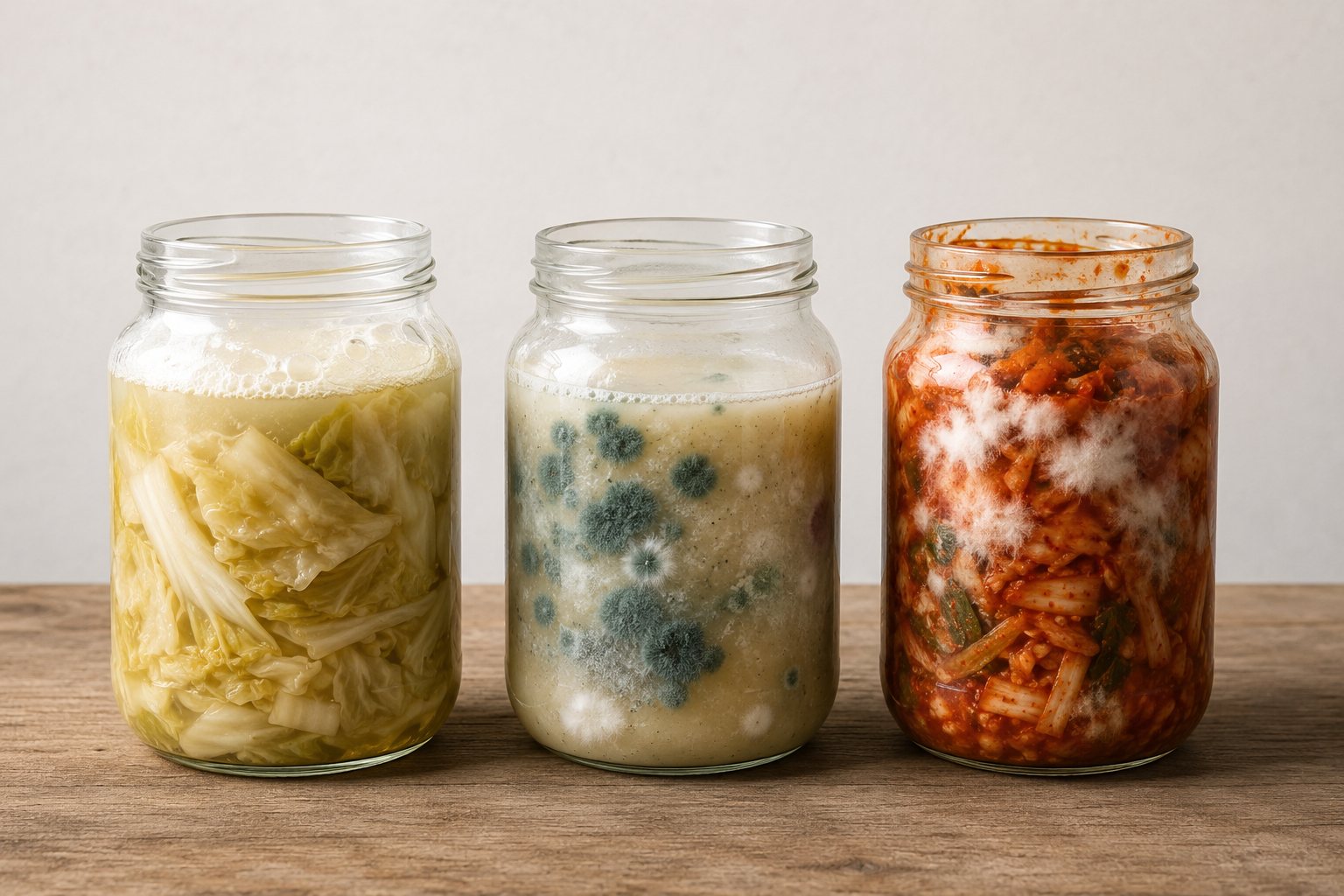
What you see: White, green, blue, or black fuzzy growth on the surface of the kimchi, sauerkraut, or other fermented vegetables. Sometimes just a thin film. Sometimes thick patches.
What caused it: Oxygen exposure. Mold is aerobic — it needs air. Any vegetable surface that sits above the brine, exposed to air, is vulnerable. This is the single most common visible failure in home fermentation.
How to fix it next time:
Keep all vegetables submerged beneath the brine at all times. Use a fermentation weight, a small plate, a zip-lock bag filled with brine, or even a clean cabbage leaf pressed down on top. Check daily during the first week and push down anything that floats up.
If the container has too much headspace, transfer to a smaller vessel where the brine rises closer to the rim.
Can you save this batch? If the mold is only on the surface and the food beneath smells normally sour and the texture is firm, you can scrape off the mold, remove the top layer of vegetables, and continue. If the mold has penetrated into the food, or if the food beneath smells rotten rather than sour, discard the batch.
Symptom: Slimy or Stringy Texture
What you see: The brine has become viscous, almost gel-like. The vegetables feel slimy when you touch them. Sometimes you can pull strings of slime from the surface.
What caused it: Usually one of two things. Either the salt concentration was too low, allowing exopolysaccharide-producing bacteria to dominate early in fermentation. Or the temperature was too high, accelerating the growth of organisms that produce these compounds before lactic acid bacteria could establish a sufficiently acidic environment.
How to fix it next time:
Measure your salt precisely. For standard baechu kimchi, aim for 2 to 3 percent salt relative to the total weight of vegetables. For sauerkraut, 2 to 2.5 percent. Do not reduce salt below these ranges.
If your kitchen is warm (above 25 degrees Celsius), consider starting the fermentation in a cooler location or moving it to the refrigerator earlier.
Can you save this batch? Mild sliminess sometimes resolves as lactic acid builds and suppresses the responsible organisms. Taste it — if it tastes normally sour and otherwise fine, it may still be edible. If the sliminess is extreme or accompanied by off-odors, discard.
Symptom: Kimchi Is Too Sour, Too Fast
What you see: After just one or two days, the kimchi is already intensely sour. The vegetables may also be softer than expected.
What caused it: Temperature. Warm environments (above 25 degrees Celsius) dramatically accelerate lactic acid production. What takes five days at 18 degrees can happen in 24 hours at 30 degrees.
How to fix it next time:
Ferment at a cooler temperature, or shorten the room-temperature phase and move to the refrigerator sooner. In hot climates, some fermenters skip room temperature entirely and ferment exclusively in the refrigerator — the process takes longer but gives much more control.
Taste daily. The moment sourness reaches the level you want, refrigerate immediately.
Can you save this batch? Over-sour kimchi is not spoiled. It is safe to eat. Use it in cooked dishes — kimchi jjigae, kimchi fried rice, kimchi pancakes — where the concentrated acidity becomes an asset.
Symptom: Kimchi Is Not Fermenting at All
What you see: After three or four days at room temperature, there is no sourness, no bubbles, no change in flavor. The vegetables taste like salted raw cabbage.
What caused it: Several possibilities.
Too much salt. If the salt concentration is too high, it suppresses even the lactic acid bacteria. Above 5 percent salt for kimchi, fermentation slows dramatically.
Too cold. If the environment is below 10 degrees Celsius, microbial activity may be too slow to produce noticeable changes within a few days.
Chlorinated water (for water kimchi). Chlorine kills lactic acid bacteria. If you made mul kimchi or nabak kimchi with unfiltered tap water, the bacteria may never have had a chance to start.
How to fix it next time:
Measure salt by weight, not by volume. Move the container to a warmer location (18 to 22 degrees is ideal for initial fermentation). Use filtered or dechlorinated water for any preparation that adds water directly.
Can you save this batch? If it has only been a few days and there are no signs of spoilage, try moving it to a warmer spot and waiting. If nothing happens after a week, the batch may not be recoverable.
Symptom: Unpleasant Smell — Not Sour, Just Bad
What you see (smell): The ferment smells putrid, sulfuric, or chemically wrong. Not the familiar pungent smell of kimchi or sauerkraut, but something distinctly rotten.
What caused it: Contamination by putrefactive bacteria — organisms that break down proteins into foul-smelling compounds like hydrogen sulfide, ammonia, and biogenic amines. This usually happens when salt was too low, ingredients were not fresh, equipment was contaminated, or the fermentation environment failed to become acidic quickly enough.
How to fix it next time:
Start with fresh, undamaged vegetables. Clean all equipment with hot water before use. Ensure adequate salt concentration. Remove any damaged or bruised portions of vegetables before packing — damaged tissue carries higher loads of spoilage organisms.
Can you save this batch? No. A truly putrid smell indicates that spoilage organisms dominated the fermentation. Discard the entire batch. Do not taste it.
Symptom: Pink, Orange, or Unusual Discoloration
What you see: The brine or vegetable surfaces develop an unusual pink, orange, or other unexpected color that is not attributable to the ingredients (like gochugaru).
What caused it: Pigment-producing yeasts or bacteria. Some species of Rhodotorula (pink yeast) or other organisms can colonize fermentation environments, especially when salt is low or oxygen exposure is high.
How to fix it next time:
Maintain proper salt levels. Minimize oxygen exposure. Ensure equipment is clean.
Can you save this batch? Small amounts of surface discoloration can sometimes be removed. If the discoloration has spread throughout the brine and the food, err on the side of discarding. The organisms causing the color may not be harmful, but their presence indicates the fermentation environment was not properly controlled.
Symptom: Explosive Gas Production
What you see: The container bulges. The lid pops. When you open it, brine sprays out. The gas production seems far beyond the gentle bubbling you expected.
What caused it: This can be normal or abnormal depending on context. In the first few days of kimchi fermentation, vigorous CO2 production by Leuconostoc species is expected and not a problem. But if the gas production is accompanied by foul odors, or if it happens late in fermentation when gas production should have slowed, it may indicate contamination by gas-producing spoilage organisms.
How to fix it next time:
Leave headspace in the container. Do not seal airtight during the first few days of active fermentation — use a loose lid or a cloth cover. Burp sealed containers daily during the active phase.
Can you save this batch? If it smells like kimchi and tastes like kimchi, it is fine — the gas is just CO2 from normal fermentation. If it smells wrong, see the “unpleasant smell” section above.
Symptom: Vegetables Are Mushy
What you see: The cabbage or radish has lost all crunch. The texture is soft, waterlogged, and unpleasant.
What caused it: Usually one of three things. Not enough salt during the initial salting step, which means the cell structure was not properly set before fermentation began. Over-fermentation — the kimchi was left at room temperature too long. Or the vegetables were old and already losing structural integrity before fermentation started.
How to fix it next time:
Salt adequately and for the right duration. For baechu kimchi, salt the cabbage for 6 to 8 hours (or overnight) with enough salt to wilt the leaves without destroying them. Use fresh, firm vegetables. Monitor fermentation daily and refrigerate when the texture and sourness reach the level you want.
Can you save this batch? Mushy kimchi is not unsafe — it is just texturally unpleasant as a side dish. Use it in cooked applications where texture matters less: jjigae, fried rice, pancakes.
The Diagnostic Checklist
When a batch fails, run through this list:
Salt: Did I measure by weight? Was it in the correct range for this fermentation? Did I use salt without additives (no iodine, no anti-caking agents)?
Temperature: How warm was my kitchen? Did I monitor the temperature? Did I taste daily and adjust timing accordingly?
Submersion: Were all vegetables below the brine? Did I check and press them down daily? Was there excessive headspace?
Equipment: Was the container clean? Was there residue from a previous use? Did I use reactive metal (aluminum, cast iron) that could interfere with the acid environment?
Ingredients: Were the vegetables fresh? Were there damaged or bruised portions I should have removed? Did I use chlorinated water?
Time: Did I check the fermentation daily? Or did I set it and forget it?
Most failures map to one or two items on this list. Identifying which variable was off is the entire troubleshooting process.
Failure Is Part of the Process
Every experienced fermenter has thrown away batches. It is not a sign of incompetence. It is a sign of working with a biological process that contains variables you cannot fully control.
The difference between a beginner and an experienced fermenter is not the failure rate. It is the diagnostic speed. An experienced fermenter opens a failed jar, identifies the likely cause within seconds, adjusts one variable, and succeeds on the next batch.
That skill comes from paying attention — smelling, tasting, watching, and connecting what you observe to the variables you set. No recipe can replace that feedback loop.
The goal is not to never fail. The goal is to fail usefully — to learn something from every batch, successful or not, that makes the next one better.
This content is for informational purposes only and is not medical advice.