Fermentation Molds: How Aspergillus, Rhizopus, and Koji Transform Food
When people hear that a food contains mold, the instinct is usually to throw it away.
In most situations, that instinct is correct.
But fermentation tells a different story.
Some molds are not spoilage organisms. They are carefully selected microorganisms that have been cultivated and used for centuries to transform grains, beans, and other raw ingredients into foods and beverages with entirely different flavors, textures, and aromas.
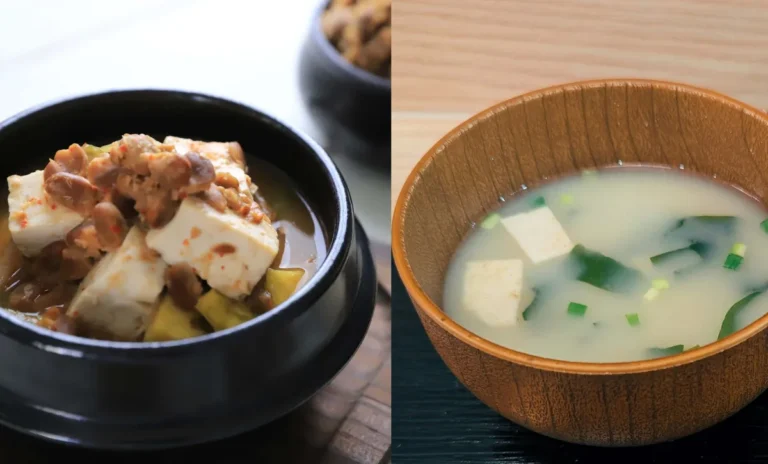
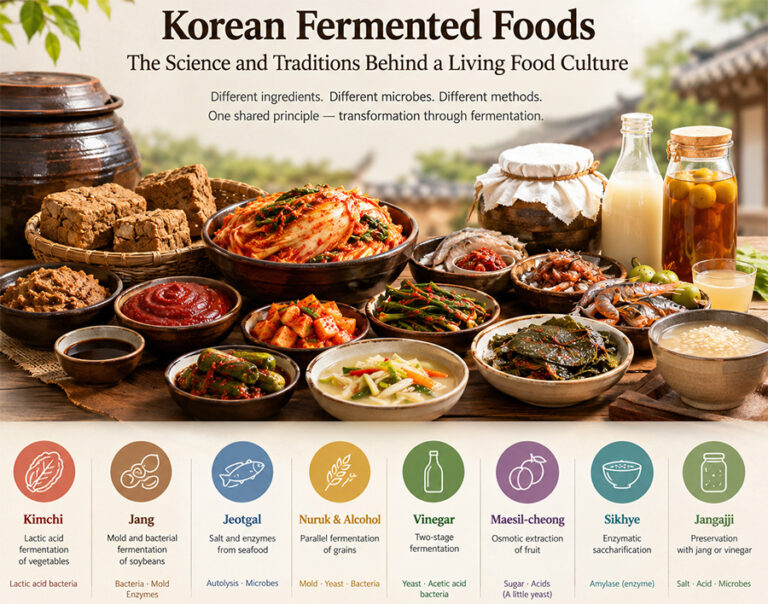
Sake, soy sauce, miso, doenjang, gochujang, tempeh, rice vinegar, and many traditional fermented foods depend on fungal activity at some stage of their production.
The important question, therefore, is not simply whether a food contains mold.
It is which mold, under what conditions, and doing what.
Understanding that distinction makes the science of fermented food much easier to understand.
The Problem Molds Solve
The most important contribution of molds to many traditional fermentations is enzymatic.
Grains and legumes contain large molecules that microorganisms cannot use efficiently in their original form.
Starch consists of long chains of glucose. Proteins are made of chains of amino acids. Lipids are composed of fats and related molecules.
Molds produce enzymes that help break these large molecules into smaller compounds.
Amylases and related enzymes break down starch into smaller carbohydrates and sugars.
Proteases break proteins into peptides and amino acids.
Lipases act on fats and release fatty acids and other compounds.
These enzymes are secreted by fungal cells into the surrounding substrate, where they act outside the organism. This is sometimes described as extracellular digestion.
The result is one of the fundamental principles of mold-based fermentation:
The mold changes the raw material into a form that other microorganisms — and eventually humans — can use.
This is why fungal starters such as Japanese koji and Korean nuruk are so important in traditional fermentation.
They are, in effect, biological enzyme factories.
But there is an important qualification.
Not every fermentation begins with mold.
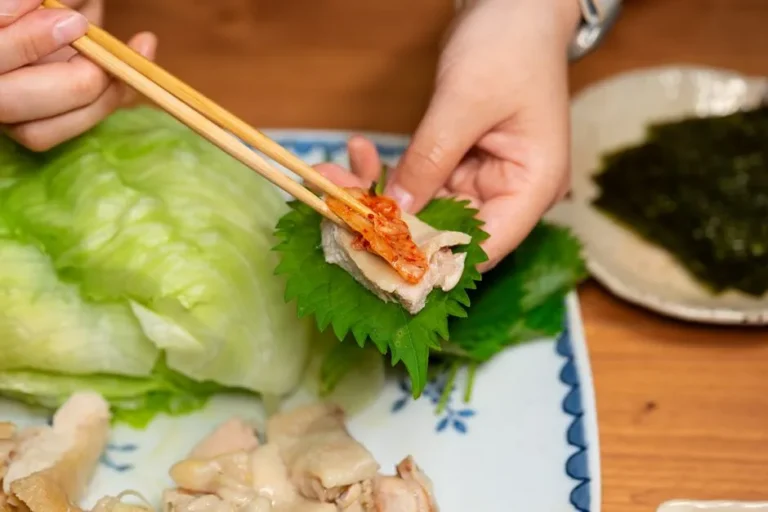
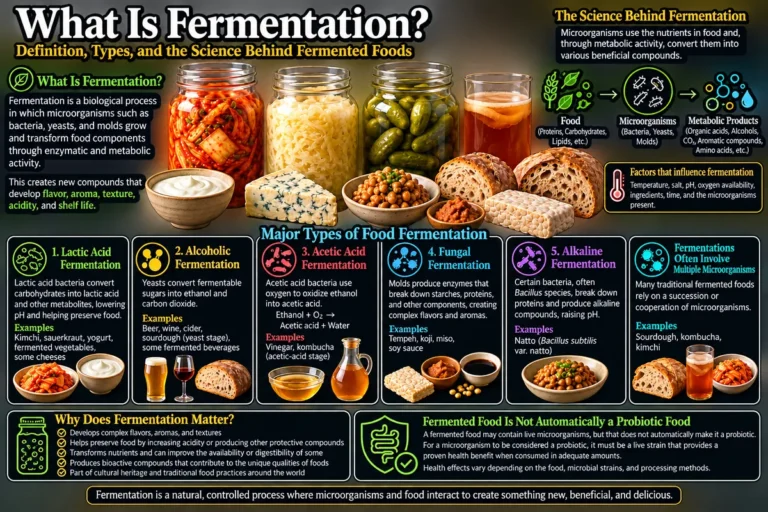
Kimchi, sauerkraut, yogurt, and many other fermented foods rely primarily on bacteria or other microorganisms rather than filamentous fungi.
Molds are particularly important in fermentations where complex carbohydrates, proteins, and other macromolecules need to be enzymatically transformed before subsequent stages of fermentation can occur.
Aspergillus oryzae: The Koji Mold
Among the molds used in Asian food fermentation, Aspergillus oryzae is one of the most important.
It is widely used in Japanese koji production and in the manufacture of foods and beverages such as sake, miso, and soy sauce.
Its value comes largely from its ability to produce a broad range of enzymes.
When grown on steamed rice, barley, or other suitable substrates, A. oryzae can produce enzymes that break down starches and proteins.
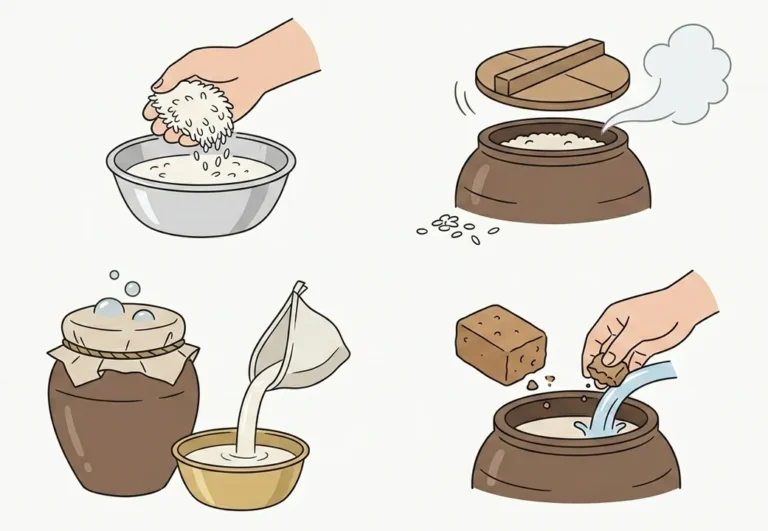
In rice-based fermentations, starch-degrading enzymes help release sugars that yeast can subsequently ferment into alcohol.
In soybean-based fermentations, proteolytic enzymes help break soybean proteins into peptides and amino acids that contribute to savory taste and aroma.
This division of labor is especially important in beverages such as sake.
The mold produces enzymes that release sugars from rice starch, while yeast converts those sugars into alcohol.
In other words, the microorganisms are not doing the same job.
They are working together.
A domesticated relative of Aspergillus flavus.
The evolutionary history of A. oryzae is particularly interesting.
Genomic studies indicate that A. oryzae is closely related to Aspergillus flavus and is generally regarded as a domesticated form derived from an atoxigenic lineage related to A. flavus. A 2017 genomic study by Machida et al., published in Nature, confirmed this relationship and showed that over centuries of selective cultivation for food production, A. oryzae lost the genetic machinery for aflatoxin biosynthesis while retaining and enhancing its enzyme-producing capabilities. The domestication of A. oryzae is, in this sense, one of the oldest and most consequential examples of human-directed microbial selection.
A. flavus is important in food safety because certain strains can produce aflatoxins — compounds classified as Group 1 carcinogens by the International Agency for Research on Cancer (IARC). These are among the most potent naturally occurring carcinogenic compounds known.
A. oryzae, by contrast, has a long history of intentional use in food fermentation, and food-production strains are selected for their useful enzymatic properties and lack of aflatoxin production.
This does not mean that a wild Aspergillus mold growing on food can be identified as safe simply by looking at it.
The distinction between food-grade fermentation strains and unwanted environmental molds is fundamental.
That is why traditional fermentation relies on established starter cultures, controlled production methods, and accumulated knowledge rather than visual identification alone.
Aspergillus in Korean Fermentation
The role of Aspergillus becomes more complicated when we move from Japanese koji to traditional Korean fermentation.
Traditional Korean meju is not simply a block of soybeans colonized by one carefully isolated mold.
It is a complex microbial ecosystem.
Bacteria, yeasts, and filamentous fungi can all participate, and the microbial community changes during fermentation and drying.
Aspergillus species may be present, along with molds such as Mucor and other fungi, while bacteria including Bacillus and lactic acid bacteria can also contribute to the process.
The exact microbial composition varies with raw materials, environment, production methods, temperature, moisture, and other conditions.
This is one reason traditional Korean fermentation cannot always be reduced to a single starter mold.
The fermentation is better understood as a microbial community working together over time.
And that complexity matters.
Different microorganisms produce different enzymes and metabolites. Together, they help break down soybean proteins, carbohydrates, and lipids and generate the compounds that eventually contribute to the distinctive flavors of doenjang, ganjang, and other jang products.
Rhizopus: The Mold Behind Tempeh
If Aspergillus is closely associated with koji, another genus is particularly famous for a different fermented food.
Rhizopus.
Tempeh, a traditional Indonesian fermented soybean food, is commonly produced using Rhizopus species.
During tempeh fermentation, fungal mycelium grows through cooked soybeans and binds them into a firm white cake.
The transformation is both biological and physical.
The fungus produces enzymes that act on soybean proteins, carbohydrates, and lipids.
Proteins are partially broken down into smaller peptides and amino acids.
Other enzymatic reactions alter carbohydrates and fats.
Rhizopus-associated phytase activity can also reduce phytate, a compound that can bind minerals such as iron and zinc. A 2019 review published in Comprehensive Reviews in Food Science and Food Safety by Nout and Kiers documented that Rhizopus fermentation increases the bioavailability of minerals including iron and zinc in soybeans, primarily through phytate reduction. The degree of improvement depends on fermentation time, temperature, and the specific Rhizopus strain used.
The result is a food that is very different from the original soybean — not simply in flavor, but also in texture and chemical composition.
Why Tempeh Ferments So Quickly
Tempeh fermentation is remarkably fast compared with long-aged foods such as doenjang or miso.
A typical tempeh fermentation can develop over roughly one to two days under suitable conditions.
The rapid growth of Rhizopus is one reason.
Another is the nature of the process itself.
Tempeh is generally produced under relatively low-salt conditions, allowing the fungus to grow rapidly.
This is very different from high-salt soybean fermentations such as doenjang, where salt concentration and long maturation strongly influence which microorganisms can survive and become dominant.
The contrast is useful because it demonstrates a basic principle of fermentation:
The environment determines which microorganisms can grow and what they can do.
Mucor and Other Fermentation Fungi
Aspergillus and Rhizopus receive much of the attention, but they are not the only fungi involved in traditional fermentation.
Mucor species have been detected in Korean meju and in traditional fermentation systems in other parts of Asia.
They produce enzymes that can contribute to the breakdown of food components and can influence the chemical and sensory characteristics of fermented products.
In a mixed fermentation such as traditional meju or nuruk, no single microorganism necessarily controls the entire process.
Instead, different microorganisms occupy different ecological niches and become more or less abundant as conditions change.
It is better to think of these fermentations as a microbial community than as the work of one organism.
Monascus and Red Fermented Foods
Another important genus is Monascus.
Monascus species have long been used in East Asian food fermentation, particularly in the production of red fermented rice, traditionally known as red yeast rice.
These fungi can produce distinctive pigments and a range of secondary metabolites.
One of the best-known compounds is monacolin K, a molecule chemically identical to the active ingredient in the pharmaceutical lovastatin. Because of this structural identity, red yeast rice products have attracted considerable scientific and regulatory attention. Several countries have debated whether these products should be classified as foods or drugs, and regulatory positions vary by jurisdiction.
For fermentation science, however, the more interesting point is broader:
A single microorganism can produce multiple classes of compounds — pigments, enzymes, and secondary metabolites — depending on its strain and growth conditions.
This illustrates just how chemically active fungal fermentation can be.
Penicillium: Mold That Makes Cheese
Fungal fermentation is not limited to Asia.
Some of the world’s best-known cheeses depend on Penicillium species.
Penicillium roqueforti is associated with blue cheeses such as Roquefort, Gorgonzola, and Stilton.
Penicillium camemberti is used in the characteristic white surface rind of cheeses such as Camembert and Brie.
Here again, the underlying principle is similar.
A selected microorganism grows under specific conditions and produces enzymes that change the food around it.
The result is a new combination of aroma, texture, flavor, and appearance.
The microorganisms are different.
The foods are different.
But the biological principle is remarkably similar.
Safe Mold and Dangerous Mold
This distinction deserves special attention.
Not every mold is suitable for food fermentation.
Food fermentation uses selected organisms and strains with established histories of safe use under appropriate production conditions.
Other molds can produce undesirable or toxic compounds.
Certain strains of Aspergillus flavus, for example, can produce aflatoxins, which are classified as Group 1 carcinogens by the International Agency for Research on Cancer (IARC). Aflatoxin contamination of grains, nuts, and other stored crops is a serious public health concern in many parts of the world.
The important point is that safety cannot be determined simply by looking at a mold.
Two molds can look similar while having very different biological properties.
This is particularly important in home fermentation.
A deliberately cultivated starter culture used according to an established fermentation method is fundamentally different from an unidentified mold that appears unexpectedly on food.
If an unfamiliar mold appears on a food that was not intentionally inoculated with a known food-grade culture, visual inspection alone is not enough to establish safety.
When in doubt, the safest choice is to discard it.
The Enzymatic Foundation of Fermented Food
This is why molds matter so much.
In many traditional mold-based fermentations, the mold does not simply ferment the food by itself.
It first changes the raw material.
Starch becomes smaller carbohydrates.
Proteins become peptides and amino acids.
Lipids are transformed into smaller compounds.
These products then become substrates for additional microbial reactions and contribute directly to the taste, aroma, and texture of the finished food.
In Japanese koji-based fermentation, Aspergillus oryzae performs this enzymatic work on grains or soybeans.
In tempeh, Rhizopus transforms cooked soybeans while its mycelium creates the characteristic structure of the food.
In Korean meju and nuruk, the situation is more complex, involving communities of fungi, bacteria, and yeasts whose composition changes throughout fermentation.
The result is not simply preservation.
It is transformation.
When you taste soy sauce, doenjang, miso, sake, tempeh, or another fermented food, you are tasting the result of thousands of microscopic reactions.
The mold itself may no longer be obvious in the finished product.
But its enzymes may have already changed the raw materials dramatically.
A grain that began primarily as starch can become a source of fermentable sugars.
A soybean containing large storage proteins can become rich in peptides and free amino acids.
Those transformations create the chemical foundation for umami, aroma, acidity, alcohol, and many of the other characteristics we associate with fermented food.
That is the hidden work of fermentation molds.
They are not simply growing on food.
They are rewriting its chemistry.
This article is for informational purposes only and is not medical advice.