Soy Sauce Fermentation: How Soybeans Become Liquid Umami
Soy sauce is one of the oldest fermented foods in human history.
It appears on tables across East Asia and, increasingly, around the world. Most people reach for it without thinking. A splash on rice. A pour into a marinade. A few drops stirred into a soup.
But what sits inside that bottle is the product of a biochemical transformation that took centuries of human observation to develop and months of microbial activity to complete.
Soy sauce fermentation is the process by which the proteins in soybeans are broken down into free amino acids — particularly glutamic acid, the compound responsible for the sensation of umami — through the combined action of molds, bacteria, yeasts, salt, and time.
Understanding that process means understanding one of the most elegant systems of food transformation that any culture has developed.
The Origin of Soy Sauce
The oldest records come from China.
Around the third century BCE, written accounts describe fermented soybean preparations collectively called jiang. These were not soy sauce as it exists today. The distinction between solid paste and liquid had not yet been made. It was simply a salty, savory, fermented soybean product — one substance, not two.
Korean records trace the tradition to the Three Kingdoms period. The Samguk Sagi, compiled in 1145, mentions jang and si — fermented soybean preparations — listed among royal wedding gifts in 683 CE. That detail is significant. Fermented soybean products were valuable enough to present at state ceremonies.
China, Japan, and Korea each developed soy sauce along different paths.
Japan blended wheat into the process and cultivated koji — Aspergillus oryzae grown under controlled conditions — separately before combining it with soybeans. The result was a sweeter, lighter sauce with a distinctive wheat-derived aroma. This is the lineage that produced modern shoyu.
Korea took a different path. Korean soy sauce fermentation centers on meju — blocks of cooked soybeans that are shaped, dried, and allowed to ferment with wild microorganisms before being submerged in brine. The process produces two products simultaneously: the liquid becomes ganjang (soy sauce), and the remaining solids become doenjang (fermented soybean paste). Two foods from one fermentation. This dual-product system is one of the defining features of Korean jang culture.
In 2024, Korea’s jang-making culture was inscribed on the UNESCO Intangible Cultural Heritage of Humanity list — a recognition of the depth and continuity of this tradition.
What Happens During Soy Sauce Fermentation
The transformation of soybeans into soy sauce is not a single event. It is a sequence of overlapping biochemical processes, each driven by different organisms and enzymes.
The process begins with protein hydrolysis.
Soybeans are approximately 36 to 40 percent protein by dry weight. These proteins are large, complex molecules that have no flavor in their intact form. During fermentation, enzymes called proteases — produced primarily by molds and certain bacteria — cleave these proteins into progressively smaller fragments: first into peptides, then into individual amino acids.
Glutamic acid is the most important of these amino acids from a flavor perspective. It is the primary molecular trigger for the umami taste receptor on the human tongue. The concentration of free glutamic acid in well-fermented soy sauce can reach levels comparable to or exceeding those found in aged parmesan cheese — one of the most umami-dense foods in Western cuisine.
But glutamic acid does not work alone. Soy sauce also contains nucleotides — particularly inosinic acid and guanylic acid — that interact synergistically with glutamic acid. This synergy multiplies the perceived umami intensity several times beyond what glutamic acid alone would produce. This is why a small amount of soy sauce can make an entire dish taste more complete. The effect is not additive. It is multiplicative.
Simultaneously, amylase enzymes break down any starches present in the soybeans or added grains into simple sugars. These sugars serve two functions: they become substrates for yeast fermentation, and they participate in Maillard reactions — non-enzymatic browning reactions between amino acids and reducing sugars that produce the dark color and complex aromatic compounds characteristic of aged soy sauce.
Yeasts, primarily Saccharomyces and Zygosaccharomyces species, ferment the available sugars into ethanol and carbon dioxide. The ethanol is not the end product — it reacts further with organic acids to produce esters, volatile aromatic compounds that contribute to the fragrance of well-aged soy sauce.
Lactic acid bacteria, including Lactobacillus species, produce organic acids that contribute brightness, acidity, and a degree of preservation to the final product.
All of these processes occur simultaneously over a period of months to years. The result is a liquid that contains hundreds of distinct flavor compounds — far more complex than any single ingredient could produce.
The Microorganisms
Four groups of organisms drive soy sauce fermentation, and each contributes something distinct.
Filamentous molds are the initiators. In Korean fermentation, the primary species are Aspergillus oryzae and related Aspergillus species that colonize the meju naturally from the environment. In Japanese fermentation, Aspergillus oryzae is deliberately inoculated onto a mixture of soybeans and wheat to produce koji. These molds secrete the proteases and amylases that begin the breakdown of proteins and starches. Without them, the raw materials would remain nutritionally dense but flavorless.
Bacillus subtilis plays a particularly important role in Korean meju fermentation. This bacterium, naturally present on the rice straw used to tie and hang the meju blocks, colonizes the interior of the blocks and produces powerful proteases that work deep within the soybean matrix. The contribution of Bacillus distinguishes Korean soy sauce fermentation from Japanese soy sauce fermentation, where Bacillus plays a minimal role.
Lactic acid bacteria, including Lactobacillus and Pediococcus species, become active during the brine fermentation stage. They produce lactic acid and other organic acids that lower the pH, suppress spoilage organisms, and add a layer of flavor complexity.
Yeasts complete the picture. Saccharomyces cerevisiae and Zygosaccharomyces rouxii — a salt-tolerant yeast particularly important in soy sauce fermentation — produce ethanol, esters, and other volatile compounds. Zygosaccharomyces rouxii is especially well adapted to the high-salt environment of soy sauce and is one of the few yeasts that can function at salt concentrations above 15 percent.
Korean Meju: The Wild Approach
The Korean method of soy sauce fermentation is distinctive because of meju.
Meju is made from whole cooked soybeans — and nothing else. The beans are boiled, mashed, shaped into dense blocks, and then hung on rice straw in a warm, ventilated space to dry and ferment naturally for 40 to 60 days.
During this period, the meju is colonized by whatever microorganisms are present in the environment. Aspergillus molds grow on the surface. Bacillus subtilis, carried on the rice straw, colonizes the interior. Yeasts and lactic acid bacteria establish themselves as conditions change.
This is wild fermentation. No cultures are added. No specific strains are selected. The microbial community reflects the place where the meju was made — the local air, the local straw, the local temperature and humidity patterns.
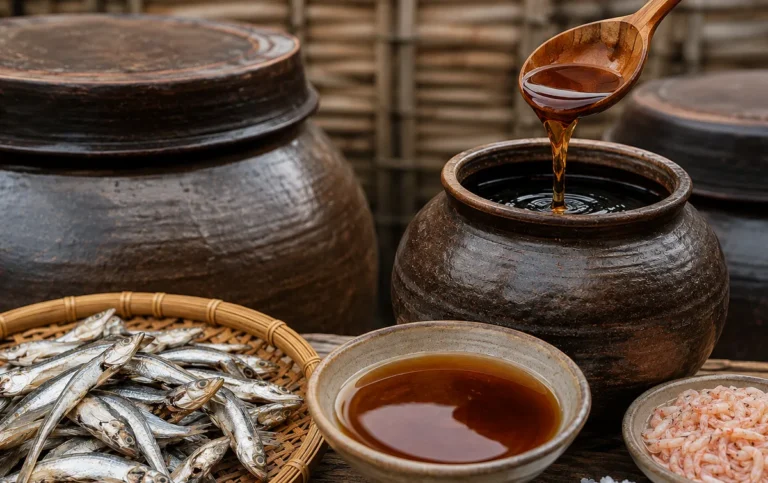
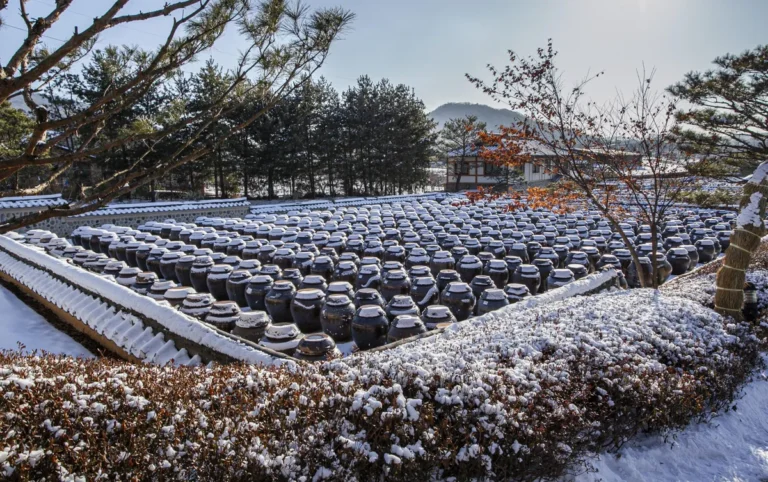
When the meju blocks are sufficiently fermented, they are submerged in a brine solution inside onggi — traditional Korean earthenware vessels — and left to ferment for an additional three to six months. During this phase, the enzymes already present in the meju continue breaking down proteins and starches, while the brine creates an environment that selects for salt-tolerant organisms.
At the end of this period, the liquid is separated from the solids. The liquid is ganjang. The solids are kneaded and packed to become doenjang.
The ganjang may then be aged further — sometimes for years. During extended aging, Maillard reactions continue, the color deepens, and the flavor becomes more concentrated and complex.
Korean Soy Sauce Types
Not all Korean soy sauce is made this way. The types differ significantly in production method, flavor, and appropriate use.
Joseon ganjang, also called guk ganjang or soup soy sauce, is the traditional product described above — the liquid separated from meju after brine fermentation. It is light in color, intensely salty, thin in body, and carries a distinctive earthy, slightly funky depth from its wild fermentation. It is used primarily in soups, namul (seasoned vegetables), and dishes where its concentrated saltiness and clean fermentation flavor are assets.
Yangjo ganjang is brewed soy sauce produced through controlled industrial fermentation, typically using a mixture of soybeans and wheat with introduced Aspergillus cultures. Japanese shoyu and most commercial Korean soy sauces fall into this category. It is darker, sweeter, less salty per unit volume than joseon ganjang, and has a more rounded, wheat-influenced flavor. It is used in marinades, braised dishes, dipping sauces, and cooking applications where its sweetness and body are desirable.
Jin ganjang refers to aged soy sauce — joseon ganjang that has been matured for three or more years. Extended aging concentrates the flavors, deepens the color, and produces a more complex, less aggressively salty product.
Honhap ganjang is a blended product that mixes traditionally fermented and chemically hydrolyzed soy sauce. It is the least expensive option and the most common in casual cooking, but it lacks the depth of either pure type.
Mat ganjang is a seasoned soy sauce, sometimes infused with additional ingredients like garlic, chili, or mushroom. It is a convenience product rather than a fermentation category.
The distinction that matters most for fermentation is between joseon ganjang and yangjo ganjang. They represent two fundamentally different approaches — wild fermentation versus controlled fermentation — and produce two fundamentally different products.
Time and What It Does
The single most important variable in soy sauce quality, after the initial microbial process, is time.
A soy sauce fermented for three months and a soy sauce fermented for three years are chemically different products. The amino acid concentration is higher in the aged product. The Maillard reaction products are more abundant. The volatile compound profile is more complex. The color is darker. The flavor is deeper.
This is not a matter of opinion. Analytical chemistry confirms it. Studies measuring free amino acid content, total nitrogen, browning index, and volatile compound diversity consistently show that extended aging produces measurably more complex soy sauce.
Traditional Korean households understood this without analytical instruments. They aged their ganjang in onggi for years, and the oldest ganjang in a household — sometimes passed down across generations — was considered the most valuable.
Time is not simply waiting. During aging, slow chemical reactions continue transforming the sauce. Maillard reactions proceed. Esters form and rearrange. Organic acids interact with alcohols. The product at year three is not simply a more concentrated version of the product at month three. It is a different substance with a different molecular profile.
Sodium and Health Considerations
Soy sauce is a high-sodium food. This is inherent to its production — salt is the agent that controls the fermentation environment and prevents spoilage.
Traditional joseon ganjang is particularly high in sodium. A single tablespoon can contain over 1,200 milligrams of sodium, sometimes more depending on the producer and aging time. Yangjo ganjang is generally lower per volume but still significant.
The American Heart Association recommends no more than 2,300 milligrams of sodium per day for most adults, with an ideal target of 1,500 milligrams for those managing blood pressure.
In traditional Korean cooking, soy sauce is used as a seasoning, not consumed as a beverage. Small quantities distributed across an entire dish or meal are the intended use. Context and portion size matter.
Research on fermented soy products has investigated possible health effects beyond basic nutrition. Some studies have examined the antioxidant properties of Maillard reaction products in aged soy sauce. Others have investigated the potential bioactivity of peptides produced during protein hydrolysis. These are active areas of research, but findings remain preliminary and should not be interpreted as evidence that soy sauce prevents or treats disease.
Soy sauce is a fermented food with a remarkable biochemical profile. That is interesting enough without overstating it.
The Simplest Description of Something Complex
Soy sauce fermentation can be described in a single sentence.
Molds break down soy protein into amino acids, bacteria and yeasts add acids and aromatics, salt controls the process, and time deepens everything.
That sentence is accurate.
But it cannot convey the centuries of observation that produced the meju tradition, or the microbial complexity of a wild-fermented block of soybeans hanging on rice straw, or the chemical difference between a sauce aged three months and one aged three years.
The dark liquid in the bottle is simple to use.
The process that created it is not simple at all.
This content is for informational purposes only and is not medical advice.