How Doenjang Is Born: The Science of Fermented Soybean Paste
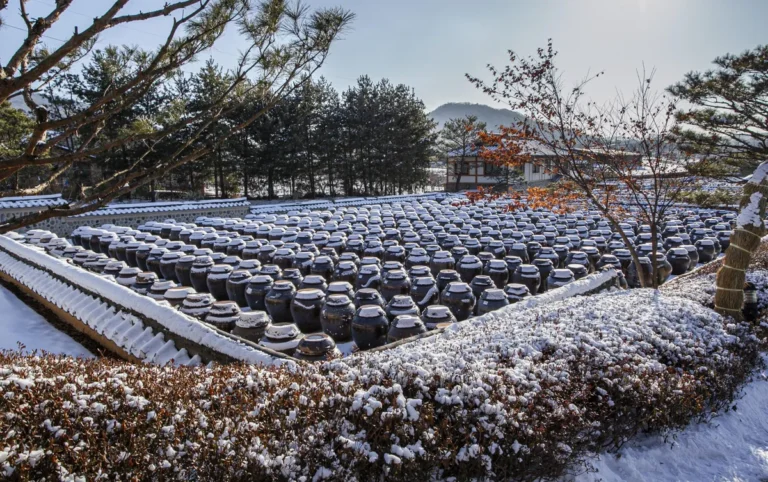
Mention making doenjang and it sounds like something that requires decades of wisdom — a grandmother’s practiced hands, a courtyard full of clay pots, some remote countryside kitchen. That image comes to mind immediately. But when you actually look at what goes into it, doenjang is just soybeans, salt, and time. Simple ingredients. Wildly complex results. What happens in between is worth understanding properly.
The Meju Stage: Fermentation Starts with Mold
Every doenjang story begins with meju. Cooked soybeans are mashed and pressed into dense brick-like blocks. That’s meju. Tie the blocks with rice straw, hang them somewhere warm with good airflow, and white mold begins to bloom across the surface. It looks unremarkable. It is anything but.
Nothing is added to meju. The blocks are colonized by whatever is present — in the air, on the straw, on the surfaces where they dry — so the community that develops is mixed and varies with place and season. Sequencing studies of Korean meju consistently find Bacillus species prominent, alongside surface molds including Aspergillus, and later, once the brine stage begins, salt-tolerant yeasts and lactic acid bacteria. The enzymes they secrete dismantle the soybean’s internal structure. Proteases break proteins into amino acids. Amylases convert starches into sugars. Without this step, the deep savory flavor doenjang is known for simply doesn’t develop.
This is where Korean and Japanese soybean fermentation part ways. Aspergillus oryzae, the koji mold behind Japanese miso and sake, is deliberately grown as a pure culture on rice or barley and then added. Traditional meju is never inoculated, which is why its microbial makeup — and the flavor that follows from it — is far less predictable.
One key detail: the rice straw isn’t decorative. Its surface harbors Bacillus subtilis, the same bacterium responsible for cheonggukjang. Straw is one of the main routes by which this bacterium reaches the block, along with the air and the drying surfaces, and it works its way inward as fermentation proceeds. Traditional technique didn’t choose rice straw by accident.
Salting the Mash: How Brine Selects the Right Microbes
Once the meju has properly fermented, it goes into a brine bath. This is jang-damgeugi — the salting stage — and it’s the moment where doenjang and ganjang (Korean soy sauce) begin their separate lives. The brine concentration sits around 18 to 20 percent. That number matters more than it might seem.
Salt isn’t just there for flavor. At high concentrations, it creates an environment where most unwanted bacteria cannot survive. The microbes that make it through are salt-tolerant lactic acid bacteria and yeasts. They take over the fermentation from here. Lactic acid bacteria produce organic acids that give doenjang its subtle tang and aroma. Yeasts contribute alcohol and additional flavor compounds. The brine acts as a filter, selecting exactly the microbial community you want.
A practical note on concentration: drop the salinity too low and fermentation accelerates, but so does the risk of contamination. One old method for checking concentration without a salometer — float a raw egg in the brine. If it rises above the surface by roughly the area of a coin, the concentration is right. If it barely floats, the brine is too weak. If it bobs up too high, it’s too salty. A simple, reliable check that’s been used for generations.
Because salt is used so heavily, doenjang carries significant sodium. A single tablespoon (15g) of commercial doenjang typically contains 700 to 900mg of sodium — close to half the adult daily recommended intake of 2,000mg set by health authorities. If you use doenjang generously in soups and stews, it’s worth keeping that in mind and adjusting quantities accordingly.
Separation and Aging: What’s Left After the Soy Sauce Runs Off
After 40 to 60 days, the mixture is separated. The liquid becomes joseon ganjang — traditional Korean soy sauce. The solids become the foundation of doenjang. Those solids get additional salt mixed in, then packed tightly into a clay onggi pot and left to age in the open air.
Real flavor requires at least one full summer. The heat accelerates fermentation significantly. During the day, the pot lid comes off so the contents can breathe and take in sunlight. At night, or when rain comes, the lid goes back on. This rhythm darkens the color and evaporates excess moisture. Freshly separated doenjang is pale and sharp-tasting. After a summer, it deepens in color and softens in flavor — the edges round out.
A common thing to notice during aging: a white film forming on the surface. This is film yeast, from the genus Pichia. It isn’t harmful. That said, leaving it undisturbed can affect the flavor, so skim it off with a spoon and dust a little extra salt over the surface. What does require attention is any black or pink mold — that needs to be removed entirely. Color is the key indicator here.
Amino Acids and Umami: What’s Actually Creating That Flavor
That deep, heavy, almost mineral richness you taste in good doenjang — it comes from free amino acids, primarily glutamic acid. These are the byproducts of protease enzymes breaking down soy protein over months of fermentation. Glutamic acid is the same compound at the core of MSG. Doenjang is essentially a naturally occurring umami bomb.
Amino acids aren’t the only thing being transformed. Isoflavones in soybeans exist initially as glycosides — bound to sugar molecules. During fermentation, they convert into aglycone forms. Research published in peer-reviewed journals, including work cited by the National Institutes of Health (NIH), suggests that aglycone isoflavones may be absorbed by the body more readily than their glycoside precursors. Fermentation appears to improve the bioavailability of these compounds, though more research is ongoing.
Doenjang also accumulates vitamin K2 during fermentation — less than cheonggukjang, but levels that build with extended aging. Longer-aged doenjang isn’t just more flavorful. Some studies suggest it may offer modestly different nutritional characteristics, though these findings should not be interpreted as health claims. As always, consult a qualified healthcare provider for guidance specific to your situation.
Why Bacillus Does the Heavy Lifting
Bacillus subtilis gets none of the cultural attention that yeast gets in bread or wine. In Korean soybean fermentation it is arguably the most consequential single organism.
Bacillus species produce extracellular proteases at rates few other common food microbes match. Those proteases are what turn soybean protein, a large and essentially tasteless molecule, into the free amino acids behind umami. The glutamic acid that gives doenjang its savory weight accumulates largely because Bacillus proteases are so efficient at liberating it.
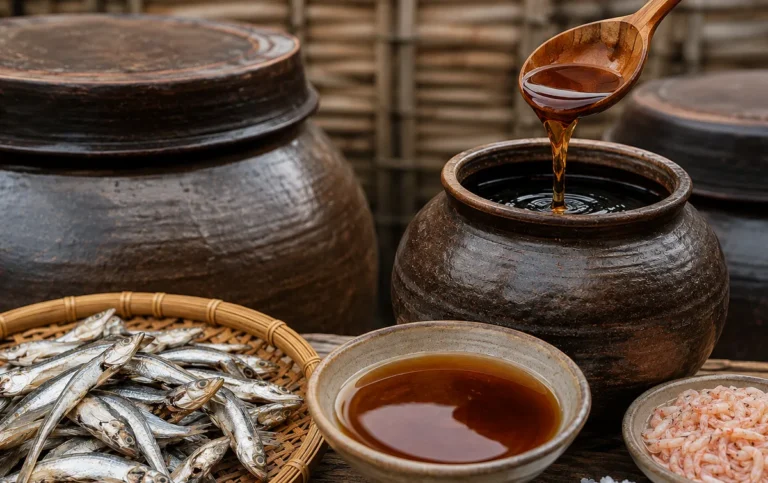
It is a different route to the same destination. Fish sauce gets there through the fish’s own enzymes; aged cheese through bacterial and enzymatic activity on casein. Different organisms, different substrates, the same end point: free glutamate in high concentration.
Bacillus also produces the sticky, stringy coating visible on well-fermented meju. That is polyglutamic acid, the same polymer responsible for the texture of cheonggukjang and Japanese natto.
What the Molds Add
Molds colonize the surface of meju blocks during drying, and their contribution runs in a different direction. Where Bacillus excels at breaking protein, molds are strong producers of amylases, the enzymes that break starch into sugar.
Soybeans are not especially starchy, but the residual carbohydrates still matter. The sugars released during this stage feed the Maillard reactions that run through the long aging period, and those reactions are what darken the paste and build its roasted depth.
Together the two groups of organisms take the bean apart more completely than either could alone.
The Brine Is an Environment, Not Just a Preservative
At 18 to 20 percent salt, most bacteria, including the Bacillus that dominated the meju stage, can no longer grow. The osmotic pressure is simply too high.
But the enzymes those bacteria already produced remain active in the brine, working outside the cells that made them. This is worth stating plainly: fermentation in the jar is largely an enzymatic process rather than a microbial growth process. The organisms did their work earlier by producing enzymes. The brine stage is where those enzymes work on the substrate.
Some salt-tolerant yeasts and lactic acid bacteria do stay active through the months of aging, and they contribute their own flavor compounds. But the dominant transformation is enzymatic hydrolysis driven by enzymes made weeks or months before.
Why No Two Batches Taste Alike
This is the practical consequence of letting the environment inoculate the meju.
Selected cultures and controlled rooms give consistency. Whatever happens to colonize a block of soybeans in a particular place, season, and year gives variation.
That variation is the signature of traditional production rather than a defect in it. A doenjang made from meju in a mountain village in Gangwon may taste measurably different from one made in a coastal town in Jeollanam-do, not because the recipe changed but because the microbial community did.
The environment shapes the organisms, the organisms shape the enzymes, and the enzymes shape the flavor. The place where fermentation happens ends up in the food.
How to Make Doenjang at Home: A Practical Recipe for Beginners
Don’t overthink it. If making your own meju from scratch feels like too much to start with, store-bought meju works perfectly well for a first attempt.
Ingredients
- 2 kg traditional meju (store-bought is fine)
- 600g sea salt (non-refined — do not use table salt or iodized salt)
- 3 liters of water
- 3 to 4 dried red chili peppers
- 1 to 2 small pieces of charcoal (to absorb off-odors)
- 5 to 6 dried jujubes, optional
Steps
- Scrub the meju blocks with a brush to remove any surface debris. Let them dry in direct sunlight for half a day.
- Dissolve 600g of sea salt completely in 3 liters of water. Drop in a raw egg — it should float with roughly a coin-sized area visible above the surface.
- Wash your onggi pot thoroughly and leave it in the sun to sanitize.
- Place the meju blocks into the pot. Pour the brine over them. Add the dried chilies, charcoal, and jujubes if using.
- Cover the opening with hanji (traditional Korean paper) or a clean cloth, then place the lid on. Set the pot somewhere sunny with good airflow.
- After 40 to 60 days, remove the meju. The liquid is your ganjang. The solids are your doenjang base.
- Mix an additional handful of salt into the solids. Pack them firmly into a pot, pressing out air pockets.
- Age through summer. Open the lid on sunny days. Close it when it rains or at night. Skim any white film that forms on the surface.
For a first attempt, scale everything down: 1 kg meju, 300g salt, 1.5 liters of water. Smaller batches are easier to manage and less discouraging if something goes wrong.
What Fermentation Actually Does to a Soybean
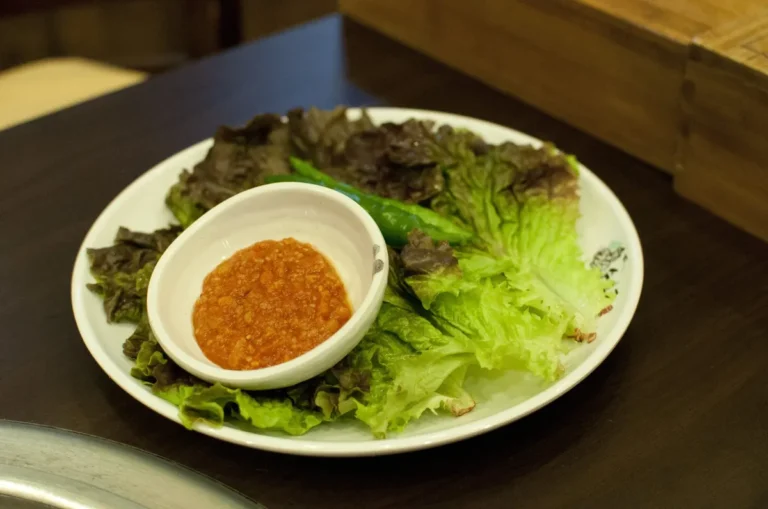
Doenjang is what happens when soybeans are handed over to microorganisms and given enough time to become something entirely different. Mold breaks the proteins apart. Salt filters the microbial community down to what’s useful. Time builds the flavor, layer by layer. The result ends up in a stone pot of doenjang jjigae on a dinner table somewhere. Knowing how it got there changes the way it tastes.
Sodium note: Doenjang is a high-sodium food. One tablespoon (15g) of commercial doenjang contains approximately 700–900mg of sodium. If you have high blood pressure, kidney disease, or any condition requiring sodium restriction, please monitor your intake carefully and speak with your doctor.
This content is for informational purposes only and is not medical advice. The nutritional and fermentation information provided here is general in nature and does not constitute a recommendation to use doenjang to prevent, treat, or cure any disease or health condition. If you have a health concern, consult a qualified medical professional.