Fish Sauce Fermentation: The History and Science of Korean Eoganjang
Fish sauce fermentation is one of the oldest preservation technologies in human history. Salt meets protein, enzymes break bonds, and months of patience produce a liquid so concentrated in umami that a few drops can transform an entire dish.
Korean eoganjang — the peninsula’s own fish sauce tradition — demonstrates this process with particular clarity. Its history stretches back over a thousand years, and the science behind it reveals a fermentation pathway fundamentally different from the lactic acid fermentation of kimchi or the mold-driven fermentation of doenjang.
What Is Fish Sauce Fermentation?
Fish sauce fermentation is not a microbial fermentation in the way that kimchi or yogurt fermentation is. It is primarily an enzymatic process — a slow, salt-mediated breakdown of fish protein into free amino acids and peptides.
When whole fish are packed with a large quantity of salt — typically 20 to 30 percent of the fish’s weight — the high salinity prevents most bacteria from functioning. But the digestive enzymes already present inside the fish’s own organs remain active. These autolytic enzymes, particularly proteases and peptidases, slowly break the fish proteins down into smaller and smaller fragments.
Over months, the solid fish tissue dissolves into a dark, amber liquid rich in free amino acids — especially glutamic acid, the primary compound behind umami taste. The liquid also contains inosinic acid (IMP), a nucleotide that acts synergistically with glutamic acid to multiply the perception of umami several times over.
This is why a small amount of fish sauce can make an entire dish taste more complete. You are not just adding salt. You are triggering a flavor multiplication effect.
The History of Fish Sauce Fermentation in Korea
The practice of fermenting fish in salt on the Korean peninsula predates written records.
Before the Three Kingdoms period: Coastal communities were already salting their catch for storage. Over time, the liquid that seeped from the salted fish was recognized as a seasoning in its own right. This was the origin of what would become eoganjang.
The Samguk Sagi (683 CE): The oldest surviving Korean historical text records that “hae” — a general term for fermented seafood — was included among ceremonial gifts during a royal wedding in Silla. This tells us that fish sauce fermentation was already systematized enough to appear in state rituals during the Three Kingdoms period.
Goryeo dynasty: Jeotgal varieties diversified further, with multiple types of fermented fish and shellfish documented in texts like the Goryeo Dogyeong.
Late Joseon dynasty — the pivotal merger with kimchi: When gochugaru entered kimchi seasoning in the 17th and 18th centuries, it restructured the kimchi flavor system. Fish sauce and jeotgal became the primary umami source in kimchi paste, replacing the soy-based seasonings used previously. This was when the regional specializations — myeolchi aekjeot (anchovy), kkanari aekjeot (sand lance), saeujeot (salted shrimp) — crystallized into the forms used today.
The history of Korean fish sauce fermentation is an evolution from preservation technique to seasoning to essential component of the kimchi ecosystem.
How Fish Sauce Fermentation Works: The Biochemistry
The fermentation process follows a specific biochemical pathway that distinguishes it from other fermentation types.
Enzymatic hydrolysis: Proteases and peptidases from the fish’s digestive organs break proteins into peptides and then into free amino acids. This is autolysis — the fish’s own enzymes digesting its own tissue. The high salt concentration prevents bacterial spoilage while allowing these enzymes to function.
Amino acid accumulation: As hydrolysis progresses, free glutamic acid accumulates in the liquid. This is the primary source of umami in fish sauce. Inosinic acid (IMP), derived from the breakdown of nucleotides in muscle tissue, provides the synergistic umami amplification.
Maillard browning: Over months, amino acids and residual sugars react slowly through non-enzymatic Maillard reactions. This deepens the amber color and generates complex roasted, caramel-like flavor compounds. A six-month fish sauce and a two-year fish sauce differ primarily because of the degree of this reaction.
The role of time: Longer fermentation produces more complete protein breakdown, deeper umami, less fishy odor, and more complex flavor. The reason well-aged fish sauce costs more is not the ingredients. It is the time.
Fish Sauce Fermentation vs. Soy Sauce Fermentation
Both fish sauce and soy sauce are liquid umami seasonings produced through protein breakdown. But the fermentation pathways are fundamentally different.
Soy sauce (ganjang): Mold enzymes (from Aspergillus in koji or meju) break down soy protein. Yeasts and lactic acid bacteria contribute secondary fermentation. The result carries roasted notes, mild sweetness, caramel color, and complex layered aromatics. The primary umami compound is glutamic acid, but inosinic acid is nearly absent.
Fish sauce (eoganjang): The fish’s own internal enzymes drive the process. Because the substrate is animal protein, both glutamic acid and inosinic acid are produced abundantly. The synergistic effect gives fish sauce higher umami intensity per unit volume. But it lacks the layered aromatic complexity of soy sauce.
Korean cuisine developed both traditions in parallel — soy fermentation from inland agricultural culture, fish fermentation from coastal fishing culture. The geography of the peninsula, ocean on three sides with farmland in the interior, provided the conditions to sustain both simultaneously.
Regional Variations in Korean Fish Sauce
Korean fish sauce fermentation is not a single product but a category, and the regional variations reveal the diversity of the tradition.
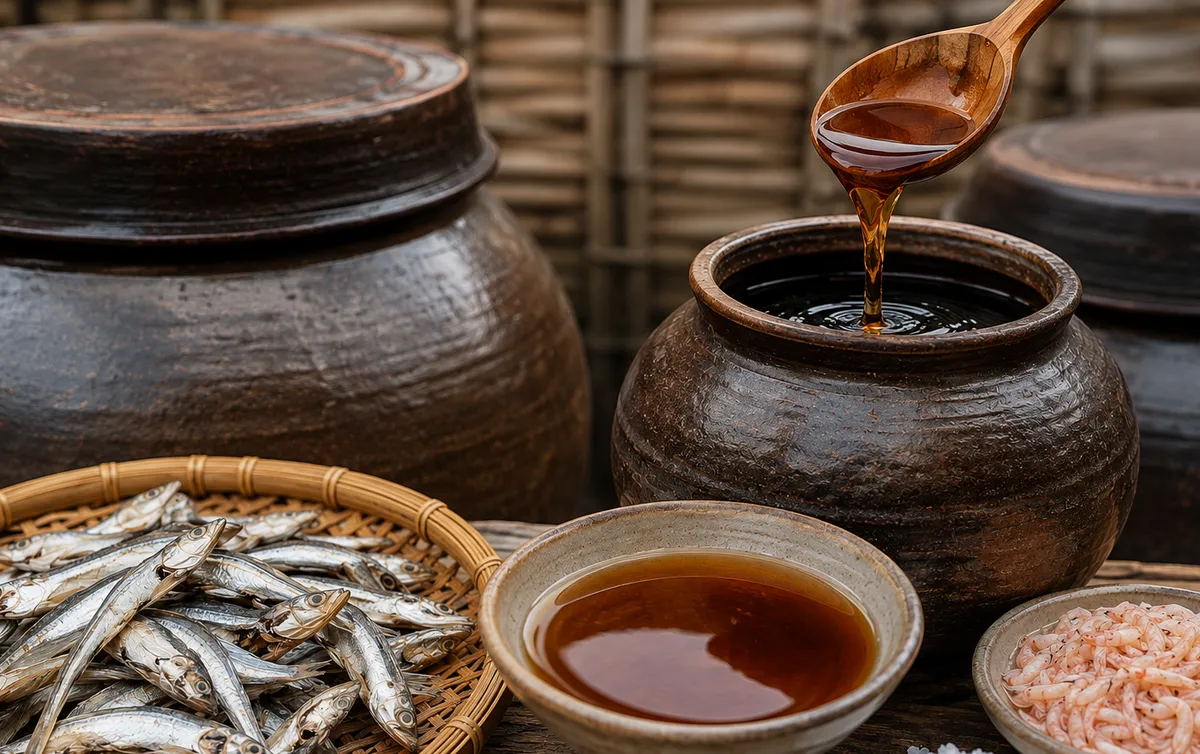
Myeolchi aekjeot (anchovy fish sauce): Produced primarily on the southern coast, especially in Gyeongnam. Anchovies have high protein content, producing strong umami upon breakdown. Fermentation period is six months to two years. This is the primary fish sauce used in kimchi seasoning.
Kkanari aekjeot (sand lance fish sauce): Produced along the western coast, particularly in Chungnam and Jeonbuk. Sand lance has softer flesh and less fat, yielding a milder, slightly sweeter result. Preferred for delicate kimchi varieties like oi sobagi and yeolmu kimchi.
Saeujeot (salted fermented shrimp): Produced across the western coast, with Gwangcheon saeujeot being the most famous. Technically a jeotgal rather than a liquid aekjeot, but it is an essential component of baechu kimchi seasoning. The umami from shrimp protein creates a different flavor texture from anchovy fish sauce.
Other regional variations include galchi sokjeot (hairtail intestine jeotgal) from Jeolla Province and ojingeo jeot (squid jeotgal) from Gangwon Province. The principle is identical — salt plus seafood plus time — but differences in protein composition, fat content, and fermentation temperature produce entirely different results.
The Role of Fish Sauce in Kimchi Fermentation
Fish sauce fermentation intersects with kimchi fermentation in ways that go beyond simple seasoning.
Nitrogen supply: The free amino acids in fish sauce provide an immediately available nitrogen source for the lactic acid bacteria that drive kimchi fermentation. This can accelerate the initial phase of fermentation.
Umami foundation: As kimchi ripens and lactic acid develops sourness, the umami contributed by fish sauce balances the acidity. The deep flavor of well-fermented kimchi emerges at the intersection of lactic acid sourness, fish sauce umami, and gochugaru heat.
Color preservation: Unlike dark soy sauce, fish sauce is nearly translucent with an amber tint. It seasons kimchi without muddying the bright red from gochugaru.
This is why traditional kimchi recipes specify fish sauce rather than soy sauce as the primary umami source. The two fermentation traditions — vegetable lactic acid fermentation and fish enzymatic fermentation — converge in a single dish.
Fish Sauce Fermentation Around the World
Korean eoganjang is part of a global family of fish sauce fermentation traditions that developed independently across widely separated cultures.
Thai nam pla, Vietnamese nuoc mam, Filipino patis — all follow the same fundamental process: enzymatic hydrolysis of fish protein in a high-salt environment. The fish species, salt ratios, and fermentation times differ, but the underlying biochemistry is nearly identical.
Ancient Roman garum was produced by layering fish and salt in stone basins and fermenting in sunlight. The production method was different, but the chemistry — salt-mediated enzymatic protein breakdown producing concentrated liquid umami — was the same.
These cultures had no contact when their fish sauce traditions developed. They arrived at the same solution independently because the biochemistry of protein hydrolysis under high salt works the same way everywhere.
Modern Fish Sauce Production
Most commercially available fish sauce today is industrially produced. Fermentation periods are shorter than traditional methods, and some producers raise temperatures or add enzymes to accelerate protein breakdown. Filtration and pasteurization extend shelf life but eliminate nearly all live microorganisms.
Traditional methods — packing fish in earthenware jars and aging at ambient temperature for one to two years — produce fish sauce with greater flavor complexity. Slow enzymatic breakdown combined with natural environmental conditions generates a more diverse array of flavor compounds.
In recent years, reduced-sodium fish sauce products have emerged. Traditional fish sauce is inherently high in sodium — salt is the essential condition that prevents spoilage and enables enzymatic breakdown. Low-sodium versions sacrifice some flavor depth in exchange for improved health accessibility.
Fish Sauce Fermentation in Korean Food Culture
Korean food culture is often summarized as jang culture — doenjang, ganjang, gochujang. But this framing captures only half the picture.
The fermentation tradition of the Korean peninsula rests on two axes. One is soybean fermentation, born from inland agricultural culture. The other is marine fermentation — fish sauce, jeotgal, and the entire eoganjang tradition — born from coastal fishing culture.
These two axes developed independently before converging in kimchi. Kimchi seasoning combines gochugaru, jeotgal (marine fermentation), and sometimes ganjang (soy fermentation). The reason Korean kimchi is a complex fermented food rather than a simple pickle is that two distinct fermentation traditions meet in one vessel.
To understand fish sauce fermentation is to understand half of Korean fermentation. Doenjang and ganjang alone do not complete the picture.
This content is for informational purposes only and is not medical advice.