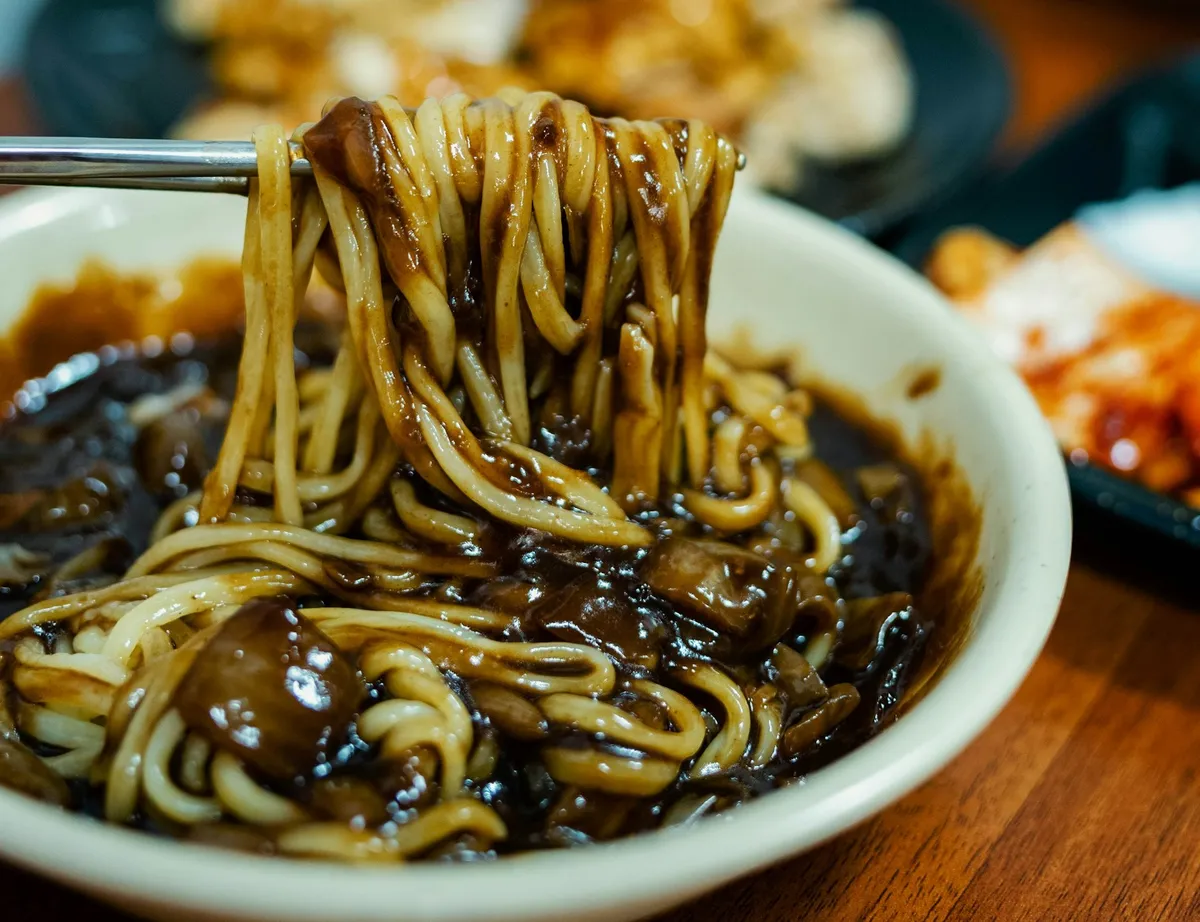
Chunjang: The Fermented Paste Behind Korean Jajangmyeon
There is a good chance you’ve eaten jajangmyeon without ever thinking much about the dark paste that gives the dish its unmistakable flavor.
That black sauce is not simply “Chinese black bean sauce.”
It is chunjang, a distinctly Korean fermented paste that sits at the intersection of fermentation, migration, adaptation, and Korean food culture.
Chunjang has a complicated history. Its roots are connected to Chinese fermented pastes, particularly the wheat-and-soy-based tianmianjiang tradition. But what developed in Korea was not simply a copy of the original.
Over time, the paste changed. Its ingredients, color, flavor, production methods, and culinary role adapted to Korean tastes.
Eventually, it became the defining ingredient of jajangmyeon.
So if you want to understand why Korean jajangmyeon tastes the way it does, you have to start with the fermentation behind the sauce.
What Chunjang Actually Is
Chunjang is a Korean fermented paste made primarily from fermented wheat flour and soybeans, along with salt and coloring ingredients.
It is thick, dark, intensely savory, and slightly sweet. Unlike many fermented pastes that are eaten directly or added to food without further cooking, chunjang is traditionally fried in oil before it becomes part of the final sauce.
That step is essential.
Straight from the container, chunjang can taste harsh, salty, and slightly bitter. Frying changes its character. The paste becomes more aromatic, smoother, and deeper in flavor.
This is why chunjang should not be thought of simply as a black-colored sauce.
It is a fermented ingredient that is transformed again through cooking.
That combination — fermentation followed by frying — is one of the reasons jajangmyeon has such a distinctive flavor.
The Chinese Roots of a Korean Fermented Paste
Chunjang did not originate in Korea in isolation.
Its history is connected to Chinese fermented food traditions that used grains, soybeans, salt, and time to create concentrated seasonings.
One of the closest relatives is tianmianjiang, a sweet fermented wheat-and-soy paste traditionally associated with northern Chinese cuisine.
Chinese immigrants, particularly people from Shandong, played an important role in bringing Chinese culinary traditions to Korea during the late nineteenth and early twentieth centuries.
Incheon was especially important.
After the opening of Incheon Port in 1883, a Chinese community developed around the port, and Chinese restaurants began serving dishes adapted to local tastes.
Jajangmyeon eventually emerged from this environment.
The dish that became Korean jajangmyeon was not identical to the Chinese zhajiangmian tradition. It changed as Chinese restaurant cooks adapted their food to Korean ingredients, customers, and eating habits.
The fermented paste changed along with it.
That is an important point in the history of fermentation.
Fermentation does not remain fixed when it crosses a border.
A fermentation tradition can move with people, encounter different ingredients and climates, and gradually become something new.
Chunjang is one example of that process.
From Tianmianjiang to Chunjang
It is tempting to describe chunjang simply as the Korean version of Chinese black bean paste.
That description is too simple.
Chinese fermented bean products are not one single category. Douchi, doubanjiang, tianmianjiang, and other fermented pastes are made from different ingredients and used in completely different ways.
Douchi consists of salted, fermented black soybeans and is usually used as a strongly flavored seasoning.
Doubanjiang is a spicy fermented paste traditionally made with broad beans and chili peppers. Its red color and spicy flavor make it fundamentally different from chunjang.
Tianmianjiang is much closer to chunjang. It is a sweet-savory fermented paste based on wheat and soybeans and has a deep fermented flavor.
But chunjang developed its own identity in Korea.
Modern Korean chunjang is darker, more intensely colored, and specifically associated with the Korean jajangmyeon style.
In other words, the important story is not simply where chunjang came from.
It is what happened to the fermentation tradition after it arrived in Korea.
What Happens During Fermentation?
This is where chunjang becomes particularly interesting from a fermentation perspective.
Fermentation transforms the original ingredients.
Proteins in soybeans and other raw materials are gradually broken down into smaller compounds, including peptides and amino acids.
Carbohydrates are also transformed during fermentation, contributing to the development of acids, alcohols, and other flavor compounds depending on the microorganisms and production conditions involved.
These chemical changes are responsible for much of the characteristic depth found in fermented pastes.
One of the most important results is the accumulation of amino acids associated with savory flavor.
Instead of tasting simply like flour, soybeans, and salt, a properly fermented paste develops layers of umami, aroma, sweetness, acidity, and roasted or earthy notes.
This is the basic logic behind fermented seasonings around the world.
Time turns relatively simple ingredients into something much more complex.
But fermentation is not the only transformation chunjang undergoes.
Cooking changes it again.
Why Chunjang Is Fried Before Use
Ask someone how to make jajangmyeon and they may tell you to add the chunjang to the pork and vegetables.
That misses one of the most important steps.
Chunjang is normally fried in oil first.
When the paste is heated, several things happen at once.
Moisture evaporates.
The paste becomes more concentrated.
Harsh fermented notes become less noticeable.
And heat-driven reactions create new aroma compounds.
The Maillard reaction can contribute roasted and nutty aromas when proteins and sugars are exposed to sufficient heat.
The result is a completely different ingredient from the raw paste.
This is why the traditional technique is not simply a matter of convenience.
Fermentation creates the foundation of chunjang’s flavor. Frying reshapes that flavor into the form used in jajangmyeon.
The process can be thought of as two stages:
Fermentation → complex flavor
Frying → roasted, concentrated flavor
That combination is what gives Korean jajangmyeon its characteristic depth.
Chunjang and Jajangmyeon
Jajangmyeon is probably the most famous food made with chunjang, but the relationship between the two is more interesting than simply saying that one is an ingredient in the other.
Jajangmyeon helped turn chunjang into a defining Korean pantry ingredient.
The sauce typically combines fried chunjang with pork, onions, zucchini or other vegetables, water or stock, and a small amount of sugar.
The onion is particularly important.
As onions cook, their natural sugars become more pronounced and help balance the strong savory and fermented character of the chunjang.
The result is a sauce that is simultaneously salty, savory, sweet, aromatic, and deeply fermented.
The noodles then provide a relatively neutral starch base that carries all of those flavors.
This is why the dark color of jajangmyeon can be misleading.
The sauce looks heavy and intensely salty, but its flavor is more complicated than its appearance suggests.
Why Chinese Black Bean Sauce Is Not a Direct Substitute
This distinction matters when cooking at home.
A bottle labeled “black bean sauce” in an Asian grocery store is not necessarily chunjang.
It may contain douchi, wheat, soybeans, sugar, starch, or other ingredients, depending on the manufacturer and the culinary tradition behind it.
Some Chinese black bean sauces are designed as ready-to-use sauces.
Chunjang is different.
It is a fermented paste designed to be incorporated into a Korean-style cooking process, particularly the frying step that precedes the final sauce.
Using the wrong product can therefore produce a sauce that is too sweet, too thin, too salty, or simply lacking the characteristic roasted depth of Korean jajangmyeon.
The important lesson is broader than jajangmyeon:
Fermented foods that look similar are not necessarily interchangeable.
Their ingredients, microorganisms, salt levels, fermentation conditions, and intended cooking methods can be completely different.
Chunjang as an Example of Fermentation Culture
There is a larger story behind chunjang.
Fermentation is often described as a traditional technique for preserving food.
That is true, but preservation is only the beginning.
Fermentation also creates new flavors and gives communities the ability to transform ordinary agricultural ingredients into highly concentrated seasonings.
Soybeans, wheat, and salt can become something that is almost unrecognizable compared with the original ingredients.
When that technology moves from one culture to another, the process does not necessarily remain unchanged.
People adapt it.
They change the ingredients.
They change the flavor.
They change the way the finished product is used.
Eventually, a food with foreign roots can become completely integrated into a new food culture.
Chunjang is a particularly clear example.
Its history connects Chinese fermentation traditions with Korean food culture, while jajangmyeon represents the culinary result of that transformation.
Fermented Does Not Automatically Mean Healthy
Because chunjang is fermented, it is sometimes tempting to treat it as a health food.
That would be an oversimplification.
Fermented soybean products can contain peptides, amino acids, and other compounds generated during fermentation, and fermented foods are an active area of research in relation to the gut microbiome and metabolic health.
But the presence of fermentation does not automatically make a food healthy.
Chunjang is also relatively high in sodium.
And because jajangmyeon combines chunjang with noodles and a substantial amount of sauce, a single serving can contribute a significant amount of sodium to the diet.
The useful distinction is simple:
Fermentation changes food. It does not automatically make every fermented food a health food.
Chunjang is best understood first as a fermented culinary ingredient, not as a supplement or medicine.
How to Use Chunjang Properly
If you are making jajangmyeon at home, the most important technique is simple.
Fry the chunjang in oil over medium heat for a few minutes before combining it with the meat and vegetables.
Do not burn it.
The goal is to develop aroma and reduce the harsher raw flavor, not to scorch the paste.
After frying, combine it with cooked pork and vegetables, add water or stock, and simmer until the sauce reaches the desired consistency.
Potato starch or cornstarch can then be used to thicken the sauce.
Serve immediately over cooked wheat noodles.
The noodles absorb the sauce quickly, so jajangmyeon is best eaten as soon as it is prepared.
The Bigger Story Behind the Black Sauce
Chunjang may look like a simple black paste sitting in a plastic container.
It is not.
It represents several layers of food history at once.
It carries the legacy of Chinese fermentation traditions.
It reflects the movement of people and food through Incheon.
It shows how an imported food can be adapted to a new culture.
And it demonstrates how fermentation can transform basic ingredients into a complex seasoning that eventually becomes central to an entirely different cuisine.
Most importantly, chunjang reminds us that fermentation is not a collection of isolated traditional foods.
It is a living technology.
It travels.
It changes.
And sometimes, after crossing a border and adapting to a new culture, it becomes something that belongs to its new home.
That is what happened with chunjang.
The black sauce on a bowl of Korean jajangmyeon is not simply a condiment.
It is the end result of fermentation, migration, adaptation, and generations of Korean cooking.
This content is for informational purposes only and is not medical advice.