Fermentation and Health – What Science Actually Proves
Korean Fermentation and Health: What Science Actually Proves
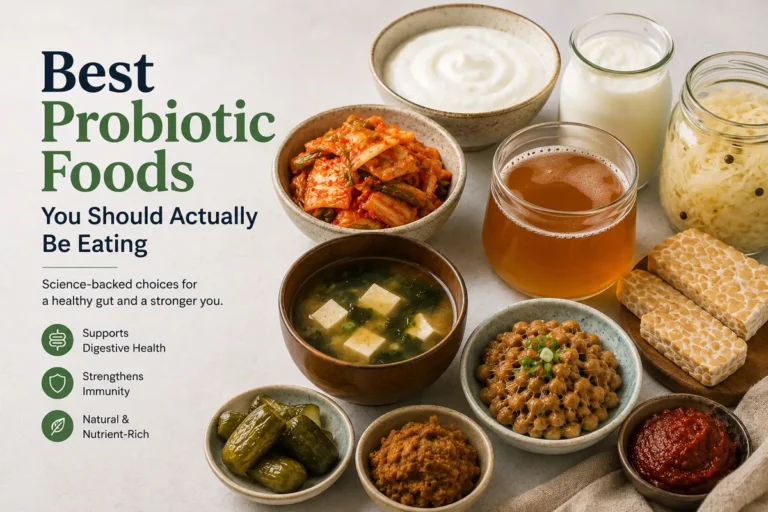
Fermented foods have a reputation problem. The wellness industry overpromises, and the science community stays cautious. The truth sits in between — and for Korean fermented foods specifically, there is more solid research than most people expect.
Let’s talk about what we actually know.
The Gut Microbiome Story Is Real, But Complicated
Start here: your gut contains a huge community of microorganisms. The composition and activity of that community – your gut microbiome – are involved in digestion, immune signaling, and metabolism. Researchers are also studying links between the microbiome and the nervous system. That much is well established. Where it gets complicated is the question of how much fermented food actually shifts that ecosystem in meaningful, lasting ways.
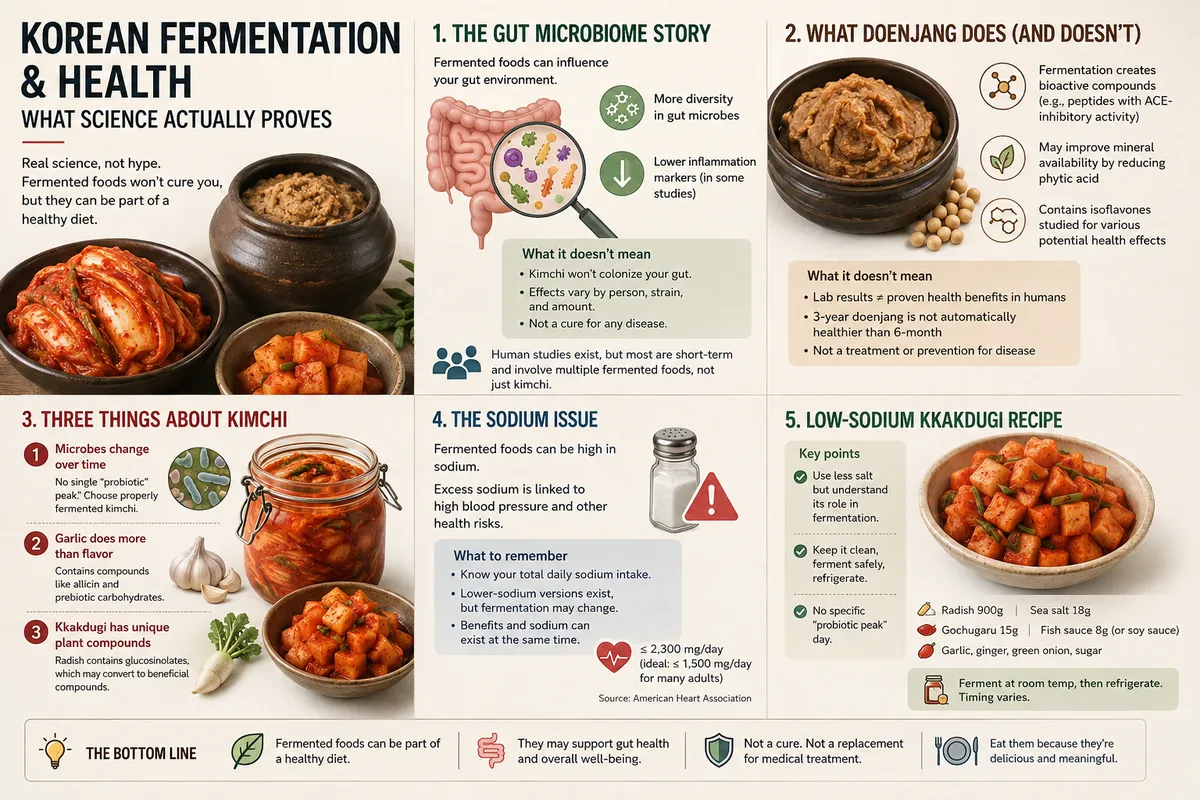
A landmark 2021 study published in Cell compared a high-fiber diet with a high-fermented-food diet over ten weeks. The fermented-food group – eating foods such as yogurt, kimchi, and fermented vegetables – showed an increase in microbiome diversity and reductions in several markers of inflammation. That’s significant. But it’s also important not to oversell what the study showed.
It can’t tell you that kimchi specifically caused those changes, how long the changes lasted after people stopped eating fermented foods, or whether the changes translated into lower rates of any particular disease. The study was also relatively small and lasted only ten weeks.
What we can say is that fermented foods can contain live microorganisms, including lactic acid bacteria. Kimchi commonly contains members of the Leuconostoc, Lactobacillus, and Weissella groups, although the exact microbial population varies considerably depending on the ingredients, salt concentration, temperature, fermentation time, and storage conditions.
Eating kimchi means you may consume these microorganisms. That does not mean they permanently colonize your gut. Some may survive passage through the digestive tract for a time, while others may not. Their effects depend on the strain, the food matrix, the amount consumed, and the person eating it.
According to the National Institutes of Health, probiotics have a generally good safety record in healthy people, but their effects vary significantly depending on the strain and the individual.
The honest translation: eating well-fermented baechu kimchi, doenjang, and other fermented foods may support a healthy diet and may influence the gut environment. It won’t cure anything. It might help.
What Doenjang Actually Does (And Doesn’t Do)
Doenjang – fermented soybean paste – gets serious attention in Korean nutritional research. And it earns some of it.
The fermentation process changes soybeans in ways that raw soybeans do not have. During fermentation, microorganisms break down proteins and other components of the soybean, producing peptides and other metabolites. Some of these peptides have shown ACE-inhibitory activity in laboratory studies. In other words, they can interfere with an enzyme involved in blood-pressure regulation.
That sounds impressive until you remember the important part: in laboratory studies.
Showing ACE-inhibitory activity in a test tube does not mean eating a spoonful of doenjang lowers blood pressure in a person. Human evidence is much more complicated, and the jump from a laboratory mechanism to a clinical effect is enormous.
Fermentation can also reduce certain anti-nutritional compounds such as phytic acid. That may improve the potential bioavailability of some minerals, but the actual nutritional effect depends on the food, the fermentation process, the overall diet, and the amount consumed. So it is more accurate to say fermentation can improve mineral availability than to claim that fermented soybean foods automatically deliver more usable minerals.
Doenjang also contains isoflavones, including genistein and daidzein. These compounds have been studied for possible effects on bone health, cardiovascular health, and other aspects of human health. The evidence is mixed, and eating doenjang should not be treated as a way to prevent or manage a disease.
One thing worth remembering: traditional fermentation can produce a different chemical profile from shorter or industrial fermentation. Longer fermentation can change the concentration of peptides, amino acids, sugars, organic acids, and other metabolites. But that does not automatically make a three-year-old doenjang “healthier” than a six-month-old product. The evidence is not strong enough to make that claim.
Three Things You Probably Didn’t Know About Kimchi
Here’s where we get specific. Most people know kimchi contains live microorganisms. Fewer people know these things:
1. The microbial population changes dramatically during fermentation – and when you eat it changes what you’re getting.
Freshly made kimchi starts with a relatively diverse microbial population. As fermentation progresses, lactic acid bacteria become increasingly dominant. Studies of kimchi fermentation have found major changes in the abundance of Leuconostoc, Lactobacillus, Weissella, and other microorganisms over time.
But there is no single universal “probiotic peak” that applies to every kimchi.
Temperature, salt concentration, ingredients, acidity, storage conditions, and the starting microorganisms all matter. Some bacterial populations increase while others decline. Even after the kimchi becomes quite sour, viable lactic acid bacteria can still be present.
So if you’re eating kimchi specifically for live microorganisms, the more useful rule is simple: choose properly fermented kimchi that has been stored appropriately rather than chasing a specific fermentation day.
2. The garlic in kimchi may do more than provide flavor.
Garlic contains a range of biologically active compounds. Allicin, which forms when garlic is crushed or damaged, is one of the best studied. It has antimicrobial and other biological activities, although much of the evidence comes from laboratory and experimental research.
Garlic also contains carbohydrates such as fructans that can interact with the gut microbiota. But calling allicin itself a “prebiotic” is too simplistic. Allicin and prebiotic carbohydrates are not the same thing.
So the garlic in baechu kimchi isn’t just seasoning. It contributes its own collection of plant compounds to the food, some of which may have biological effects.
3. Kkakdugi may offer a different collection of plant compounds than baechu kimchi.
The radish in kkakdugi belongs to the cruciferous vegetable family and contains glucosinolate compounds. These compounds can be converted into other biologically active substances, including isothiocyanates, depending on the plant enzymes, microorganisms, and processing conditions.
These compounds are being studied for potential anti-inflammatory and other biological effects. But this is an area where the chemistry is much stronger than the human clinical evidence.
You’re not just getting “fermentation benefits.” You’re also eating a vegetable, garlic, ginger, red pepper, and other ingredients, each with its own nutritional and phytochemical profile.
The Sodium Issue – We Have to Talk About It
Here’s the thing about kimchi and doenjang that wellness content almost always glosses over: they can be high in sodium.
The exact amount varies enormously depending on the recipe and the product. Kimchi can contain several hundred milligrams of sodium per 100 grams, while doenjang can be particularly concentrated because it is a salty fermented paste.
The American Heart Association recommends no more than 2,300 milligrams of sodium per day for most adults, with an ideal limit of 1,500 milligrams for many adults, particularly those who need to manage blood pressure.
If you’re eating kimchi several times a day, the sodium can add up quickly – especially when the rest of the meal includes soup, stew, soy sauce, gochujang, or other salty foods.
This doesn’t mean stop eating kimchi.
It means be aware.
If you’re managing blood pressure or trying to reduce sodium intake, the total sodium content of your diet matters more than whether one particular fermented food is “healthy.” Lower-sodium versions can be made, but reducing salt also changes the fermentation environment, so it should not be assumed that you can simply cut the salt dramatically without changing the fermentation process.
The potential benefits of fermented foods and the sodium issue exist simultaneously. Neither cancels out the other. You hold both.
Reducing the salt in a ferment changes the microbial environment, not just the taste, so a lower-sodium version behaves differently rather than simply tasting milder. If you want to try it, our kkakdugi recipe is the place to start, with less salt and a shorter time at room temperature.
What to Actually Take Away From All of This
The science of Korean fermented foods is real science. It’s not fraudulent, and the interest from researchers worldwide isn’t misplaced. What it is, is still developing.
Fermentation clearly changes food. It can alter proteins, carbohydrates, fats, vitamins, minerals, phytochemicals, and other compounds. It can also produce new metabolites and change the microorganisms present in the food. Some of those changes may be nutritionally or biologically useful.
What some human studies suggest is that regular consumption of certain fermented foods may influence the gut microbiome and may improve some aspects of gastrointestinal wellbeing. A recent systematic review and meta-analysis found potential improvements in bowel movements, stool consistency, gastrointestinal symptoms, and intestinal transit time, but the certainty of evidence varied and was often low.
What the science does not support yet is the idea that all fermented foods are automatically healthy, that every fermented food works through probiotics, or that eating kimchi, doenjang, or gochujang can treat a specific disease.
The evidence is especially uneven when you move from fermented dairy products, which have been studied relatively extensively, to individual Korean foods such as kimchi and doenjang. Reviews have repeatedly pointed out that high-quality human trials are still limited for many fermented foods.
What the science doesn’t support yet: treating any specific disease with kimchi. Using doenjang to manage a diagnosed condition. Skipping a doctor because you eat a lot of gochujang.
Eat fermented foods because they’re genuinely interesting. Because the process of turning salted vegetables, soybeans, milk, or grains into something chemically and biologically different is remarkable. Because they taste good in a way that nothing else quite replicates. And because there is credible – although still incomplete – evidence that some fermented foods can contribute to a healthy diet and may benefit aspects of gut health.
Just don’t eat them instead of medicine.
And watch the sodium.
This content is for informational purposes only and is not medical advice.