What Happens When You Eat Doenjang Soup Every Day
There’s something quietly reassuring about a bowl of doenjang-guk on the table. The deep, savory smell of fermented soybean soup bubbling in an earthenware pot — it’s the kind of food that carries memory in it. For many Koreans, it’s the scent of a grandmother’s kitchen. But what does eating it every day actually do for you? The honest answer is more interesting than the usual “superfood” story — and more limited.
This article separates what fermentation reliably does to soybeans from what has actually been shown in people — because those are not the same thing.
Note: This article is for informational purposes only and does not constitute medical advice. Consult a healthcare professional for personal dietary guidance.
Doenjang: Thousands of Years of Fermentation Wisdom
Doenjang’s history stretches back to the Three Kingdoms period. The Samguk Sagi — one of Korea’s oldest historical chronicles — records that fermented soybean paste (jang, 醬) was included among the ceremonial gifts at the wedding of King Sinmun of Silla in 683 CE. By the Joseon Dynasty, methods for making doenjang were being documented in detail in household texts like Gyuhap Chongseo and Eumsik dimibang. It wasn’t a condiment. It was a staple.
What sets Korean doenjang apart from Japanese miso (味噌) or Chinese doubanjiang (豆瓣醬) is its fermentation method. The key is meju — dense blocks of cooked soybeans that are tied with rice straw and hung to ferment naturally. The rice straw carries Bacillus subtilis, which colonizes the meju surface along with other airborne microorganisms. This wild, uncontrolled fermentation is exactly what gives Korean doenjang its distinctive depth of flavor and functional complexity that you simply can’t replicate with a controlled starter culture.
The Science of Doenjang Fermentation: Microbes and Enzymes Working Together
Doenjang fermentation happens in two broad stages. First, during the meju phase, bacteria — primarily Bacillus subtilis — break down the soy proteins. Then, during the brining and aging phase, meju blocks are submerged in saltwater, and the solids are eventually separated into doenjang and ganjang (soy sauce). At this stage, molds from the Aspergillus family, lactic acid bacteria, and yeasts all join in, creating a layered microbial ecosystem.
All that protein breakdown produces amino acids — and that’s the source of doenjang’s rich, savory umami. Glutamic acid levels in particular climb higher with longer aging. Free amino acids generally increase as doenjang ages, which is why older doenjang tastes deeper and rounder. Keep the quantity in perspective, though: a bowl of soup uses only a tablespoon or two of paste, so doenjang works as a flavor base rather than a major protein source.
Fermentation also transforms the isoflavones in soybeans. In raw soybeans, isoflavones are bound to sugars in glycoside form, which limits how well the body absorbs them. During fermentation, they’re converted into free aglycone forms — daidzein and genistein — which some human studies found are absorbed faster and in higher amounts than the sugar-bound forms (Izumi et al., 2000). Other studies found little difference, so the size of this advantage is still debated.
What Changes in Your Body When You Eat Doenjang Soup Daily
1. Regular Exposure to Fermentation Microbes — With a Catch
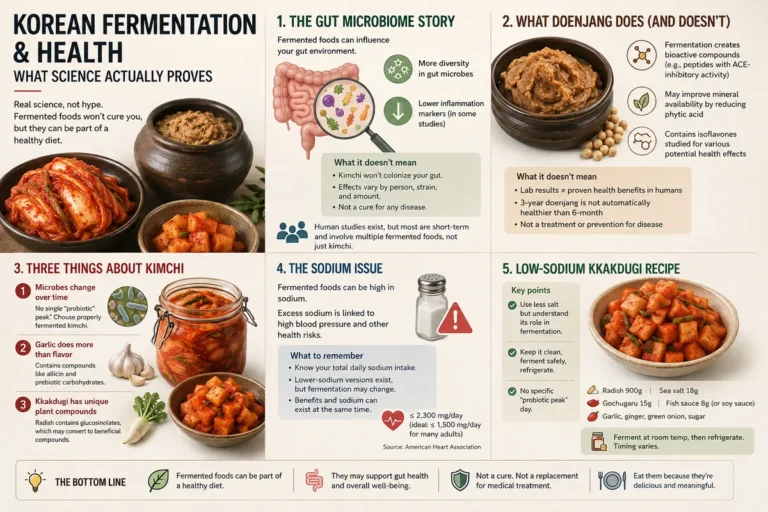
Traditionally made, unpasteurized doenjang contains Bacillus species and other microbes from fermentation. But doenjang soup is simmered, and heat kills many of those organisms before the bowl reaches the table. What reaches your gut is a mix of fermentation byproducts, soybean fiber, and whatever vegetables are in the soup. Human studies measuring what daily doenjang does to the gut microbiome are limited, so it is more accurate to call doenjang soup a gut-friendly traditional food than to promise a specific change in your gut bacteria.
2. Antioxidant Compounds — Measured in the Lab
Doenjang contains compounds with antioxidant activity, including isoflavones and melanoidins — the brown pigments formed through the Maillard reaction during long aging. Laboratory tests generally show antioxidant activity rising as doenjang darkens and ages. What those test-tube results mean inside the human body is much less clear, so treat this as a property of the food, not a proven anti-aging effect.
3. The Immune Question
Doenjang is often described as immune-boosting. The evidence behind that idea comes mostly from cell and animal studies of fermented soybean compounds — including poly-γ-glutamic acid, which is produced mainly by Bacillus fermentation and is far more characteristic of cheonggukjang and natto than of doenjang. There is no good human evidence that eating doenjang soup prevents colds or measurably strengthens immunity. If regular doenjang soup helps, it is more likely through the overall eating pattern — vegetables, legumes, home-cooked meals — than through doenjang alone.
4. Heart Health: Start With the Sodium
Soy isoflavones have been studied for effects on cholesterol and blood vessel function, with mixed results. For doenjang, the most important cardiovascular fact is simpler: traditional doenjang contains several thousand milligrams of sodium per 100g — far more than its potassium. Some Japanese research on miso soup is more encouraging than its salt content would suggest; one intervention study reported lower nighttime blood pressure after long-term miso soup intake (Hypertension Research, 2019). That is one study, on miso rather than doenjang, and it is not a reason to ignore salt.
Doenjang Nutrition at a Glance (Per 100g)
| Nutrient | Amount | Key Function |
|---|---|---|
| Protein | ~12–14g | Muscle synthesis, enzyme production |
| Isoflavones | ~30–50mg | Antioxidant, estrogen-like activity |
| Potassium | ~400–500mg | Blood pressure regulation, sodium excretion |
| Sodium | ~3,500–4,500mg | Electrolyte balance (watch intake — high) |
| Dietary Fiber | ~5–7g | Gut health, blood sugar regulation |
| Vitamin B2 | ~0.2mg | Energy metabolism support |
Typical ranges only — values vary widely by brand, recipe, and aging time.
Important: Doenjang is high in sodium. If you are managing hypertension or a salt-restricted diet, speak with your doctor before making doenjang soup a daily habit. Using it as a seasoning in a diluted soup form, rather than eating the paste directly, helps moderate intake.
A Simple Daily Doenjang Soup Recipe
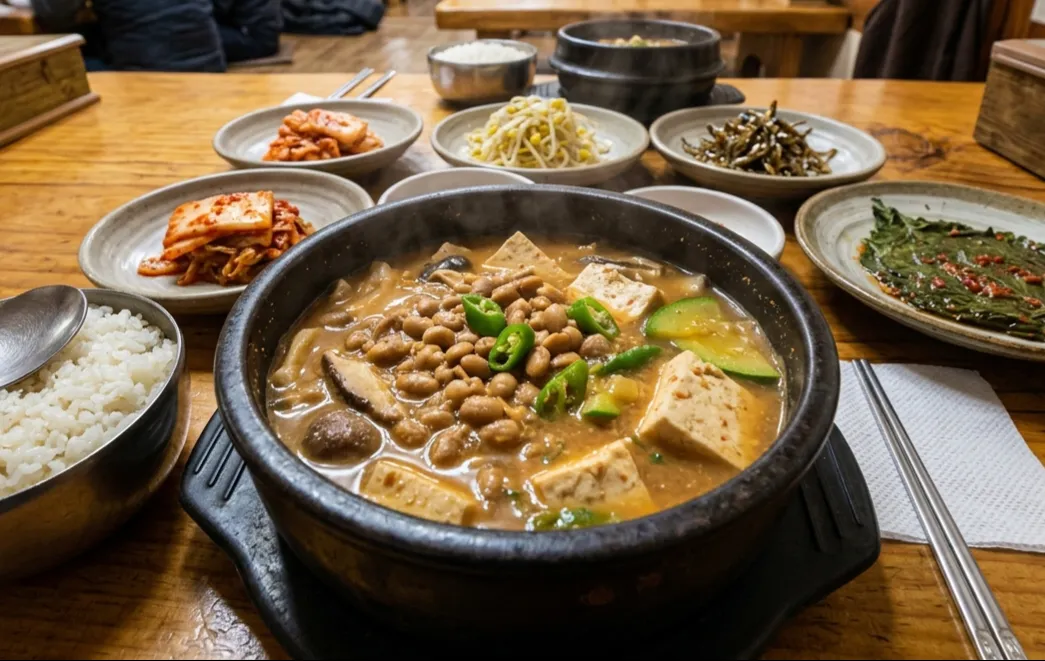
Tofu and Shiitake Doenjang-Guk (Serves 2)
Ingredients
- 2 tablespoons traditional doenjang (about 40g)
- ½ block firm tofu (about 150g)
- 2 shiitake mushrooms
- ¼ zucchini (Korean aehobak if available)
- ⅓ stalk green onion
- 500ml dashima (kelp) or anchovy broth
- ½ teaspoon minced garlic
- ½ teaspoon guk-ganjang / soup soy sauce (optional)
Instructions
- Cut the tofu into 2cm cubes. Remove the stems from the shiitake mushrooms and slice them 0.5cm thick.
- Slice the zucchini into half-moon shapes. Cut the green onion on the diagonal.
- Pour the broth into a pot and bring to a medium boil. Once boiling, strain the doenjang through a fine mesh sieve directly into the pot. Straining removes any chunks and gives you a clean, smooth broth.
- When the soup returns to a boil, add the shiitake mushrooms and zucchini. Cook for 3 minutes.
- Add the tofu and minced garlic. Reduce heat to low and cook for another 2 minutes. Add the tofu last — overcooking makes it rubbery.
- Just before turning off the heat, add the green onion and taste. If it needs more depth, add a splash of soup soy sauce.
- Serve immediately in an earthenware bowl (ttukbaegi) for the best flavor and heat retention.
Shiitake mushrooms are rich in guanylic acid, which creates a synergistic umami effect with the glutamic acid already present in doenjang — the combination is significantly more savory than either ingredient alone. Tofu shares the same soybean base as doenjang but is unfermented, which means it delivers different forms of soy protein and isoflavones. Together, they complement each other beautifully.
Tips for Getting the Most Out of Your Daily Bowl
- Add doenjang after the broth boils, not before. Long boiling dulls doenjang’s aroma and kills most of its live microbes. Dissolving it into already-hot broth and keeping the simmer short gives better flavor — just don’t expect a simmered soup to be a meaningful probiotic source.
- Choose traditional, unpasteurized doenjang. Many commercial doenjang products are heat-pasteurized, which kills most of the live cultures. Look for traditionally made doenjang (jaerae doenjang) that hasn’t been sterilized if you want more of its original fermentation character — and eat some of it uncooked, for example in ssamjang, if live cultures are what you’re after.
- Load it with seasonal vegetables. Spinach, chard, shepherd’s purse (naengi), or mallow (auk) all work beautifully in doenjang soup and add vitamins and dietary fiber that round out the nutritional profile.
A daily bowl of doenjang soup is not medicine. What it can be is a cheap, vegetable-heavy, deeply savory habit that fits well into a healthy diet — as long as the sodium fits too. That is a smaller claim than most articles make, but it is one the evidence can actually support.
References
- Izumi T, et al. (2000). Soy isoflavone aglycones are absorbed faster and in higher amounts than their glucosides in humans. Journal of Nutrition, 130(7), 1695–1699. PubMed
- Long-term intake of miso soup decreases nighttime blood pressure in subjects with high-normal blood pressure or stage I hypertension. Hypertension Research (2019). Nature
- World Health Organization. Salt reduction fact sheet. WHO