Fermented vs. Pickled: What’s the Difference?
Here is a simple experiment you can do in your own kitchen.
Take two clean jars. Put the same fresh cucumbers in each one.
Fill the first jar with vinegar, water, and a little salt.
Fill the second jar with salt water only. No vinegar at all.
Close both jars and leave them on the counter for a few days.
The first jar does not do much. The water stays clear. The cucumbers taste sour almost right away, because you poured something sour in.
The second jar is different. After a day or two, the water turns cloudy. Tiny bubbles rise to the top. The smell changes. And slowly, the cucumbers turn sour, even though you never added anything sour.
At the end, both jars hold sour cucumbers. People call both of them pickles.
But only one of them fermented.
In the first jar, you made the sourness. In the second jar, something alive made it.
The Short Answer
Pickling means keeping food in something sour or salty so it lasts longer. It is a general word for a way of preserving food.
Fermentation means letting tiny living things, called microbes, change the food. You can’t see them, but they are working the whole time.
So you can make a pickle in two ways:
- Vinegar pickles are sour from the start, because you add acid.
- Fermented pickles start out salty, not sour. They become sour on their own, because bacteria make the acid.
That is the whole difference. Every fermented vegetable is a kind of pickle. But not every pickle is fermented.
Scientists agree on this point. An international group of fermentation researchers wrote that food made just by adding vinegar should not be called fermented.
What Happens Inside the Salt-Water Jar
Every vegetable carries tiny bacteria on its skin. You can wash it, and most of them stay. That is normal.
When you put the vegetable in salt water, the salt acts like a gatekeeper. Many of the bacteria that make food go bad can’t handle much salt. But one helpful group can. They are called lactic acid bacteria.
These bacteria eat the natural sugar inside the cucumber. As they eat, they make lactic acid. It is the same kind of acid that makes yogurt taste sour.
Little by little, the acid builds up. The jar gets more sour every day. Soon it becomes too sour for the bad bacteria to grow at all. The good bacteria have taken over the jar and protected the food.
What you saw in the jar has simple explanations:
- The cloudy water is millions of bacteria growing.
- The bubbles are gas the bacteria give off as they eat.
- The sour taste is the acid they make.
This is exactly what happens in sauerkraut and in kimchi. Different vegetables, different seasoning, the same basic process.
What Happens Inside the Vinegar Jar
Vinegar is already a strong acid. When you pour it over cucumbers, the jar is sour from the very first minute.
Almost nothing can grow in it. No bacteria take over, because the vinegar leaves them no room. The cucumber simply soaks up the sour taste and the spices around it.
That makes vinegar pickles fast and very predictable. You can eat them the next day, and every batch tastes about the same.
Here is a small twist. Vinegar itself is made by fermentation. Bacteria turn alcohol into vinegar. But that happened in a factory, long before the bottle reached your kitchen. Nothing in your pickle jar is fermenting.
Side by Side
| Vinegar pickles | Fermented pickles | |
|---|---|---|
| Where the sour taste comes from | Vinegar you add | Acid made by bacteria |
| How long it takes | Hours to a day | Days to weeks |
| Taste | Sharp, clean, sour | Rounder, deeper, a little funky |
| The liquid | Usually clear | Usually cloudy |
| Living bacteria inside | No | Yes, unless heated afterwards |
| Examples | Most shelf-stable dill pickles, pickled onions, quick pickles | Kimchi, sauerkraut, traditional dill pickles |
How to Tell Which One You’re Buying
At the store, a few simple clues help.
- Read the ingredients. If vinegar is on the list, the pickle is almost certainly a vinegar pickle.
- Look at where it’s kept. Jars sold on a normal shelf at room temperature are usually made with vinegar, heated, or both. Fermented pickles with live bacteria are usually in the refrigerator.
- Look for the words. “Naturally fermented,” “raw,” or “live cultures” point to fermentation.
- Look at the liquid. Cloudy brine with a little sediment at the bottom is a good sign of fermentation. Crystal-clear liquid usually means vinegar.
One small catch. Some foods are fermented first and then heated to make them last longer on the shelf. They are still fermented foods. They just no longer contain living bacteria.
Where Kimchi Fits
Kimchi is a fermented pickle. Salted cabbage and seasoning go into a jar, and lactic acid bacteria do the souring. Traditional kimchi has no vinegar in it. Its sour taste comes entirely from fermentation, and it keeps getting more sour the longer it sits.
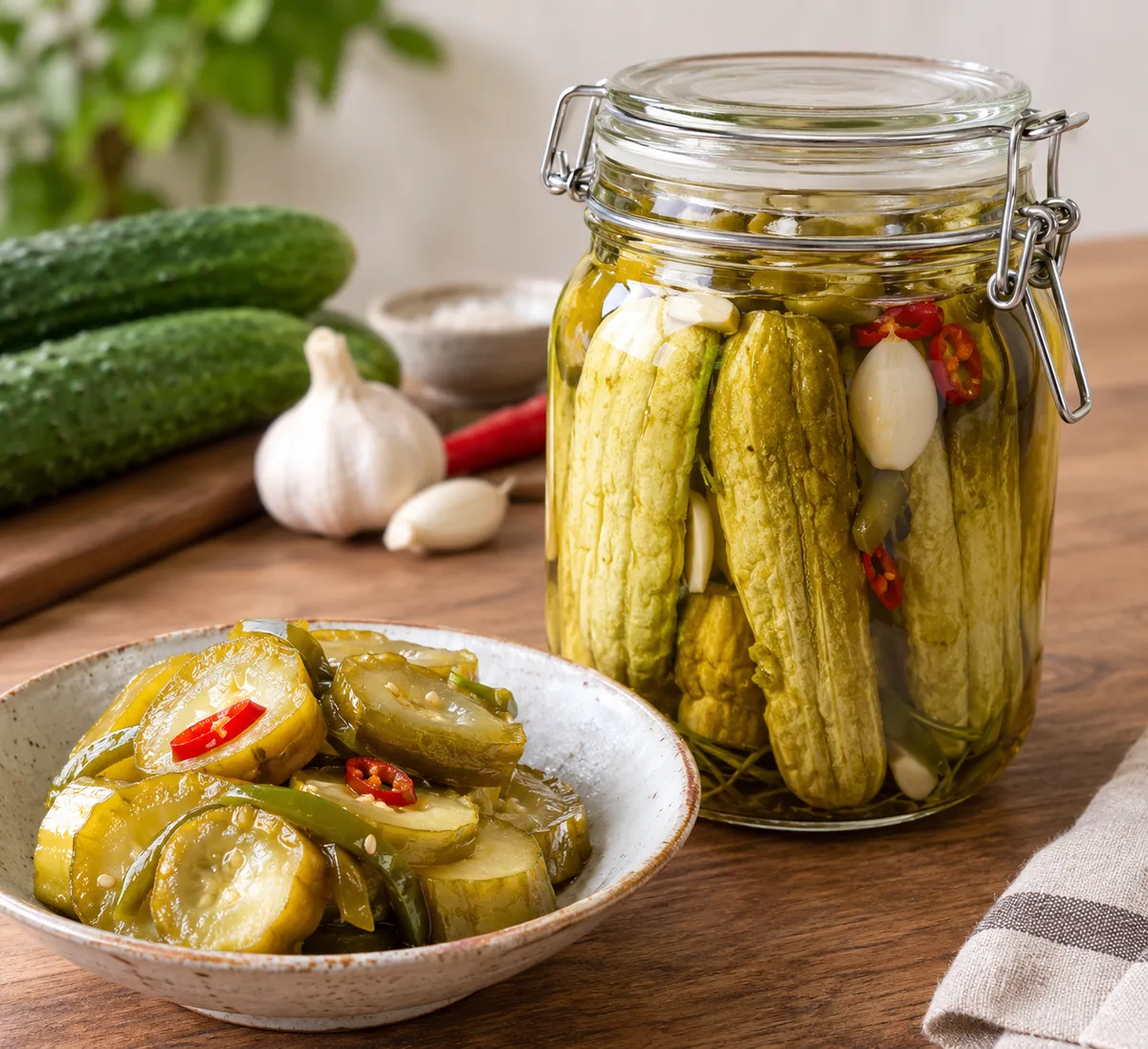
Korea also has its own version of the salt-water jar from the experiment at the top of this article. It is called oiji. Whole cucumbers are packed into a jar and covered with boiled salt water, with no vinegar at all. Over the following days and weeks, lactic acid bacteria sour them, and the cucumbers turn yellow, wrinkled, and pleasantly tangy. Oiji is usually sliced and soaked in water to take out some of the salt, then served cold or squeezed dry and seasoned as a side dish.
One thing to watch for: some modern quick oiji recipes add vinegar and sugar to speed things up. Those are closer to a vinegar pickle. Traditional oiji is salt, water, cucumbers, and time.
Korean cooking has vinegar-style pickles too. Many kinds of jangajji are made by soaking vegetables in soy sauce, sometimes with vinegar added. These work more like a pickle than like kimchi.
So a Korean table often shows both sides of this story on the same day.
Is One Better Than the Other?
Not better. Different.
Vinegar pickles are quick, simple, and very consistent. They are a good choice when you want something crunchy and sharp without waiting.
Fermented pickles take patience. In return, they develop a deeper, more layered flavor, and if they are not heated, they contain living bacteria. That does not automatically make them a health food. Whether live bacteria in food do anything special for you depends on many things, and the science is more careful than the marketing.
Both kinds can be high in salt. That matters more for most people than which method was used.
Want to See It for Yourself?
The two-jar experiment at the top of this article is real, and it is the easiest way to understand fermentation.
For the salt-water jar, follow a tested recipe for the amount of salt, like the fermented dill pickle guide from the National Center for Home Food Preservation. The salt level is what keeps the jar safe, so this is not the place to guess.
A few simple rules:
- Keep the vegetables fully under the liquid.
- Keep the jar out of direct sun, at normal room temperature.
- Taste every day or two. Move it to the refrigerator when you like the flavor.
- Cloudy water, bubbles, and a sour smell are normal.
- Fuzzy mold, pink or black spots, slime, or a rotten smell are not. Throw that jar away. Our guide to fixing fermentation problems explains the difference.
By the end of the week, you will be able to taste the difference with your own mouth. That tends to teach it better than any explanation.
The Simple Way to Remember It
Both jars end up sour. The word is the same. The story behind it is not.
In one jar, you made the pickle.
In the other, the pickle made itself, with a lot of help from things too small to see.
That is fermentation. If you want to go one step deeper, start with what fermentation is and how it works.
Frequently Asked Questions
Are pickles fermented?
Some are, but most are not. Most pickles sold on regular store shelves are made with vinegar, which means they are not fermented. Pickles made in salt water without vinegar, usually sold in the refrigerator section, are fermented.
Is pickling the same as fermenting?
No. Pickling is the general idea of keeping food in something sour or salty. Fermenting is one way to do it, where bacteria make the sour taste instead of vinegar. All fermented vegetables are pickles in the broad sense, but not all pickles are fermented.
Is kimchi a pickle?
In the broad sense, yes, because it is a preserved vegetable. But it is a fermented pickle. Traditional kimchi uses no vinegar. Its sourness comes from lactic acid bacteria working in the jar.
Do vinegar pickles have probiotics?
No. Vinegar pickles are not fermented, so they do not contain the living bacteria that fermented pickles have. If you want live bacteria, look for fermented pickles kept in the refrigerator and labeled as raw or naturally fermented.
What is oiji?
Oiji is a traditional Korean cucumber pickle made by covering whole cucumbers with boiled salt water and letting them ferment, with no vinegar. Lactic acid bacteria make it sour, and the cucumbers turn yellow and wrinkled. It is usually sliced, soaked to reduce the salt, and served as a side dish.
References
- Marco ML, et al. (2021). The International Scientific Association for Probiotics and Prebiotics (ISAPP) consensus statement on fermented foods. Nature Reviews Gastroenterology & Hepatology, 18, 196–208. doi:10.1038/s41575-020-00390-5
- National Center for Home Food Preservation. General information on fermenting. nchfp.uga.edu
- National Center for Home Food Preservation. Fermented dill pickles. nchfp.uga.edu