Kimjang Culture – How Koreans Prepare for Winter
Kimjang: What Happens Inside the Jar When Kimchi Ferments at Scale
Most people think of kimchi as a side dish.
Something that comes out of the refrigerator, sits beside a bowl of rice, and disappears between bites.
That is certainly one way to experience kimchi.
But it tells only a small part of the story.
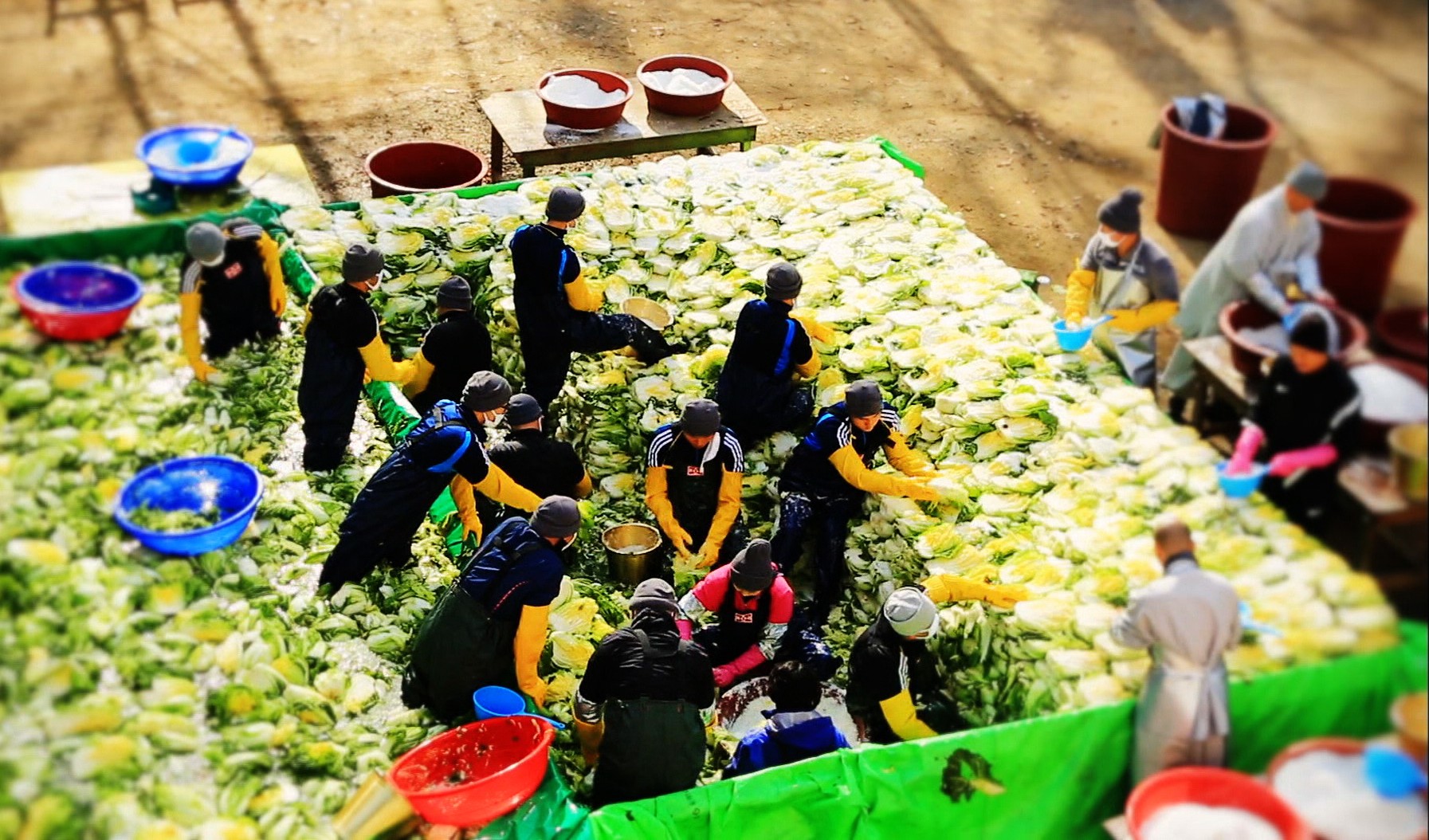
To understand kimchi in Korean culture, you have to go back to late autumn, when families and neighbors once gathered together around enormous piles of napa cabbage. They salted the cabbage. They prepared the seasoning. They mixed, packed, carried, stored, and shared. They were not simply making food for dinner. They were preparing for winter.
This seasonal tradition is called kimjang.
And kimjang is not a recipe. It is not a festival. It is a seasonal labor event — a collective act of preservation built around one of the most complex vegetable fermentation systems in the world.
In 2013, UNESCO inscribed kimjang on the Representative List of the Intangible Cultural Heritage of Humanity. Not as a food. Not as a recipe. As a social practice — the cooperative labor, the knowledge transmission between generations, the shared preparation that connected communities before and after winter.
But for fermentation, the most interesting part of kimjang is not the social structure.
It is what happens inside the jar.
Why Late Autumn: The Biochemistry of Timing
The timing of kimjang is not tradition for its own sake. It is biochemically precise.
Baechu kimchi ferments most successfully when ambient temperatures stay between roughly 0 and 5 degrees Celsius after preparation. At those temperatures, lactic acid bacteria dominate the fermentation slowly and evenly. The process avoids the rapid, uncontrolled acidification that occurs at warmer temperatures, which produces excessively sour, texturally degraded kimchi within days rather than weeks.
Late October through early December catches the exact window when outdoor temperatures in Korea drop into that range naturally. Traditional households did not need thermometers. They watched the weather, felt the air, and knew.
Before refrigeration, kimjang kimchi was stored underground in onggi — large earthenware vessels whose microporous clay walls allow controlled gas exchange while the surrounding soil maintained stable temperatures through winter. Modern Korean apartments have kimchi refrigerators that replicate those conditions electronically, maintaining the same 0 to 5 degree range with added humidity controls. Samsung and LG compete in this appliance category, which generates hundreds of millions of dollars annually in South Korea.
The technology changed. The principle did not.
Temperature determines which microorganisms dominate, how fast acids accumulate, how long the cabbage retains structural integrity, and ultimately what the kimchi tastes like three months later.
The Microbial Succession Inside Kimchi
What happens inside a jar of kimjang kimchi is not a single fermentation event. It is a succession of microbial communities, each creating conditions that favor the next.
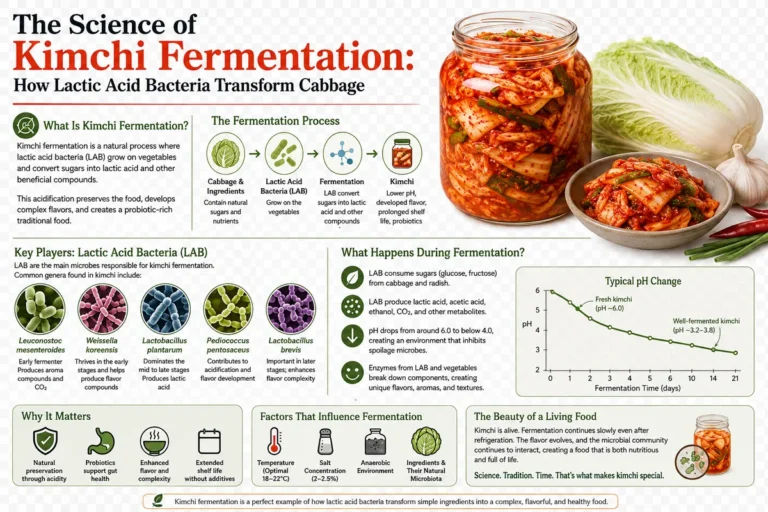
The process begins with Leuconostoc mesenteroides. This heterofermentative bacterium is among the first to become active after the cabbage is sealed. It metabolizes available carbohydrates and produces lactic acid, acetic acid, ethanol, and carbon dioxide. The CO2 rapidly displaces oxygen inside the container, creating the anaerobic environment that subsequent organisms require. Simultaneously, the organic acids drive the pH down from a near-neutral starting point of roughly 6.0 to 5.5 toward 4.5 within the first week.
As pH drops below approximately 4.5, Leuconostoc becomes less competitive. Lactobacillus species — particularly Lactobacillus sakei and Lactobacillus plantarum — take over. These homofermentative bacteria are more acid-tolerant and continue producing lactic acid as the dominant metabolic product. They drive pH further down toward 3.5 to 4.0 over the following weeks.
Weissella and Pediococcus species also participate at various stages, contributing to the overall metabolite profile. The exact composition varies batch to batch depending on ingredients, salt concentration, temperature, oxygen exposure, and the microbial load present on the raw cabbage itself.
A 2011 study published in the Journal of Medicinal Food identified a wide range of lactic acid bacteria in kimchi and noted that this microbial diversity may support gut microbiome function, though the researchers emphasized that more clinical trials are needed to confirm specific health outcomes in humans.
This is why kimchi fermentation is better understood as a microbial ecosystem than as a simple chain of events. The organisms interact. They compete for nutrients. They modify each other’s environment. And the flavor of the final product reflects not any single species but the entire trajectory of that succession.
Salt: Engineering the Microbial Environment
Salt does far more than make kimchi taste salty.
When napa cabbage is submerged in brine, water moves out of plant cells through osmosis. This serves two purposes simultaneously.
First, it changes the physical structure of the cabbage. The cell walls partially collapse, producing the flexible, translucent texture that distinguishes properly fermented kimchi from raw cabbage. This structural change is irreversible — it happens during salting, not during fermentation. Skipping or rushing the salting stage is the single most common mistake in home kimchi production, and the kimchi suffers for it throughout its entire fermentation life. Properly salted cabbage bends without snapping. Under-salted cabbage stays rigid and resists seasoning penetration. Over-salted cabbage tears too easily and ferments poorly because excessive sodium inhibits even the salt-tolerant bacteria you want.
Second, salt creates selective pressure on the microbial community. By reducing water activity and creating osmotic stress, salt inhibits many spoilage organisms while permitting salt-tolerant lactic acid bacteria to persist and eventually dominate. Traditional baechu kimchi uses a two-stage salt system — first the brine soak on the cabbage itself, then the incorporation of jeotgal (salted fermented seafood) into the seasoning paste. This dual-salt approach creates layered osmotic environments that further select for beneficial fermentation organisms.
The salt concentration in traditional kimchi is not fixed. Published studies have found substantial variation among traditional products, reflecting differences in household recipes, regional preferences, and seasonal conditions. Statements claiming traditional kimchi always contains exactly a certain percentage of salt are misleading. Traditional fermentation is more variable than that.
What Jeotgal Actually Does
Most kimchi explanations describe jeotgal — salted fermented shrimp, anchovy, or other seafood — as a flavor ingredient. It adds salt and umami.
That is true but incomplete.
Jeotgal is itself a fermented product. Before it enters the kimchi, it has already undergone weeks to months of protein hydrolysis. The fish or shrimp proteins have been partially broken down by endogenous enzymes and halophilic (salt-loving) bacteria into free amino acids and peptides. Glutamic acid is among the most abundant products — the same compound responsible for the savory taste of aged parmesan, soy sauce, and MSG.
When jeotgal enters the kimchi paste, it contributes three things beyond flavor. It provides a concentrated source of free amino acids that become substrates for further microbial metabolism. It introduces additional salt-tolerant microorganisms that can participate in fermentation. And the amino acids themselves undergo Maillard-like reactions and other transformations during aging that contribute to the deepening complexity of mature kimchi.
This is why kimchi made with jeotgal tastes fundamentally different from kimchi made with only salt or soy sauce. The fermentation has more raw material to work with. The metabolite profile is richer. The umami deepens in ways that salt alone cannot produce.
The Rice Paste: A Quiet Catalyst
One ingredient that receives almost no attention in popular kimchi writing is the glutinous rice paste.
Two tablespoons of rice flour cooked into a thin porridge might seem negligible. It is not.
The cooked starch serves as an immediately available carbon source for lactic acid bacteria during the critical first hours of fermentation. While the bacteria can eventually access carbohydrates from the cabbage tissue itself, the rice paste provides a head start — a burst of easily metabolized glucose and maltose that accelerates the initial Leuconostoc bloom and the rapid pH drop that protects the batch from spoilage organisms.
The paste also functions as a physical adhesive. It helps the gochugaru and other seasoning components cling to the cabbage leaves rather than settling to the bottom of the container. This ensures more even distribution of fermentable substrates and microorganisms throughout the batch.
Skipping the rice paste produces kimchi that ferments more slowly at the start and often has patchier seasoning distribution. The difference is subtle in small batches. In kimjang-scale production — fifty to two hundred heads of cabbage — it becomes significant.
Scale Changes the Fermentation
This is something that most home fermenters do not consider: the size of the batch affects the microbiology.
A one-liter jar of kimchi and a fifty-liter onggi of kimjang kimchi do not ferment identically, even with the same ingredients and temperature.
In larger volumes, the core of the batch takes longer to equilibrate with the ambient temperature. This creates thermal gradients — the outer layers cool faster and ferment more slowly, while the interior retains heat from the exothermic metabolic activity of the bacteria themselves. In very large batches, this internal heat can sustain fermentation activity even when external temperatures drop below the optimal range.
Larger volumes also have a lower surface-area-to-volume ratio, which reduces oxygen exposure. Since the transition from Leuconostoc to Lactobacillus depends partly on anaerobic conditions, larger batches may complete this transition more rapidly.
The microbial inoculum is also different at scale. When you pack two hundred heads of cabbage, the sheer volume of raw material carries a larger and more diverse population of wild lactic acid bacteria. The fermentation starts with a richer microbial community, which can produce a more complex metabolite profile in the finished product.
This is one reason why experienced kimjang participants insist that large-batch kimchi tastes different from small-batch kimchi, even when the recipe is identical. They are not being sentimental. They are observing a real microbiological difference.
What Happens as Kimchi Ages
The flavor of kimchi at one week, one month, and three months reflects genuinely different chemistry.
At one week, Leuconostoc activity has produced the initial tang. The pH has dropped to approximately 4.5. Carbon dioxide is still being generated. The cabbage retains significant crunch. The garlic is still sharp. The overall impression is bright and fresh with emerging acidity.
At one month, Lactobacillus species have become dominant. pH has dropped further to approximately 4.0 to 3.8. The cabbage texture has softened noticeably. The garlic sharpness has mellowed as allicin and related sulfur compounds have been partially metabolized. Organic acids have accumulated. The flavor has more depth, more sourness, and a rounder overall character.
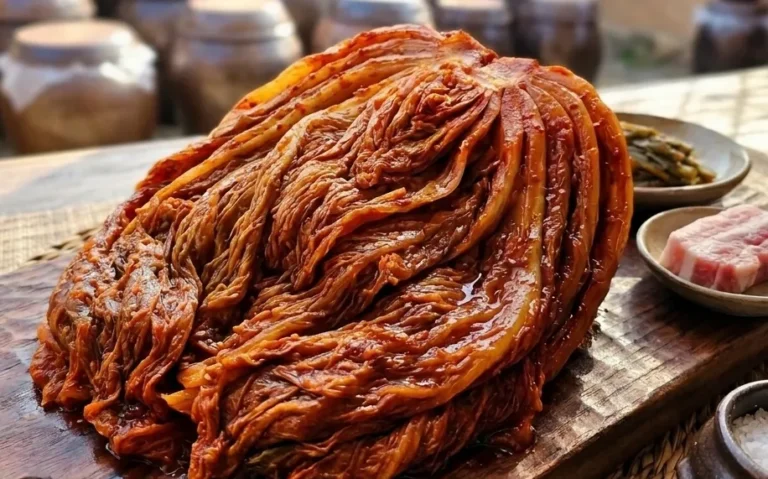
At three months and beyond, the kimchi enters what Korean cooks call mugeun-ji territory — aged kimchi. The pH may have dropped below 3.5. The cabbage is fully softened, sometimes translucent. The microbial community has largely stabilized, with Lactobacillus plantarum often becoming the final dominant organism. The flavor is deeply sour, intensely savory, and carries fermentation-derived aroma compounds — diacetyl, acetoin, various esters — that did not exist in the original ingredients.
This aged kimchi is not spoiled. It is a different food from what it was at week one. It is used differently in Korean cooking — in stews, in jjigae, stir-fried with pork — precisely because its chemistry has changed enough to function as a cooking ingredient rather than a fresh side dish.
Three Things Most People Do Not Know
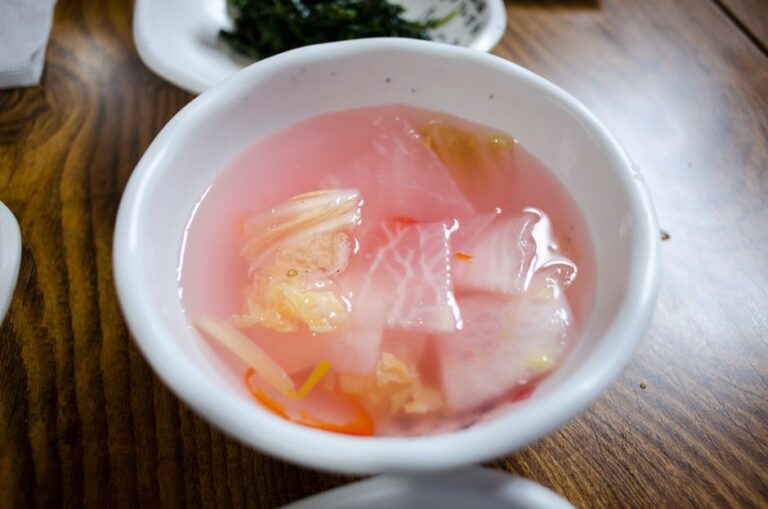
First, the dongchimi comes before the baechu. During kimjang, most households prepare dongchimi — a clear-brine radish water kimchi — in the first day or two. Dongchimi ferments in liquid, not paste, and it serves a practical winter purpose: the brine itself becomes a drinking liquid when diluted, providing hydration and mild organic acids during cold months. Experienced kimjang cooks start with dongchimi because it takes longer to reach its optimal fermentation point.
Second, geotjeori is quality control, not impatience. Right after the paste is applied, before any fermentation happens, families eat a bowl of the fresh, unfermented kimchi. This is a calibration step. If the geotjeori tastes balanced fresh — properly salty, adequately spicy, enough garlic bite — the aged kimchi will develop correctly. If it is off, adjustments happen before the jars are sealed. It is quality control embedded in cultural practice.
Third, the seasoning is applied by hand for a functional reason. The warmth of your hands slightly softens the paste and helps it penetrate between leaf layers more evenly than a utensil can achieve. Your hands also provide real-time feedback — if a leaf tears too easily, the cabbage was over-salted; if it resists the paste entirely, it was under-salted. Experienced kimjang participants read the cabbage with their hands the way a baker reads dough.
Is Kimchi a Probiotic Food?
This question requires the same caution applied to any fermented food.
Kimchi contains living microorganisms. But fermented food and probiotic food are not automatically the same thing. The term probiotic has a specific scientific definition: a microorganism that, when consumed in adequate amounts, confers a health benefit on the host. Meeting that definition requires strain-level identification and evidence of benefit.
Research has investigated the microorganisms found in kimchi and their possible relationships with the gut microbiome and metabolic health. The Korean Rural Development Administration has published findings suggesting that kimchi may support immune function and metabolic health, citing the density of vitamins C and K in napa cabbage along with the probiotic activity of fermented kimchi. Their analysis notes that these effects may vary significantly based on fermentation time, ingredient ratios, and individual gut microbiome composition.
These are interesting findings. They are not proof that eating kimchi prevents or treats disease.
One nutritional issue worth remembering: traditional baechu kimchi contains significant sodium from both the initial brining and from jeotgal. A single 100-gram serving can contain 500 to 700 milligrams of sodium depending on preparation. The American Heart Association recommends no more than 2,300 milligrams of sodium per day for most adults. People managing hypertension or kidney conditions should consider portion size carefully.
A Small-Batch Kimjang Recipe
You do not need forty people or a hundred heads of cabbage for a genuine kimjang experience. One head and an afternoon will teach you the fundamentals.
This recipe reflects traditional kimjang proportions scaled for a home kitchen. It is a practical adaptation, not a claim to represent one definitive historical formula.
Ingredients for the brine: 1 medium napa cabbage (approximately 1.2 kg), 60 g coarse sea salt (non-iodized — iodized salt can inhibit fermentation), 1 liter cold water.
Ingredients for the seasoning: 50 g gochugaru (Korean red pepper flakes — not cayenne, not paprika), 15 g fish sauce (or soy sauce for a vegan version), 10 g saeujeot (salted fermented shrimp — omit for vegan), 20 g fresh garlic minced (approximately 6 cloves), 5 g fresh ginger grated, 10 g sugar, 2 stalks green onion cut into 2 cm lengths, 200 g daikon radish julienned into matchsticks.
For the rice paste: 2 tablespoons glutinous rice flour, 120 ml cold water.
Step 1. Quarter the cabbage lengthwise, then cut into roughly 5 cm pieces. Dissolve salt in water and submerge the cabbage. Weigh it down with a plate. Let sit at room temperature for 12 to 16 hours, turning once halfway through. The cabbage is ready when a thick stem piece bends without snapping.
Step 2. Make the rice paste. Combine glutinous rice flour and cold water in a small saucepan. Whisk until dissolved. Heat over medium, stirring constantly, until the mixture thickens to a translucent paste — about 5 minutes. Cool completely before using. This paste carries the seasoning and provides an early carbon source for fermentation.
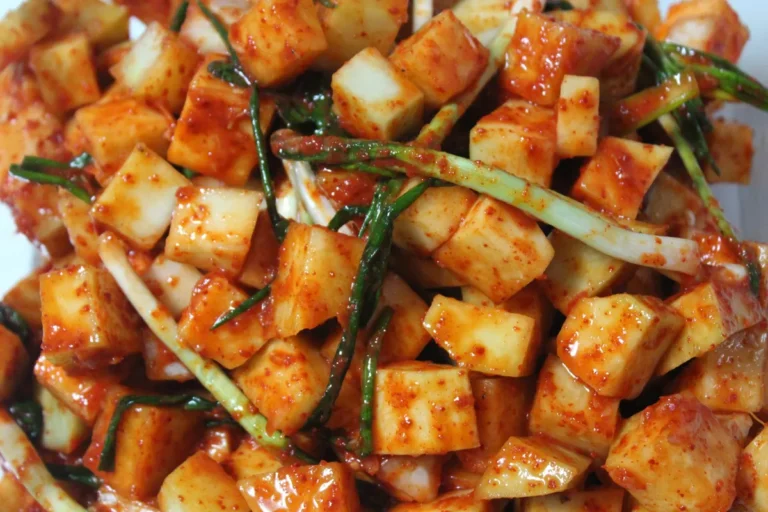
Step 3. Combine the cooled rice paste with gochugaru, fish sauce, saeujeot if using, garlic, ginger, and sugar. Mix thoroughly. The color should be deep red, glossy, and slightly sticky. Fold in the julienned radish and green onion.
Step 4. Drain the brined cabbage. Rinse twice under cold water to remove excess salt. Taste a piece — it should be pleasantly salty but not overwhelming. Squeeze out as much water as possible and drain in a colander for 30 minutes.
Step 5. Wear gloves. Working a few pieces at a time, coat each piece thoroughly with the paste, pressing it between the layers. Pack tightly into a clean glass jar or airtight container, pressing down firmly after each layer to eliminate air pockets. Leave about 2 centimeters of headspace — the kimchi expands as it ferments.
Step 6. Leave the jar at room temperature (18 to 22 degrees Celsius) for 24 hours. This jumpstarts the Leuconostoc bloom. After 24 hours, taste it. If it tastes bright and slightly tangy at the base, move it to the refrigerator. If it still tastes flat and raw, give it another 12 hours at room temperature.
Step 7. Refrigerate. The kimchi is edible immediately but reaches its characteristic flavor at approximately two weeks. It continues developing for up to three months, becoming more sour and complex over time.
Geotjeori step. Before sealing the jar, eat a small bowl of the freshly coated kimchi. This is your calibration moment. It should taste salty, spicy, slightly sweet, with a raw garlic bite. If it needs adjustment, this is your last chance before the jar closes and fermentation takes over.
The Tradition That Fermentation Carries
Today, kimjang continues in adapted forms. Urban Korean families use kimchi refrigerators instead of underground onggi. Community organizations coordinate neighborhood kimjang events. Korean diaspora communities in cities around the world organize autumn kimjang days. The core practice — collective labor, large-batch production, knowledge sharing — adapts to new contexts more easily than you might expect.
What is harder to preserve is the knowledge density. Traditional kimjang participants spent years learning through proximity. They knew which cabbage heads to select, how to read the texture during salting, how to feel when the fermentation had progressed correctly without opening the jar. That embodied knowledge moves slowly through written recipes and cooking classes. It accumulates through repetition, through failure, and through watching someone who knows what they are doing.
The recipe above will teach you something.
Making it ten times will teach you what the recipe cannot say.
That has always been the nature of fermentation. The written instructions describe the inputs. The microorganisms decide the outcome. And the person who has done it enough times learns to read the signs that no recipe can fully capture.
That is what kimjang preserves. Not simply kimchi. A way of knowing how to make it.
This content is for informational purposes only and is not medical advice.
Title Alternatives
- Kimjang Kimchi Fermentation: What Happens Inside the Jar
- The Microbiology of Kimjang: Large-Batch Kimchi Science
- Why Kimjang Kimchi Ferments Differently at Scale
Illustration Prompt
minimalist editorial illustration of a cross-section view showing a large onggi jar half-buried in earth, inside the jar layers of kimchi with abstract representations of microbial communities shifting from Leuconostoc at top to Lactobacillus at bottom, temperature gradient indicated by cool blue at edges warming to subtle amber at center, a pH scale descending along one side, limited color palette of terracotta and fermentation gold against cool grey, conceptual clean composition, professional magazine style