Salt and Fermentation: How Sodium Controls the Microbial World Inside Your Food
Salt is the most important variable in fermentation that most people never think about.
WhSalt and Fermentation: How Salt Shapes the Microbial World Inside Your Food
Salt is easy to overlook.
We taste it, adjust it, and move on. In ordinary cooking, that is usually enough. A little more salt makes a dish saltier; a little less makes it milder.
Fermentation is different.
When you add salt to cabbage, vegetables, fish, or soybeans before fermentation begins, you are not simply seasoning the food. You are changing the environment in which microorganisms have to live and compete.
That change can affect which microorganisms grow, which ones are held back, how quickly fermentation proceeds, and what kinds of acids, gases, amino acids, and other flavor compounds are eventually produced.
This is why salt matters so much in fermentation.
It does not make fermentation happen.
It helps determine what kind of fermentation can happen.
What Salt Actually Does to Microorganisms
The first thing salt changes is the movement of water.
When salt dissolves in the moisture surrounding a microbial cell, it increases the concentration of dissolved substances outside the cell. Water tends to move across the cell membrane toward the more concentrated environment.
The cell suddenly has to work harder to maintain its internal water balance.
This is part of what we mean by osmotic stress.
Microorganisms are not equally sensitive to that stress. Some can adjust their internal chemistry and accumulate compounds that help them retain water. Others are much less tolerant and stop growing as the salt concentration increases.
This difference is extremely useful in fermentation.
Salt can suppress or slow many unwanted microorganisms while allowing more salt-tolerant organisms to remain active.
Lactic acid bacteria are particularly important in vegetable fermentations such as kimchi and sauerkraut. Different species and strains have different salt tolerances, so it is not accurate to think of all lactic acid bacteria as behaving the same way.
The same is true of spoilage and pathogenic microorganisms.
There is no single salt concentration at which all undesirable bacteria suddenly die. Their response depends on the organism and on the rest of the environment, including pH, temperature, water activity, oxygen, and the composition of the food.
That distinction is important.
Salt is a selective pressure, not a sterilizer.
Salt Changes the Fermentation Environment
Once you look at salt this way, many traditional fermentation practices make more sense.
Consider kimchi.
The cabbage is salted before it is mixed with the seasoning. That salt does several things at once.
It draws water from the cabbage.
It changes the texture of the vegetable.
It creates a salty environment in which some microorganisms are more competitive than others.
And as fermentation proceeds, the changing acidity creates another layer of selection.
The fermentation environment is therefore not fixed.
It changes over time.
Salt is one of the conditions established at the beginning, while microbial metabolism gradually changes others, especially pH and the concentration of organic acids.
This is why it is misleading to describe fermentation as if one microorganism simply enters the food and does all the work.
Fermentation is usually a succession.
Different microorganisms may become more or less abundant as the environment changes.
Kimchi is a good example. Species belonging to groups such as Leuconostoc, Weissella, and Lactobacillus can become important at different stages, and their relative abundance is influenced by factors including temperature, ingredients, and salt concentration.
The exact pattern is not identical in every batch.
That is not a problem with fermentation.
It is one of the characteristics of fermentation.
There Is No Universal “Fermentation Salt Percentage”
This is where many explanations of fermentation become too simple.
You will sometimes see fermentation divided into neat categories such as:
- 1–3% salt = one type of fermentation
- 3–5% = another
- 5–10% = another
- 15–25% = another
The problem is that these numbers can mean different things.
Are we talking about the percentage of salt added relative to the raw ingredients?
The salt concentration of the brine?
The final salt content of the fermented food?
These are not interchangeable measurements.
Kimchi provides a good example.
The salt used to salt the cabbage is not necessarily the same thing as the final salt concentration of the finished kimchi.
The cabbage loses water during salting. Some salt is washed away during rinsing, and the final product contains many ingredients besides cabbage and salt.
So a single chart cannot accurately describe every Korean fermentation.
What we can say with confidence is that changing salt concentration changes the fermentation environment.
Studies of kimchi have found that different salinities can alter microbial community composition, the production of organic acids and other metabolites, and the rate at which fermentation develops.
That is more useful than pretending there is one perfect salt number for every fermented food.
Why “Salt to Taste” Does Not Work the Same Way in Fermentation
In everyday cooking, “salt to taste” is perfectly reasonable.
Fermentation is less forgiving.
Suppose you are making kimchi.
If the initial salt conditions are too low, microorganisms that you did not intend to favor may have a greater opportunity to grow before acid-producing lactic acid bacteria establish themselves.
If the salt level is too high, microbial activity can be slowed substantially and the development of acidity and flavor may be delayed.
But there is another complication.
Temperature matters.
So does the amount of water.
So does the amount of sugar available to the microorganisms.
So does the condition of the cabbage.
And, of course, the microorganisms already present on the ingredients matter too.
This is why a fermentation recipe cannot always be reduced to one number.
Salt is one control variable inside a larger system.
That is also why experienced kimchi makers pay attention to the condition of the salted cabbage before mixing in the seasoning.
They are not simply deciding whether the cabbage tastes salty enough for dinner.
They are trying to create the right starting conditions for the fermentation that comes next.
Salt Changes Texture Before Fermentation Even Begins
The effect of salt is not limited to microorganisms.
It begins with the vegetable itself.
When cabbage is salted, water moves out of the plant tissue. The leaves lose some of their rigidity and become more flexible.
This is why freshly salted cabbage feels completely different from raw cabbage.
Some of the water released from the cabbage also becomes part of the liquid environment surrounding the food.
That matters because fermentation takes place in that changing liquid environment.
The goal in kimchi is not simply to remove as much water as possible.
You want enough dehydration to soften the cabbage and allow the seasoning to work into the leaves, while retaining enough structure for the cabbage to remain pleasant to eat after fermentation.
Too little salting and the cabbage may remain difficult to work with.
Too much or too long, and the texture can move in the opposite direction.
The exact result depends on salt concentration, time, cabbage size, temperature, and the condition of the cabbage itself.
This is one reason kimchi making is more than following a fixed clock.
You have to look at the food.
Does the Type of Salt Matter?
Yes, but probably not in the way people sometimes claim.
Korean kimchi making is strongly associated with cheonilyeom, or solar sea salt, and many Korean recipes specifically call for it.
There is research showing that different salts can influence kimchi fermentation.
Some studies have found differences in microbial communities and metabolite profiles when different types of salt are used. These differences suggest that the mineral composition and other characteristics of the salt can have an effect on fermentation.
But this does not mean that minerals in sea salt are some kind of magic ingredient that makes fermentation work.
The dominant variable is still the overall fermentation environment, including salt concentration.
Mineral composition can have an effect, but it should not be confused with the much larger role played by salinity itself.
There is another practical issue: salt products can contain additives, and different products dissolve at different rates.
For that reason, when fermenting vegetables, it is sensible to know what is actually in the salt you are using rather than assuming that every type of salt behaves identically.
The important point is not that one particular salt is automatically “good” and another is automatically “bad.”
The important point is understanding what you are putting into the fermentation.
Salt Does Not Kill Everything
This point deserves its own section because fermentation advice often gets this wrong.
Salt is sometimes described as if it simply kills harmful bacteria while leaving beneficial bacteria untouched.
Real fermentation is not that clean.
Salt creates stress.
Different microorganisms tolerate that stress differently.
Some are inhibited strongly.
Some adapt.
Some remain active.
Some may survive without growing rapidly.
And the effect changes again as the food becomes more acidic.
This is why salt works together with other preservation hurdles rather than acting alone.
In kimchi, for example, salt is only one part of the system.
As lactic acid bacteria metabolize available nutrients, acidity increases. Temperature influences growth rates. The availability of oxygen changes. The physical structure of the vegetables changes.
All of these factors interact.
Fermentation is an ecosystem, not a single switch.
High-Salt Fermentation Is Not Simply “No Microbes”
The same caution applies to highly salted foods such as traditional fish products and fermented soybean foods.
At high salt concentrations, the growth of many microorganisms becomes more restricted.
But “restricted” does not mean “nothing is alive.”
Salt-tolerant and salt-loving microorganisms can survive in environments that would inhibit many ordinary bacteria.
Traditional Korean fermented soybean foods are a good example.
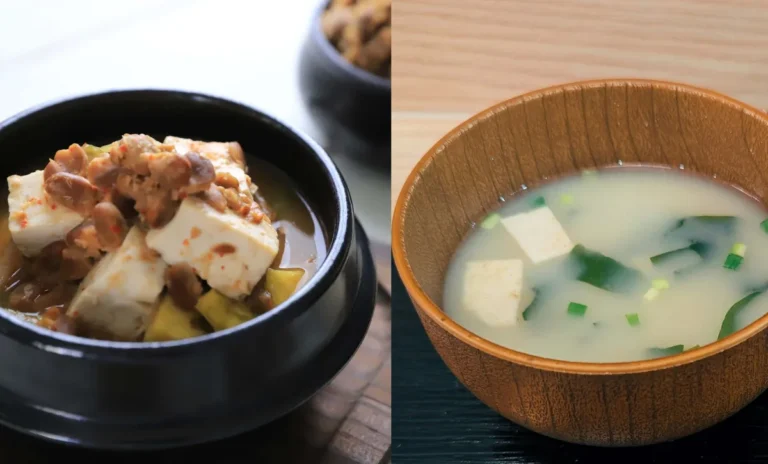
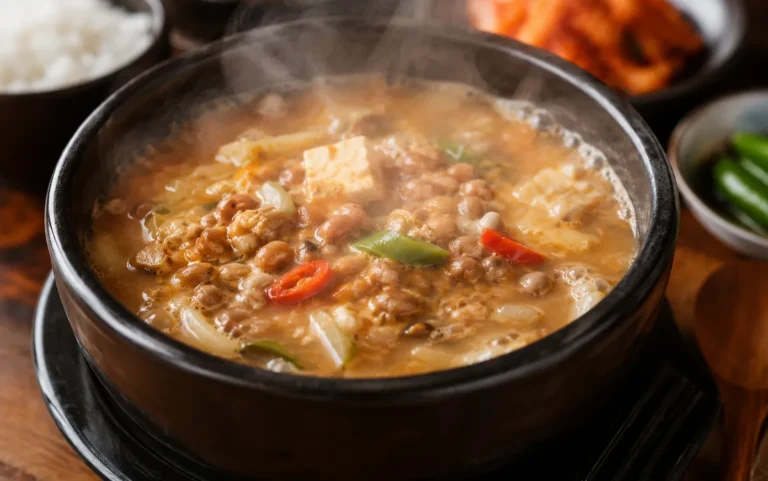
Meju and the subsequent fermentation of doenjang and ganjang involve complex microbial communities rather than a completely sterile, enzyme-only process.
Bacteria and fungi contribute to the breakdown of soybean proteins, carbohydrates, and other components, while salt helps shape which organisms can remain active.
Enzymes are also important.
Proteases and other enzymes break large molecules into smaller compounds, including peptides and amino acids that contribute to flavor.
So in a high-salt fermentation, it is better to think in terms of reduced microbial growth combined with continuing enzymatic activity, rather than saying that microbes disappear and only enzymes remain.
That distinction may sound small.
It isn’t.
It is the difference between describing fermentation as a living system and describing it as a chemical reaction that happens to involve food.
Salt and the Flavor of Fermented Foods
The reason all of this matters in the kitchen is flavor.
Salt changes which microorganisms have an opportunity to grow.
Those microorganisms then change the food.
They consume sugars and other nutrients and produce compounds such as organic acids, carbon dioxide, alcohols, and other metabolites.
At the same time, enzymes break down proteins and other large molecules into smaller compounds.
The result is a constantly changing mixture of flavor and aroma compounds.
This is why changing the salt concentration can change more than the perceived saltiness of a fermented food.
It can change the entire flavor profile.
A small change in the starting environment can sometimes produce a noticeable difference in the finished food.
That is one of the reasons experienced fermentation makers pay attention to salt so carefully.
Salt as the Thread Through Korean Fermentation
Once you start looking for it, salt appears everywhere in Korean fermentation.
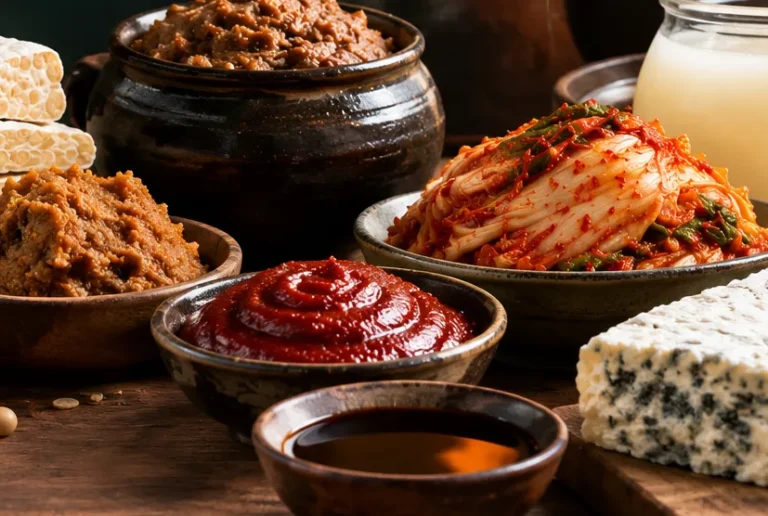
Kimchi begins with salted vegetables.
Jeotgal is made by salting fish or seafood.
Traditional doenjang and ganjang are produced by fermenting meju in brine.
Gochujang also depends on salt as part of its fermentation environment.
The foods are different.
The microorganisms are different.
The fermentation times are different.
But the underlying principle is familiar:
The environment determines which biological processes are possible.
Salt is one of the most important parts of that environment.
It does not dictate the final result by itself.
Temperature, water activity, pH, oxygen, raw materials, microorganisms, and time all matter.
But change the salt, and you change the starting conditions under which all of those other factors operate.
That is why salt deserves to be treated as more than a seasoning.
It is one of the tools used to build the fermentation environment.
The Salt You Add at the Beginning Becomes Part of the Flavor at the End
When we eat kimchi, we usually notice the sourness first.
Maybe there is garlic, ginger, chili, seafood, sweetness, or the fresh crunch of cabbage.
It is easy to forget the salt.
But the salt was there before most of those flavors developed.
It helped draw water from the cabbage.
It changed the physical structure of the vegetable.
It altered the environment in which microorganisms competed.
It influenced which organisms could grow and how quickly fermentation proceeded.
And through all of those effects, it helped shape the compounds that eventually became part of the flavor.
That is the part of fermentation that I find most fascinating.
The flavor we taste at the end began with the environment we created at the beginning.
So when you start a fermentation, the question is not simply:
“How much salt should I add?”
A better question is:
“What kind of environment am I creating?”
That is where fermentation really begins.
Frequently Asked Questions
Why does salt concentration matter so much in fermentation?
Salt concentration determines which microorganisms can survive and remain active during fermentation. Different microbes tolerate different salt levels, so raising or lowering the salt percentage shifts which species dominate, which in turn shapes the acidity, texture, and flavor of the finished food.
Can I reduce the salt in a fermentation recipe for health reasons?
Reducing salt changes the fermentation environment, not just the taste. Lower salt levels can allow different, sometimes less desirable, microorganisms to compete more successfully, and can also affect texture and food safety. If you want to reduce sodium, it is safer to look for recipes specifically designed around a lower salt range rather than simply cutting the amount in a standard recipe.
Does the type of salt affect fermentation?
The mineral content and additives in salt can have some effect, but the sodium concentration is the primary factor driving fermentation. Iodized salt and anti-caking agents are sometimes avoided by traditional fermenters due to concerns about minor effects on brine clarity or microbial activity, though the evidence for a major impact is limited compared to the effect of salt concentration itself.
Is high-salt fermentation still fermentation if fewer microbes are active?
Yes. High-salt fermentation, such as in traditional jang or some pickles, favors a smaller set of salt-tolerant microorganisms and enzymatic processes rather than eliminating fermentation altogether. The activity is slower and the microbial community is narrower, but the fermentation process, including enzymatic breakdown and flavor development, still occurs over a longer timescale.
This content is for informational purposes only and is not medical advice.