What Is Fermentation? Definition, Types, and the Science Behind Fermented Food
Fermentation is one of those words that people use confidently without being entirely sure what it means. You might say kimchi is fermented, or that beer goes through fermentation, or that sourdough relies on fermentation — and you would be right every time. But what is actually happening inside that jar, that barrel, or that dough?
The answer is simpler than most explanations make it sound, and more interesting than most definitions capture.
Fermentation Definition: What It Actually Means
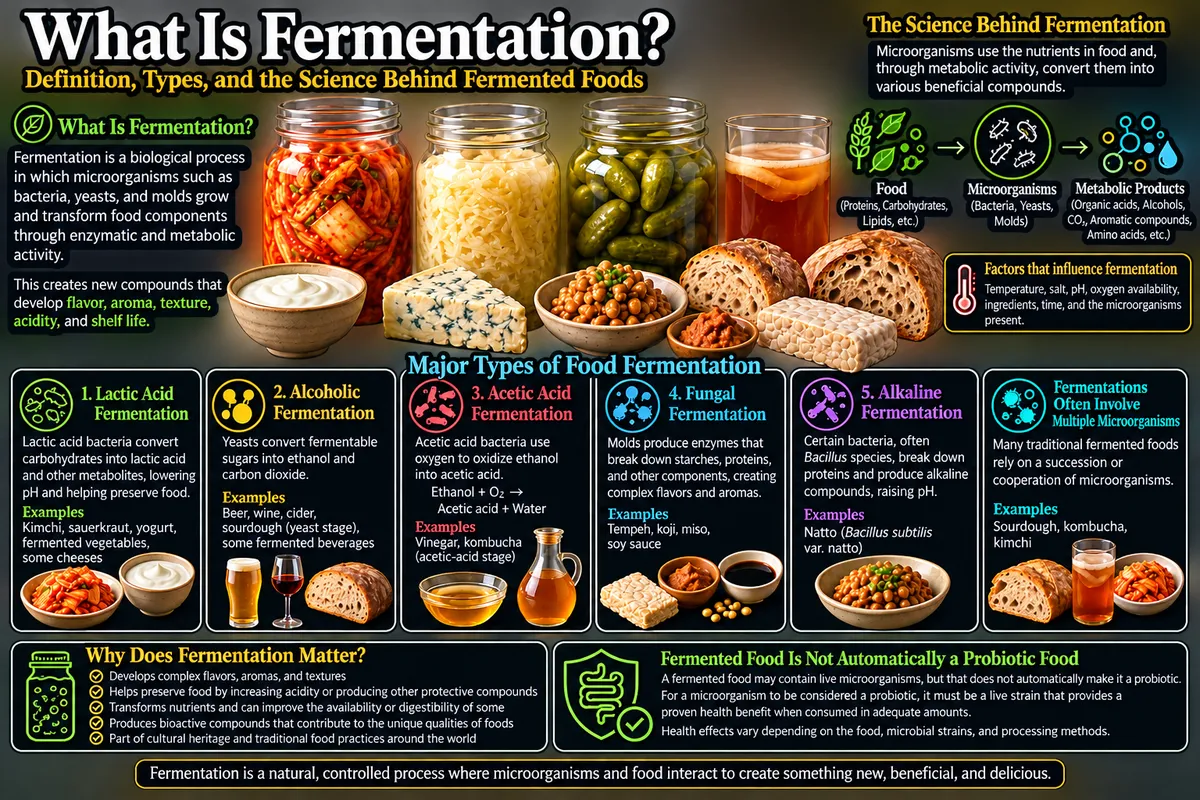
Fermentation is a metabolic process in which microorganisms — primarily bacteria, yeasts, and molds — convert carbohydrates (sugars, starches) into other compounds, typically organic acids, alcohols, or gases, in the absence of oxygen or under low-oxygen conditions.
That is the textbook definition. Here is what it means in practical terms.
When you salt cabbage and leave it in a jar, bacteria that are already present on the leaves begin consuming the sugars inside the vegetable. As they metabolize those sugars, they produce lactic acid. The acid accumulates, the pH drops, the environment inside the jar becomes hostile to spoilage organisms, and the cabbage transforms into something that tastes, smells, and behaves completely differently from the raw vegetable you started with.
That is fermentation. Microorganisms transform food by eating part of it and producing new compounds in the process.
The food changes. The flavor changes. The chemistry changes. And in most cases, the food becomes more stable, more complex, and more interesting than the raw ingredient.
The Three Main Types of Fermentation in Food
Not all fermentation produces the same result. The type of fermentation depends on which microorganisms are doing the work and what compounds they produce.
Lactic Acid Fermentation
Lactic acid fermentation is the most common type in food preservation. Lactic acid bacteria — organisms from genera such as Lactobacillus, Leuconostoc, and Weissella — convert sugars into lactic acid.
This is the fermentation behind kimchi, sauerkraut, yogurt, pickles, and many other foods. The lactic acid lowers the pH, creates sourness, and inhibits the growth of harmful bacteria. It is also why fermented vegetables can last for months without refrigeration — the acid environment is hostile to most spoilage organisms.
Lactic acid fermentation is particularly important in Korean cuisine. The fermentation of cabbage into kimchi, the fermentation of radish into kkakdugi, and the souring of water kimchi are all driven by lactic acid bacteria working under controlled salt and temperature conditions.
Alcoholic Fermentation
Alcoholic fermentation is driven primarily by yeasts, which convert sugars into ethanol (alcohol) and carbon dioxide. This is the process behind beer, wine, sake, and Korean makgeolli.
When rice is combined with nuruk (a traditional Korean fermentation starter containing molds, yeasts, and bacteria), the mold enzymes break down rice starch into sugars. Yeasts then convert those sugars into alcohol. In traditional Korean brewing, these two processes happen simultaneously — a technique known as parallel saccharification and fermentation.
The carbon dioxide produced during alcoholic fermentation is what makes bread rise and gives naturally fermented beverages their carbonation.
Acetic Acid Fermentation
Acetic acid fermentation converts alcohol into acetic acid — the compound that gives vinegar its sour taste. Unlike the first two types, this fermentation requires oxygen. Acetobacter bacteria oxidize ethanol at the surface of the liquid, which is why vinegar fermentation happens in open or loosely covered vessels.
This means vinegar is actually a two-stage fermentation: first sugars become alcohol (by yeasts), then alcohol becomes acid (by bacteria). Korean traditional vinegars, such as persimmon vinegar and brown rice vinegar, follow this exact sequence.
Fermentation of Cabbage: From Raw Vegetable to Kimchi and Sauerkraut
The fermentation of cabbage is one of the clearest demonstrations of how fermentation works, and it appears independently in multiple food cultures.
In Korea, napa cabbage is salted, seasoned with gochugaru, garlic, ginger, and fermented seafood, and packed into containers where lactic acid bacteria begin their work. The result is kimchi — a complex, sour, spicy, and deeply savory food that continues to change over weeks and months as fermentation progresses.
In Germany, shredded green cabbage is salted and packed tightly, with no additional seasoning. The same groups of lactic acid bacteria — Leuconostoc species followed by Lactobacillus species — produce the same lactic acid and the same preservation effect. The result is sauerkraut — simpler in flavor than kimchi but driven by identical microbiology.
The cabbage is different. The seasoning is different. The cultural context is completely different. But the fermentation process is the same. This is one of the most striking patterns in food science: the same microbial mechanism, discovered independently by cultures that had no contact with each other, producing foods that serve the same preservation and flavor functions.
What Makes Fermentation Different From Spoilage?
This is a question that matters, because both fermentation and spoilage are caused by microorganisms transforming food.
The difference is control.
In fermentation, you create an environment — through salt, temperature, oxygen control, or starter cultures — that favors specific microorganisms. Those organisms produce compounds (lactic acid, alcohol, acetic acid) that preserve the food and create desirable flavors.
In spoilage, uncontrolled microorganisms break down food in ways that produce off-flavors, toxins, or unsafe conditions.
Salt is the most common control mechanism in vegetable fermentation. At the right concentration (typically 2 to 5 percent for kimchi), salt suppresses most spoilage bacteria while allowing lactic acid bacteria to thrive. Temperature, oxygen exposure, and the freshness of ingredients are the other major variables.
Fermentation is not the absence of control. It is the application of specific environmental conditions that steer microbial activity toward a desired outcome.
Why Does Fermented Food Taste Different?
The flavors in fermented food do not exist in the raw ingredients. They are created by microbial metabolism.
Lactic acid produces sourness. Acetic acid produces sharpness. Alcoholic fermentation produces ethanol and complex esters. Enzymatic breakdown of proteins releases free amino acids — especially glutamic acid, the compound responsible for umami.
This is why aged doenjang (Korean fermented soybean paste) tastes so much more complex than raw soybeans. Months of enzymatic and microbial activity have broken proteins into hundreds of smaller compounds, each contributing to the overall flavor profile. The same principle applies to aged cheese, fish sauce, soy sauce, and any food where extended fermentation builds flavor over time.
Fermentation does not simply preserve food. It creates flavors that cannot exist without microbial transformation.
The Role of Salt, Temperature, and Time
Three variables control virtually every fermentation:
Salt determines which microorganisms can survive. Low salt (1 to 2 percent) produces fast, active fermentation — this is the environment for water kimchi. Medium salt (3 to 5 percent) produces the slower, more complex fermentation of standard kimchi. High salt (15 to 25 percent) suppresses almost all microbial growth and creates conditions for enzymatic processes — this is the environment for doenjang brine and fish sauce.
Temperature determines speed. Warmer conditions accelerate microbial metabolism. Cooler conditions slow it. Refrigeration does not stop fermentation — it slows it enough that food can remain in a specific flavor stage for weeks rather than days.
Time is the variable that cannot be replaced. A young kimchi at two days tastes different from the same kimchi at two weeks, two months, or two years. Each stage represents a different balance of acids, amino acids, and microbial metabolites. Long-fermented foods like mukeunji (aged kimchi) or well-aged doenjang carry the accumulated complexity of months or years of microbial work.
Fermented Foods Around the World
Fermentation is not limited to any single culture. Every food tradition that lasted long enough to develop a cuisine also developed fermentation.
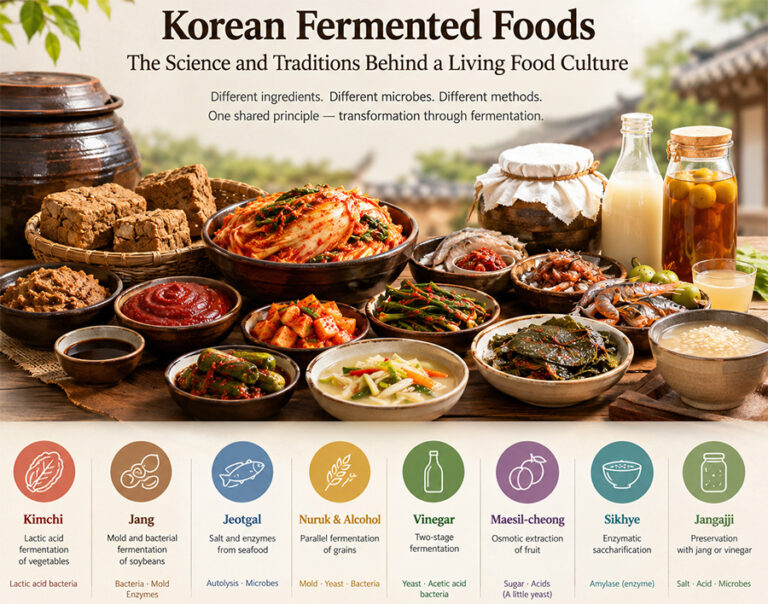
Korean cuisine alone includes dozens of fermented foods: kimchi in all its varieties, doenjang, ganjang, gochujang, jeotgal, makgeolli, and traditional vinegars. Each uses different microorganisms, different substrates, and different environmental conditions — but they all rest on the same fundamental principle.
Globally, the list extends further. Yogurt and kefir (dairy fermentation). Bread and beer (yeast fermentation of grain). Miso, tempeh, and natto (soybean fermentation with different organisms). Sauerkraut, pickles, and fermented hot sauce (vegetable lactic acid fermentation). Fish sauce across Southeast Asia, Korea, and ancient Rome (enzymatic protein hydrolysis under salt).
The process is universal. The results are culturally specific. And that combination is what makes fermentation one of the most important technologies humans have ever developed — even though most people who use it every day do not think of it as technology at all.
Fermentation and Health: What We Can and Cannot Say
Fermented foods are the subject of active scientific research, particularly in relation to the gut microbiome and metabolic health.
Some studies suggest that diets including fermented foods may be associated with increased gut microbial diversity. Fermented foods can contain live microorganisms, organic acids, and bioactive compounds produced during fermentation.
But fermentation does not automatically make a food healthy, and fermented foods are not medicines. Fermented soybean paste is also high in sodium. Fermented alcohol is still alcohol. A food being fermented tells you something about how it was made, not whether it will improve your health.
The responsible way to discuss fermentation and health is to acknowledge the research without overstating the evidence. That is the approach we take on this site.
Understanding Fermentation Changes How You See Food
Once you understand what fermentation is, you start seeing it everywhere.
The sourness in your kimchi is lactic acid produced by bacteria. The depth in your doenjang is glutamic acid released by enzymes. The fizz in your makgeolli is carbon dioxide from yeast metabolism. The sharpness of your vinegar is acetic acid from bacterial oxidation of alcohol.
None of these flavors existed in the raw ingredients. All of them were created by microorganisms doing what they do: consuming nutrients and producing new compounds.
That is fermentation. It is not mysterious. It is not magical. It is biology, chemistry, and time working together on a substrate that humans chose and an environment that humans created.
The food that goes into the jar is not the food that comes out.
And that transformation is the entire point.
This content is for informational purposes only and is not medical advice.