Korean Fermented Foods Are Taking Over the World
The Rich, Tangy, Umami-Packed Story of Korean Fermentation
The earthy aroma of doenjang jjigae. The sharp, lively scent of kimchi. The deep, layered flavor of soy sauce aged in clay pots. These foods have sat at the center of Korean tables for thousands of years. Now, quietly but unmistakably, they’re finding their place on tables around the world.
Michelin-starred restaurants in New York are building dishes around kimchi. Natural food shops in Paris are stocking doenjang on their shelves. What started as a niche curiosity has become a full-blown cultural movement. This article digs into the history and science behind Korean fermented foods — and wraps up with a beginner-friendly recipe you can make at home today.
Disclaimer: The health information in this article is for educational purposes only and is not intended as medical advice. Please consult a qualified healthcare provider before making dietary changes for health reasons.
A History Thousands of Years in the Making
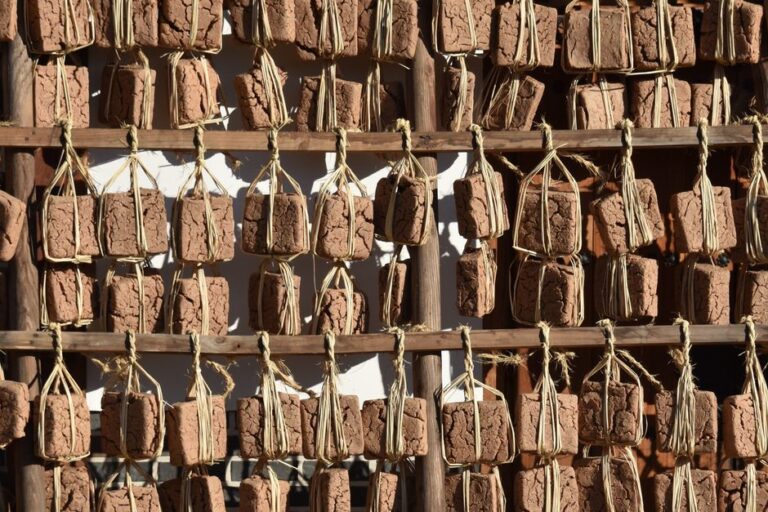
Korean fermentation didn’t start with a food trend. It goes back well before the Three Kingdoms period. Records from the Goguryeo era already describe the making of meju — fermented soybean blocks used as the base for doenjang and ganjang (soy sauce). Wedding documents from the Silla kingdom list ganjang and doenjang among the gifts exchanged between families. These weren’t just condiments. They were treasures.
Kimchi, in its earliest form, appeared during the Goryeo period. But it looked nothing like what we know today. There was no red pepper. No gochugaru. Early kimchi was simply salted vegetables — a preservation method, clean and spare. Chili peppers didn’t arrive on the Korean peninsula until after the Japanese invasions of the late 16th century. By the 17th century, gochugaru had been woven into the recipe, and the kimchi we recognize today was born.
Korea’s four distinct seasons shaped all of this. Long, harsh winters made fresh vegetables scarce for months at a time. So people learned to preserve, to ferment, to transform. The jangdokdae — the traditional courtyard filled with large clay fermentation jars — was more than a storage space. It was the heart of a household’s health and care, a physical symbol of a family’s skill and devotion. Recipes and techniques passed from mother to daughter, generation after generation. Each family’s jars developed their own unique microbial ecosystem, producing flavors no factory could replicate.
The Science: What’s Actually Happening Inside the Jar
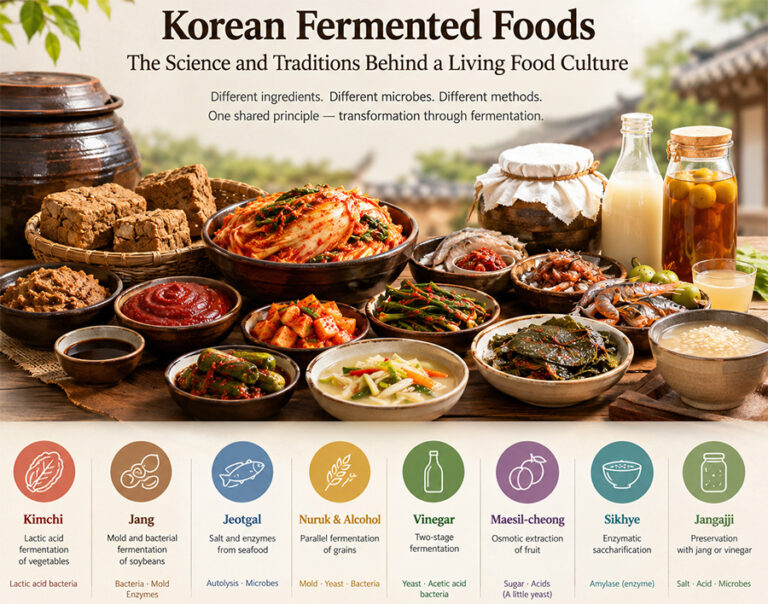
Fermentation isn’t spoilage. It’s controlled transformation. Specific microorganisms break down organic compounds in a managed environment, creating entirely new substances in the process. Korean fermented foods rely on a complex, layered interplay of microbes — and understanding even a little of that science makes eating them feel like a small miracle.
Here’s a breakdown of the key microorganisms at work:
| Food | Primary Microorganisms | What They Produce | What That Does |
|---|---|---|---|
| Kimchi | Lactobacillus plantarum, Leuconostoc mesenteroides | Lactic acid, acetic acid, CO₂ | Creates sourness, extends shelf life |
| Doenjang / Ganjang | Aspergillus oryzae, Bacillus subtilis | Amino acids, organic acids, browning compounds | Builds umami depth, antioxidant activity |
| Makgeolli | Saccharomyces cerevisiae, Aspergillus | Ethanol, organic acids, enzymes | Alcohol fermentation, aroma development |
| Cheonggukjang | Bacillus subtilis var. natto | Nattokinase, polyglutamic acid | Protein breakdown, characteristic sticky texture |
What Happens Inside a Jar of Kimchi
Kimchi fermentation unfolds in stages. First, Leuconostoc mesenteroides gets to work, producing carbon dioxide that pushes oxygen out of the jar. That creates an anaerobic environment — exactly the conditions the next wave of bacteria needs. Then Lactobacillus plantarum takes over, generating large amounts of lactic acid and dropping the pH. That acidic environment shuts down harmful bacteria while building kimchi’s signature tang and satisfying crunch.
Something else happens too. The vitamin C naturally present in cabbage actually increases during fermentation. The result is a food rich in dietary fiber and live probiotics — a far cry from a simple pickled vegetable.
The Umami Machine: How Doenjang Gets Its Depth
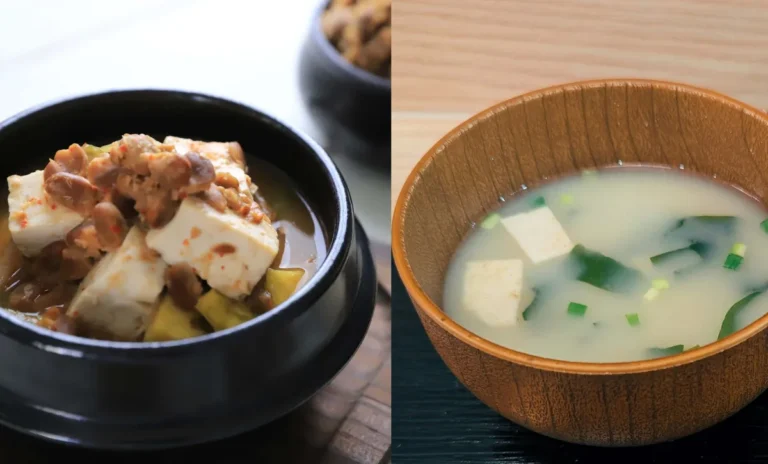
Doenjang’s flavor complexity comes down to enzymes. The Aspergillus oryzae living in meju secretes protease enzymes that break soybean proteins down into free amino acids — most importantly, glutamic acid. That glutamic acid is the direct source of doenjang’s deep, savory umami. A single gram of doenjang can contain tens of millions to hundreds of millions of microorganisms. The longer it ages, the deeper the protein breakdown goes, and the more complex the flavor becomes.
Why the World Is Paying Attention
The timing makes sense. Global interest in gut health has exploded over the past decade. As microbiome research has advanced, so has public curiosity about probiotic-rich foods. Korean fermented foods sit right at the intersection of that scientific interest and a broader wellness movement.
The functional benefits are real and well-documented. Here’s what the research shows:
- Probiotics: 100 grams of kimchi contains approximately 10⁸ to 10⁹ CFU of lactic acid bacteria, contributing to the growth of beneficial gut flora.
- Antioxidants: Doenjang contains isoflavones and melanoidins — browning reaction compounds — that show strong antioxidant activity.
- Bioavailable plant protein: The fermentation process in cheonggukjang and doenjang breaks proteins into forms the body absorbs more easily.
- Vitamin K2: Cheonggukjang is rich in menaquinone-7 (MK-7), a form of vitamin K2 associated with bone and cardiovascular health.
- Complex umami flavor: Chefs worldwide have taken note. The layered, fermentation-driven umami in Korean condiments has become a sought-after secret weapon in professional kitchens.
In 2021, a Stanford University research team published a landmark study in the journal Cell showing that a high-fermented-food diet significantly increased gut microbiome diversity. That finding rippled through nutrition science and mainstream media alike. Studies like this are building the case for Korean fermented foods not just as flavorful ingredients, but as functional foods with measurable health benefits.
Make It Yourself: Classic White Kimchi (Baek Kimchi)
White kimchi — baek kimchi — is the perfect starting point for anyone new to Korean fermentation. There’s no gochugaru, so it isn’t spicy. The flavor is clean, refreshing, and subtly complex. It gives you a direct, hands-on feel for how fermentation actually works.
Note: This recipe uses a significant amount of salt during the brining stage. If you are monitoring sodium intake for health reasons, please consult your healthcare provider.
Ingredients (Serves 4)
- 1 head napa cabbage (approximately 2 kg)
- 200 g sea salt (for brining)
- ¼ Korean radish (daikon), julienned
- 50 g scallions
- 6 cloves garlic, thinly sliced
- 1 knob fresh ginger, thinly sliced
- ¼ Asian pear, julienned or grated
- Salt to taste (for seasoning)
- 500 ml water + 1 tablespoon glutinous rice flour (for the rice paste)
Step-by-Step Instructions
Step 1 – Brine the Cabbage
Quarter the cabbage lengthwise and score the thick core sections with a knife. Sprinkle sea salt between each leaf, working it in evenly. Let the cabbage sit for 6 to 8 hours until it has wilted and softened. Rinse under cold running water 2 to 3 times to remove excess salt, then place upside down in a colander for at least 2 hours to drain thoroughly.
Step 2 – Make the Rice Paste
Whisk the glutinous rice flour into 500 ml of water until smooth. Cook over low heat, stirring constantly, until the mixture turns translucent and thickens. Remove from heat and let it cool completely. This paste feeds the lactic acid bacteria and gives fermentation a head start.
Step 3 – Prepare the Filling
Julienne the radish and pear into thin matchsticks. Cut the scallions into 4 cm lengths. Slice the garlic and ginger into thin rounds. Combine everything with the cooled rice paste and season lightly with salt.
Step 4 – Pack the Cabbage
Tuck the filling between each leaf of the brined cabbage, distributing it as evenly as you can. Fold the outermost leaf around each quarter to hold the shape together.
Step 5 – Ferment and Store
Pack the kimchi tightly into an airtight container, pressing down firmly to eliminate air pockets. Leave it at room temperature — ideally 18 to 20°C — for 12 to 24 hours. Then move it to the refrigerator. Lactic acid fermentation kicks into gear after 3 to 5 days, and the flavor deepens noticeably from there.
Going Global: Where Korean Fermentation Stands Today
The numbers tell a clear story. According to the Korea Agro-Fisheries and Food Trade Corporation (aT), kimchi exports hit approximately $160 million USD in 2023, reaching over 80 countries. Exports of jang products — doenjang, gochujang, ganjang — are climbing steadily alongside the broader K-food wave driven by the global reach of Korean pop culture and media.
Still, real challenges remain. Each country has its own food safety standards and import regulations, and adapting large-scale production to meet those requirements without sacrificing quality is genuinely difficult. Getting consumers unfamiliar with strong fermented aromas on board requires thoughtful localization — not watering down the product, but building the right context and entry points. And there’s an ongoing tension between factory-produced kimchi and traditionally made kimchi, a debate that touches on authenticity, economics, and what it even means to preserve a food culture as it travels the world.
These aren’t small problems. But Korean fermented foods have already crossed one of the hardest thresholds: they’ve earned genuine respect — from scientists, from chefs, and from home cooks around the world who’ve discovered that a spoonful of aged doenjang or a bite of well-fermented kimchi is something genuinely worth seeking out.