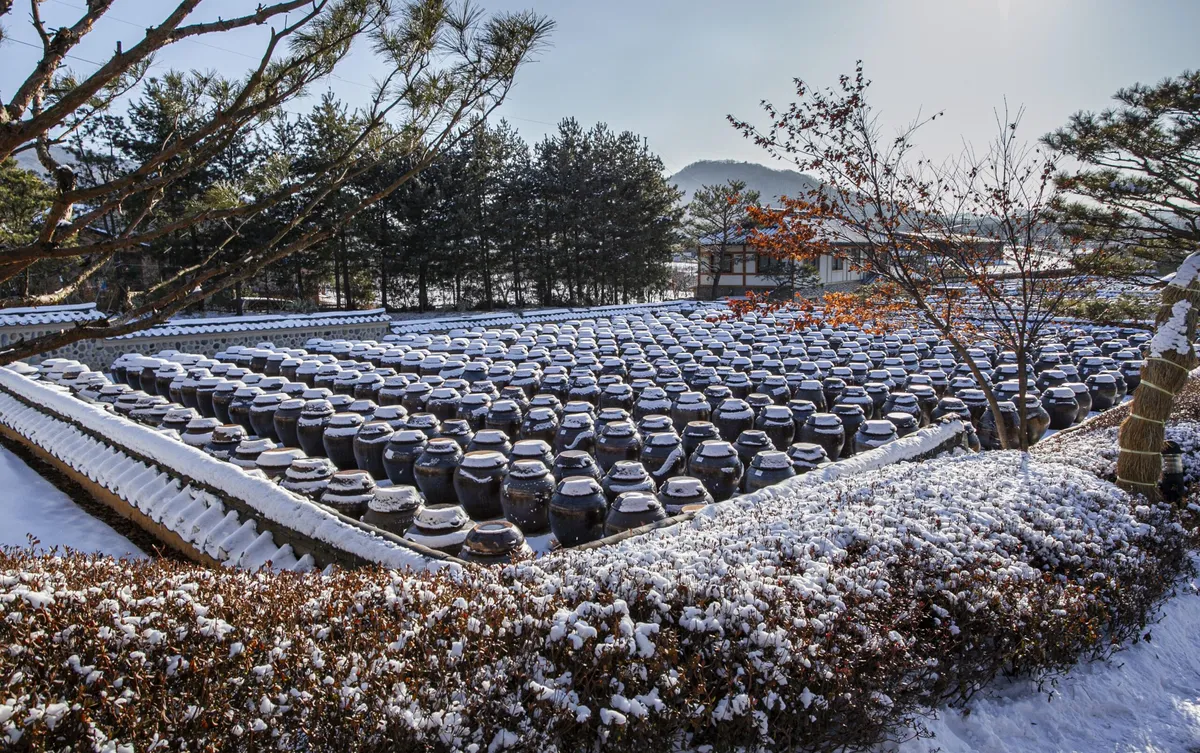
The Living Memory of the Jangdokdae
How Traditional Gochujang Fermentation Turns Rice, Soybeans, and Chili into a Complex Korean Condiment
There is a particular scene that belongs to the memory of many Korean households.
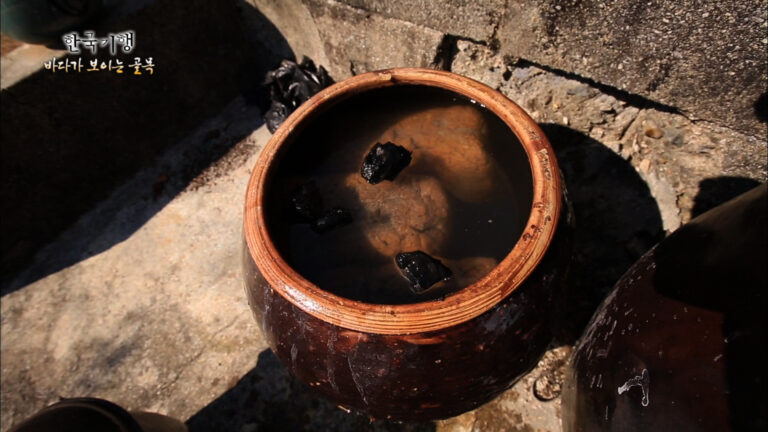
On a warm spring day, someone crouches beside a row of earthenware jars.
The lids are lifted.
Inside one jar is doenjang. In another, ganjang. And somewhere among them is a deep red paste made from chili, grain, meju, malt, and salt.
The jars sit quietly in the sunlight.
Nothing appears to be happening.
But inside the jar, a complicated transformation is underway.
Enzymes are breaking down starches and proteins. Microbial communities are changing. Sugars and amino acids are being produced and consumed. Acids develop. Aromas become deeper. The harshness of freshly mixed ingredients gradually gives way to something rounder, richer, and more complex.
That paste is gochujang.
To understand traditional gochujang, it helps to look beyond the recipe.
Gochujang is not simply chili powder mixed with sweetness and salt. It is a fermented food whose character develops from the interaction of ingredients, enzymes, microorganisms, salt, temperature, time, and the environment in which it matures.
And that is what makes the red paste in the jar so interesting.
What Exactly Is Gochujang?
Gochujang is a traditional Korean fermented condiment made from a combination of ingredients that commonly includes red chili powder, glutinous rice or another grain, meju or meju powder, malt, and salt.
The exact formulation is not universal.
Recipes have varied according to region, household tradition, available ingredients, and historical period. Some versions are sweeter, some saltier, some more intensely savory, and some are aged for considerably longer than others.
What they share is a basic idea:
Use fermentation to transform grains and soybeans into a condiment with sweetness, umami, aroma, heat, and depth.
This combination is unusual.
The chili provides capsaicin and aroma. The grain provides starch. The malt provides enzymes that help convert starch into smaller sugars. The meju contributes soybean-derived proteins, enzymes, and a diverse microbial history. Salt helps control the environment in which microorganisms grow.
The result is much more than the sum of its ingredients.
A Brief History of Gochujang
Korean fermented soybean foods have a long history, but gochujang has a more complicated historical story because its identity depends on chili peppers.
Chili peppers originated in the Americas and spread through Europe and Asia after the late fifteenth century. They reached East Asia before becoming firmly established in Korean cuisine, although the exact route and timing of their introduction remain subjects of historical discussion.
This means that the red chili-based form of gochujang familiar today developed later than Korea’s older soybean-based fermented foods.
Over time, however, chili became deeply integrated into Korean food culture.
Gochujang emerged as one of the most distinctive expressions of that transformation: an older tradition of grain and soybean fermentation combined with the heat and color of chili.
Traditional gochujang therefore belongs to a broader Korean fermentation culture, but it should not be treated as if it has always been made according to one fixed recipe.
There is no single original formula.
There are traditions.
And those traditions changed.
Why Gochujang Is Different from Other Jang
At first glance, gochujang may seem closely related to doenjang and ganjang.
They share important elements of Korean fermentation culture, especially soybean fermentation and the use of meju.
But gochujang has a different balance.
It combines starch-derived sweetness, soybean-derived umami, chili heat, saltiness, fermentation-derived aroma, and organic acids and other metabolites.
This makes gochujang particularly interesting from a fermentation perspective.
The fermentation is not simply about preserving food.
It is about changing the chemistry of the ingredients.
The Science Inside the Jar
If you opened a jar of freshly mixed gochujang and tasted it immediately, you might find the flavor surprisingly rough.
The ingredients are there, but they have not yet become one thing.
During aging, that changes.
Three major processes are particularly important:
Starch breakdown. The starch in glutinous rice and other grains is too large for many microorganisms to use directly. Enzymes produced by malt and microorganisms break starch molecules into smaller carbohydrates. Some of these compounds contribute to sweetness and can subsequently be consumed or transformed during fermentation. This is one reason traditional gochujang can develop a naturally complex sweetness without relying entirely on added sugar.
Protein breakdown. Soybean proteins are large molecules. During fermentation, enzymes such as proteases break them into smaller peptides and amino acids. These compounds are important contributors to umami and savory flavor. This is one of the reasons meju is so important. Meju is not simply dried soybean powder. It is a fermented material carrying enzymes and a complex microbial history that can influence the later character of the gochujang.
Formation of acids and aroma compounds. Microorganisms metabolize available nutrients and produce a variety of compounds, including organic acids and volatile compounds. These compounds influence acidity, aroma, and overall flavor. The process is not controlled by one microorganism. It is a microbial ecosystem.
The Hidden World of Meju
Meju is one of the most important ingredients in traditional Korean fermentation.
Soybeans are cooked, shaped, dried, and naturally fermented. During this process, a diverse community of microorganisms develops.
Research on meju has found bacteria, yeasts, and filamentous fungi, with microbial composition changing according to fermentation conditions, moisture, temperature, region, and production method. Bacillus species are often important, but they are only part of the microbial community.
This matters when we talk about gochujang.
It is tempting to say: Aspergillus makes the enzymes, Bacillus makes the amino acids, and yeast makes the flavor.
Real fermentation is not that simple.
Different microorganisms can overlap in their functions, and their abundance changes during fermentation.
The microbial community in gochujang also changes over time.
One study found Bacillus, Aerosakkonema, and Enterococcus among the predominant bacterial genera, while Aspergillus, Zygosaccharomyces, and Millerozyma were important fungal groups. After fermentation, Aspergillus decreased in relative abundance while Zygosaccharomyces became more prominent in the samples studied.
This is a much better way to think about fermentation: not as a single organism performing a single job, but as a succession of microbial communities interacting with changing food chemistry.
Why Malt Matters
Malt is another important piece of the traditional process.
When glutinous rice is combined with malt and held under appropriate conditions, enzymes in the malt help break down starch.
This is essentially a form of saccharification.
The process is related to the principle behind other traditional Korean foods and beverages in which starch is converted into simpler sugars.
That sweetness becomes part of the foundation of gochujang.
But the sweetness does not remain unchanged.
During fermentation, microorganisms can consume and transform some of the available sugars.
This is one reason the flavor of gochujang changes during aging.
Freshly mixed paste and mature paste may contain the same basic ingredients, yet taste remarkably different.
What Happens as Gochujang Ages?
Aging is where the ingredients begin to behave less like separate ingredients and more like a unified food.
Researchers studying fermented gochujang have observed changes including lower pH, increased acidity, changes in reducing sugars, increases in amino-type nitrogen, changes in microbial communities, and development of fermentation-related flavor compounds.
Amino-type nitrogen is particularly useful as a scientific indicator because it reflects the formation of amino compounds associated with protein breakdown.
In practical terms, that chemistry translates into something people can taste.
More savory depth.
The paste becomes less dominated by the sharpness of individual ingredients and more characterized by a layered combination of sweet, salty, spicy, sour, and umami notes.
This is why time matters.
The Jangdokdae: More Than a Place to Store Food
Traditionally, gochujang was often fermented in onggi, Korean earthenware vessels, on the jangdokdae.
The jangdokdae was not simply a storage shelf.
It was part of the fermentation environment.
Temperature, humidity, airflow, evaporation, seasonal changes, and exposure to the surrounding environment could all influence the maturation process.
This does not mean that sunlight itself magically creates fermentation.
Rather, traditional outdoor fermentation exposed the jars to changing environmental conditions.
The material of the vessel also matters.
Onggi is porous compared with many modern impermeable containers, and traditional fermentation environments were very different from today’s temperature-controlled factories.
But we should be careful not to romanticize this.
Traditional fermentation was not automatically safer or better simply because it was traditional.
It was a process developed through experience, observation, seasonal knowledge, and repeated practice.
Salt: The Quiet Regulator
Salt does much more than make gochujang taste salty.
It changes the environment available to microorganisms.
By reducing water activity and creating osmotic stress, salt makes it more difficult for many microorganisms to grow while allowing more salt-tolerant organisms to persist.
This helps shape the microbial community during fermentation.
But there is no single salt percentage that represents every traditional gochujang.
Published studies have found substantial variation among traditional products, reflecting differences in recipes and production methods.
So statements such as traditional gochujang always contains exactly X percent salt are misleading.
Traditional fermentation is more variable than that.
A Traditional-Style Gochujang Recipe
There is no single authentic recipe for gochujang.
The following should therefore be understood as a traditional-style formulation, not as the definitive historical recipe.
Ingredients: 500 g Korean red chili powder, 500 g glutinous rice flour, 300 g meju powder, 200 to 250 g salt, about 200 g rice syrup or jocheong, malt and water as needed for saccharification and consistency.
Step 1: Prepare the Malt Water. Soak malt in clean water and strain the liquid. The malt water contains enzymes capable of breaking down starch.
Step 2: Prepare the Rice Base. Mix the glutinous rice flour with the malt water. Warm the mixture under controlled conditions appropriate for saccharification. The goal is not to cook the mixture aggressively, but to allow the malt enzymes to convert part of the starch into simpler carbohydrates. After saccharification, heat the mixture as appropriate for the traditional method, then allow it to cool sufficiently before adding the fermentation ingredients.
Step 3: Add the Meju. Once the mixture has cooled, add the meju powder. The meju introduces enzymes and microorganisms associated with fermented soybean products. This is one of the most important differences between a simple chili paste and a traditional-style fermented gochujang.
Step 4: Add Chili and Salt. Add the red chili powder and salt. Mix thoroughly. The final consistency should be thick enough to remain stable in the fermentation vessel without excessive free liquid.
Step 5: Transfer to a Fermentation Vessel. Place the mixture in a clean, food-safe fermentation container. Traditional production often used onggi, but a modern food-safe container can also be used. The important point is not the appearance of the vessel. It is cleanliness, appropriate environmental control, and the ability to monitor the product safely.
How Do You Know When Gochujang Is Changing Normally?
Fermentation is not simply a matter of waiting six months and assuming everything is fine.
The product should be observed.
Normal maturation may involve changes in aroma, color, viscosity, acidity, sweetness, saltiness, and savory depth.
Visual appearance alone cannot determine food safety.
A white surface growth should not automatically be declared harmless.
Different microorganisms can produce different colors and appearances, and an unidentified mold should not simply be scraped away and assumed to be safe.
If a batch develops unusual mold, strong rotten or putrid odors, unexpected gas production, or other obvious signs of spoilage, it is safer not to consume it.
Traditional knowledge is valuable.
But food safety still comes first.
The Flavor Transformation
Perhaps the most fascinating part of gochujang fermentation is that the ingredients do not simply become more fermented.
They become chemically different.
The starches are transformed. The proteins are hydrolyzed. Sugars change. Acids accumulate. Amino acids and peptides increase. Volatile compounds develop. Microbial populations shift.
And all of those changes interact.
This is why a freshly prepared paste can taste relatively harsh while a mature gochujang can taste rounded and deeply savory.
The chili does not disappear. It becomes integrated.
The sweetness does not disappear. It becomes more complex.
The salt does not disappear. It becomes part of a larger flavor structure.
That is fermentation at work.
Is Gochujang a Probiotic Food?
This is where we need to be careful.
Gochujang is a fermented food, but that does not automatically make it a probiotic food.
A probiotic is generally defined as a microorganism that, when administered in adequate amounts, provides a health benefit to the host.
Simply finding microorganisms in a fermented food is not enough.
The organisms must survive in relevant amounts, be appropriately identified, and have evidence supporting a health benefit.
Traditional gochujang contains a complex microbial history, and fermentation can generate or transform bioactive compounds. Research has investigated possible effects involving metabolism, inflammation, and the gut microbiome. But these findings should not be turned into claims that eating gochujang will prevent or treat a particular disease.
The most scientifically responsible statement is simpler:
Gochujang is a fermented food with a complex microbial and chemical profile, and some of its fermentation-derived compounds are being investigated for potential health effects.
That is interesting enough without exaggerating it.
What About Capsaicin?
The heat of gochujang primarily comes from chili peppers and their capsaicinoids.
Capsaicin has been studied extensively for its effects on sensory perception, energy metabolism, and other physiological pathways.
But the effects observed in controlled research should not be interpreted as proof that ordinary servings of gochujang produce dramatic weight loss or metabolic improvements.
Gochujang is a condiment.
Portion size matters.
And it can also contain a significant amount of sodium.
So the healthiest way to think about gochujang is not as a miracle food.
It is a flavorful fermented ingredient that can contribute to a varied diet when used appropriately.
This content is for informational purposes only and is not medical advice.
How to Use Mature Gochujang
Once mature, gochujang can become one of the most versatile ingredients in the Korean kitchen.
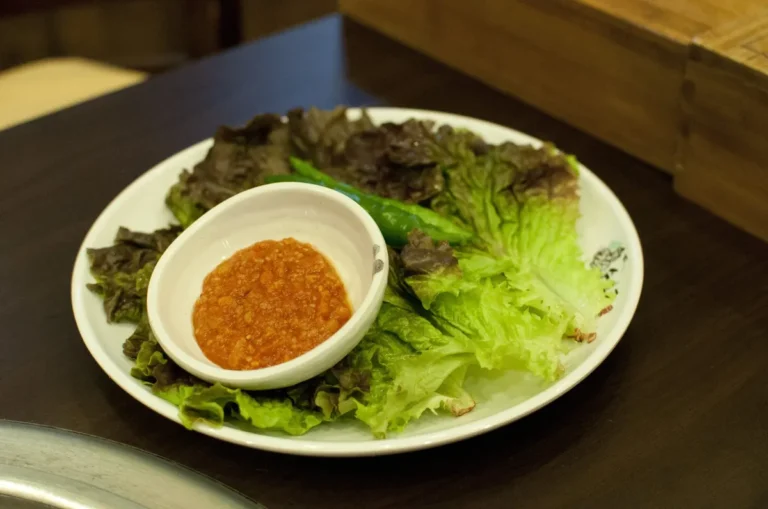
It can be used in bibimbap, ssamjang, spicy dipping sauces, marinades, stews, soups, stir-fries, grilled meat, roasted vegetables, noodle sauces, and modern fusion dishes.
Its strength is not simply its heat.
It is the combination of heat, sweetness, saltiness, acidity, and umami.
That is why a small amount can transform an otherwise simple dish.
The Living Food in the Jar
Today, most people encounter gochujang in a plastic tub on a supermarket shelf.
It is easy to forget that the red paste has a history that begins long before the package.
Someone had to cook the grain. Someone had to prepare the meju. Someone had to grind the chili. Someone had to mix the ingredients. And someone had to wait.
That waiting was not empty time.
Inside the jar, enzymes were breaking molecules apart. Microorganisms were adapting to salt, acidity, moisture, and changing nutrients. Proteins were becoming amino acids and peptides. Starches were becoming sugars. Aromas were developing. The chemistry was changing.
And eventually, separate ingredients became something new.
That is the real meaning of fermentation.
It is not simply decay controlled by humans.
It is transformation.
Traditional gochujang is a particularly beautiful example because it brings together several worlds at once: the soybean, the grain, the chili, the salt, the microorganisms, the vessel, the seasons, and the patience of the person who makes it.
The jar may look quiet from the outside.
But inside, it is anything but quiet.
It is a living system of transformation.
And perhaps that is why the old jangdokdae remains such a powerful image in Korean food culture.
The jars seem to be waiting.
But they are actually working.