Fermented Foods and Skin Health: The Gut-Skin Connection
For thousands of years, our ancestors knew from experience that fermented foods kept the body healthy. Every Korean household passed down the same wisdom: eat doenjang and your stomach settles, eat kimchi regularly and your skin clears up. Now modern science is catching up to that old knowledge, one study at a time. At the center of it all is a concept called the Gut-Skin Axis. Today we’re digging into how fermented foods travel through your gut and reach all the way to your skin — and why that connection is more remarkable than most people realize.
Note: This article is for informational purposes only and is not intended as medical advice. Please consult a healthcare professional for any skin or digestive health concerns.
Your Gut and Skin Are Closer Than You Think
Ever been told “your skin is breaking out because your gut is off”? It sounds like folk medicine. But there’s real science behind it. A 2019 study published in Frontiers in Microbiology found that imbalances in the gut microbiome are closely linked to a range of skin conditions — atopic dermatitis, psoriasis, acne, and rosacea among them.
The connection goes deeper than that. During fetal development, skin and gut tissue both originate from the same ectoderm layer. Even in adulthood, the two organs keep talking to each other through the nervous system, immune system, and endocrine system. About 70 to 80 percent of the body’s immune cells are concentrated in the gut lining. The metabolites produced by gut microbes enter the bloodstream and directly influence skin condition.
So no, “your gut is making your skin bad” isn’t just something your grandmother made up.
A Brief History of Korean Fermented Foods
Fermentation on the Korean peninsula goes back at least 2,000 years. Records from the Three Kingdoms period already mention fermented soybean pastes and pickled vegetables. By the Goryeo era, a precursor to kimchi called chimchae (沈菜) — literally “sunken vegetables” — had spread widely. During the Joseon dynasty, fermented soybean products like doenjang, ganjang, gochujang, and cheonggukjang were collectively known as the “Five Jang” (五醬) and were considered essential to aristocratic table culture.
Korea’s four distinct seasons were practically designed for fermentation. Long, cold winters pushed people to find ways to preserve vegetables, and fermentation was the answer. As temperatures and humidity varied by region, microbial communities evolved differently too — which is why fermented foods took on distinct local characters. Jeolla Province has its deeply aged mukeunji kimchi. Gyeongsang Province is known for its kkakdugi radish kimchi. Hamgyong Province in the north produced gajami sikhae, a fermented flatfish dish unlike anything from the south.
The Science of Fermentation: How Microbes Make Skin Medicine
1. Lactic Acid Bacteria and Short-Chain Fatty Acids (SCFAs)
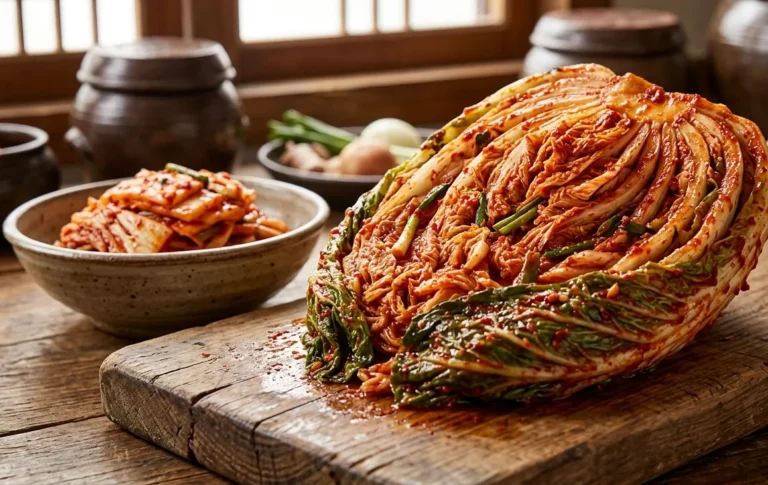
The heart of kimchi and doenjang fermentation is Lactobacillus bacteria. In kimchi specifically, the key players include Lactobacillus plantarum, Leuconostoc mesenteroides, and Lactobacillus brevis. As these bacteria break down carbohydrates, they produce lactic acid, which lowers gut pH, suppresses the growth of harmful bacteria, and strengthens the protective function of the gut lining.
Even more important is what happens with short-chain fatty acids, or SCFAs. Butyric acid, propionic acid, and acetic acid are the main ones. SCFAs serve as the primary energy source for cells lining the gut, and they reinforce the tight junctions between intestinal epithelial cells — essentially patching up the gaps that cause leaky gut syndrome. When the gut wall stays intact, microbial toxins and micro-proteins can’t seep into the bloodstream. Systemic inflammation goes down. And that reduction in inflammation shows up on your skin.
2. Doenjang’s Isoflavones and Anti-Aging Effects
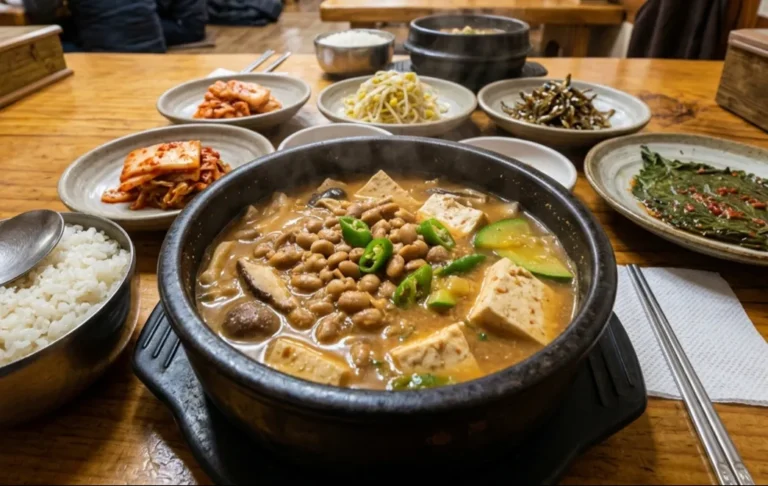
During doenjang fermentation, the isoflavones in soybeans are converted into a more bioavailable form called aglycones. Specifically, genistein and daidzein in their aglycone forms bind to estrogen receptors and stimulate collagen synthesis, which improves skin elasticity. One Japanese study found that women who consumed miso soup daily for 12 weeks showed a statistically significant increase in skin moisture levels.
3. Cheonggukjang’s Nattokinase and Circulation
Cheonggukjang is fermented by Bacillus subtilis, the same strain behind Japanese natto. This bacterium produces an enzyme called nattokinase, which helps dissolve blood clots and improve circulation. Better blood flow means more nutrients and oxygen reaching skin cells — which translates to a more even skin tone and less dullness.
Korean Fermented Foods and Their Skin Benefits at a Glance
| Fermented Food | Key Microorganism | Active Compounds | Skin-Related Benefits | Notes |
|---|---|---|---|---|
| Kimchi | Lactobacillus plantarum, others | Lactic acid bacteria, Vitamin C, beta-carotene | Antioxidant, anti-inflammatory, gut health | High in sodium |
| Doenjang | Aspergillus oryzae | Isoflavone aglycones, peptides | Collagen synthesis, hydration | High in sodium |
| Cheonggukjang | Bacillus subtilis | Nattokinase, polyglutamic acid | Circulation, skin radiance | Purine content worth noting for gout-prone individuals |
| Makgeolli | Saccharomyces cerevisiae | Farnesol, kojic acid | Skin brightening (topical use under research) | Watch alcohol intake |
| Brown Rice Vinegar | Acetobacter aceti | Acetic acid, organic acids | Skin pH balance, gentle exfoliation | Undiluted use can irritate |
Recipe: Fermented Veggie Smoothie Bowl for Gut-Skin Health
This smoothie bowl layers several fermented foods into one meal. The plant-based probiotics from white kimchi work alongside the animal-based probiotics in Greek yogurt. Blueberry anthocyanins bring powerful antioxidant protection to skin cells. And chia seeds supply omega-3 fatty acids that help reinforce the skin barrier.
Ingredients (serves 1)
- 30g white kimchi (baek kimchi) — rinse once under cold water if you want to reduce sodium
- 150g plain Greek yogurt, unsweetened
- 100g frozen blueberries
- ½ banana
- ¼ teaspoon doenjang (optional — adds umami depth)
- 1 teaspoon honey
- Toppings: 30g granola, 1 teaspoon chia seeds, fresh blueberries, mint leaves
Steps
- Prep the kimchi. Gently squeeze out excess liquid and chop into rough pieces. Do not heat the kimchi — keeping it raw preserves the live lactic acid bacteria.
- Blend. Add Greek yogurt, frozen blueberries, banana, white kimchi, and honey to a blender. If you’re using doenjang, add it here too. Blend until smooth.
- Check the consistency. A smoothie bowl should be thick enough to eat with a spoon, not drink through a straw. If it’s too thin, add a few more frozen blueberries and blend again.
- Assemble. Pour the smoothie into a bowl and arrange granola, chia seeds, fresh blueberries, and mint leaves on top.
- Eat immediately. Lactic acid bacteria are sensitive to heat and don’t keep well once blended. Serve cold and eat right away for the best probiotic benefit.
Practical Tips for Getting the Most from Fermented Foods
- Consistency beats quantity. Probiotic benefits don’t appear overnight. A small amount every day outperforms a large amount once in a while. Think of it as a daily practice, not a quick fix.
- Variety is the point. Don’t rely on just one fermented food. Rotating between kimchi, doenjang, yogurt, and vinegar increases the diversity of your gut microbiome — and diversity is what researchers keep pointing to as a marker of gut health.
- Pair with prebiotics. Probiotics need something to eat. Feed the good bacteria in your gut by combining fermented foods with prebiotic-rich ingredients like garlic, onion, leeks, and bananas. The smoothie bowl above already does this with the banana.
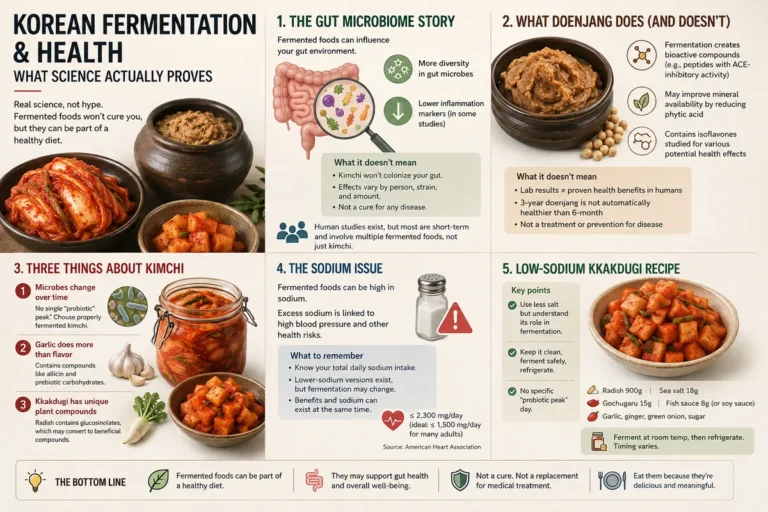
- Watch the sodium. Kimchi and doenjang are both high in sodium. People managing blood pressure or kidney health should be mindful of portion sizes and consider rinsing kimchi or using lower-sodium versions where possible.
- Keep live cultures alive. Heat kills lactic acid bacteria. When cooking with fermented foods, add them at the end of the cooking process, or enjoy them raw when possible, to preserve their probiotic activity.
The gut-skin connection is one of the more exciting frontiers in nutritional science right now. And Korean fermented foods — built over millennia of trial, error, and extraordinary culinary intuition — sit right at the center of it. Your ancestors were onto something. The research is just now catching up.