Kimchi: Complete Guide to Korea’s Most Famous Fermented Food
Kimchi is a Korean dish of salted, seasoned vegetables fermented mainly by lactic acid bacteria. It shows up at almost every Korean meal, in hundreds of regional and seasonal forms, and it has kept changing for well over a thousand years. This page is the starting point for kimchi on Fermentpedia: a short version of each topic, with links to the longer articles where we go deeper.
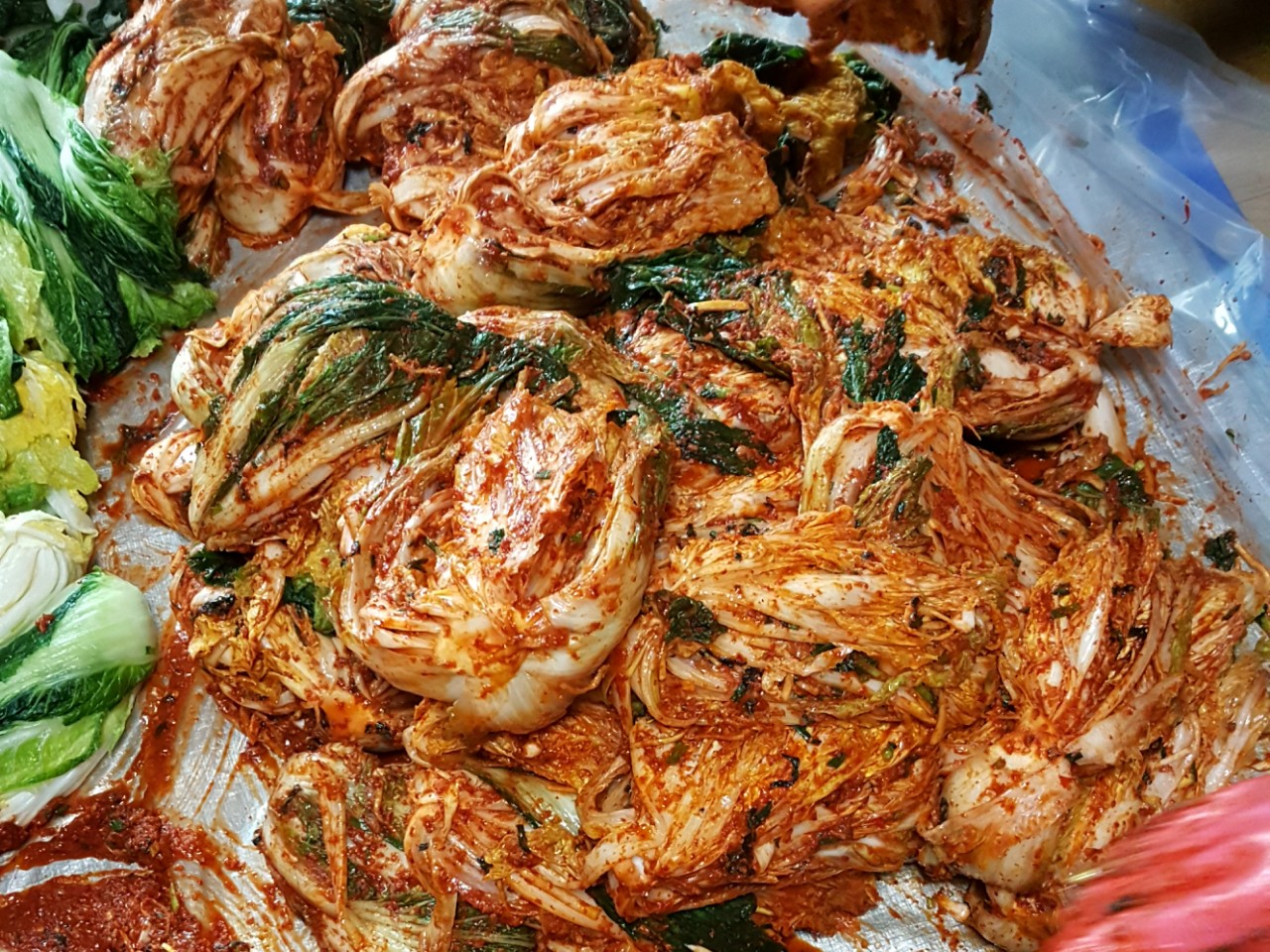
Where this guide comes from. I have worked in food distribution in Korea for about twenty years. My interest in fermented foods started while selling food on home-shopping channels, including a dried kimchi seasoning, and I have used that seasoning to make cabbage geotjeori and pa kimchi at home (I wrote about it in this hands-on post). I have also worked with a kimchi factory, and my family made meju and looked after jang crocks. I have not made every kimchi described below. The history, science, and health sections draw on the published sources listed at the end of the page. The photo at the top of this page is one I took on a kimjang day, around 2024.
A Brief History of Kimchi
From Salt Pickles to a National Staple
Kimchi began long before the red, chili-seasoned dish most people picture today. Salt-preserved vegetables in Korea are generally traced back to at least the Three Kingdoms period. These early versions were simple: vegetables kept in salt or brine, with no chili and none of the layered seasoning pastes of modern kimchi.
By the Goryeo dynasty (918–1392), the practice had grown more varied. The poet Yi Gyu-bo wrote about pickling radish for the winter, and brine-based radish kimchi in the style of dongchimi dates from this era. Garlic and scallions entered the picture, but chili and salted seafood (jeotgal) had not yet arrived.
The Arrival of Chili Peppers
Chili peppers are native to the Americas and reached Korea around the turn of the seventeenth century. The first known Korean written mention appears in Jibong yuseol, an encyclopedia completed around 1614. Adoption in kimchi was slow. The cookbook Eumsik dimibang (around 1670) describes vegetable pickling without any chili at all, and the familiar red kimchi became widespread only by the nineteenth century. One explanation offered by food historians is that chili paired well with jeotgal, which was becoming common in kimchi around the same time. For how kimchi fits alongside doenjang, ganjang, and gochujang, see Korean Fermented Foods Explained.
UNESCO Recognition
In 2013, UNESCO inscribed “Kimjang, making and sharing kimchi in the Republic of Korea” on its Representative List of the Intangible Cultural Heritage of Humanity. The listing covers kimjang, the late-autumn practice of households and neighbors making large batches of kimchi together for winter, rather than kimchi as a food. Recipes and methods are passed down within families, which is why two households in the same town can make noticeably different kimchi.
How Kimchi Fermentation Works
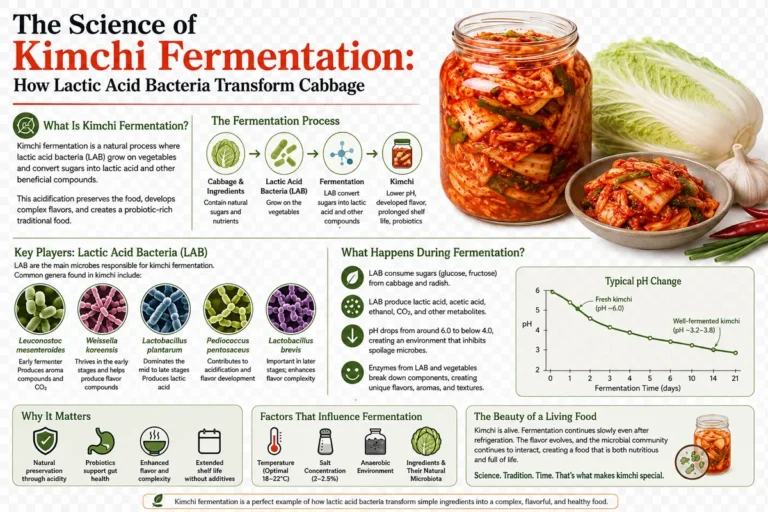
Kimchi is not inoculated with a starter culture. The lactic acid bacteria come in on the raw ingredients themselves, and salt decides which of them get a head start. What follows is a general pattern rather than a fixed schedule.
In the first stage, heterofermentative bacteria, mainly Leuconostoc and Weissella, take the lead. They turn sugars into lactic acid, acetic acid, a little ethanol, mannitol, and carbon dioxide. That carbon dioxide is why young kimchi tastes lightly fizzy, why bubbles rise in the brine, and why a sealed container can swell. As the acid builds and the pH falls, acid-tolerant lactobacilli (now split into several genera, such as Latilactobacillus and Lactiplantibacillus) become more prominent, and the flavor turns sharper and more sour.
Salt works in two steps. The cabbage is first soaked in a strong brine to draw out water, then rinsed, so the finished kimchi ends up far less salty than the brining stage suggests. Freshly seasoned kimchi starts close to neutral, around pH 6, and is usually considered at its best somewhere around pH 4 to 4.5. Temperature controls the speed of all of this: a few days on the counter can do what takes weeks in the refrigerator.
For the stage-by-stage version, with what happens on which day and why, see our kimchi fermentation guide. For more on salt itself, see Salt and Fermentation.
Types of Kimchi
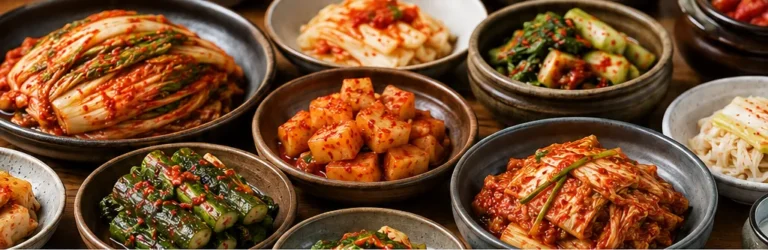
Estimates usually run from about 200 to more than 300 kinds of kimchi, depending on how regional and seasonal versions are counted. These are the ones most people meet first.
Baechu Kimchi (Napa Cabbage Kimchi)
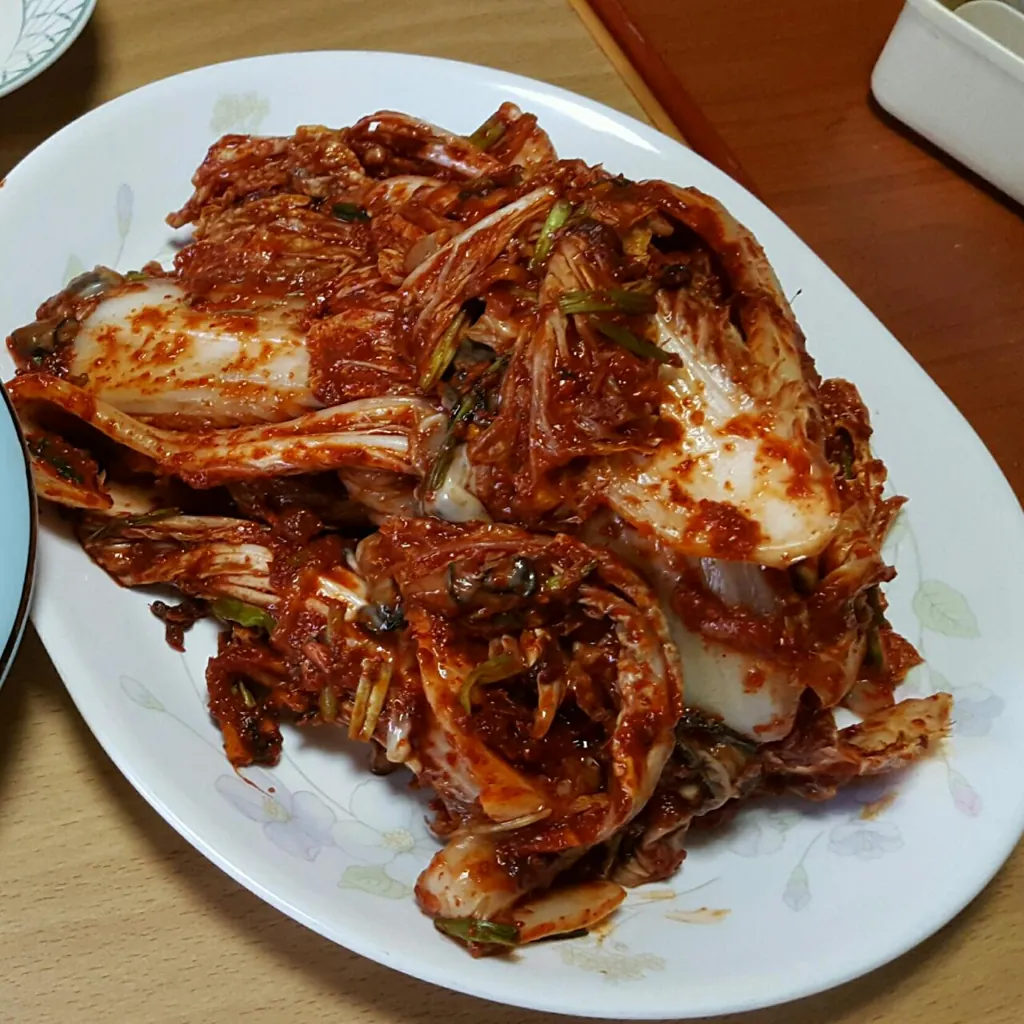
The standard: salted napa cabbage layered with a paste of gochugaru (chili flakes), garlic, ginger, scallions, and usually jeotgal or fish sauce. This is the kimchi most people picture. Our step-by-step method is in Baechu Kimchi Recipe.
Geotjeori (Fresh Kimchi)
Geotjeori is seasoned like baechu kimchi but eaten fresh, within a day or so, before real fermentation sets in. It tastes more like a dressed salad than a sour pickle. Geotjeori is one of the kimchi I have made myself, using a dried seasoning; that experience is written up here.
Kkakdugi (Cubed Radish Kimchi)
Korean radish cut into cubes and seasoned with gochugaru and garlic. The radish keeps its crunch for weeks. See our kkakdugi article.
Pa Kimchi (Green Onion Kimchi)
Made with whole green onions, often served with grilled pork. I have made pa kimchi at home with the same dried seasoning I used for geotjeori. See Pa Kimchi.
Oi Sobagi (Stuffed Cucumber Kimchi)
A summer kimchi: small cucumbers are slit and stuffed with seasoning, and are best eaten while still crisp. See Oi Sobagi.
Baek Kimchi (White Kimchi)
Made without chili, so it is clean and mild, a good choice for anyone who wants kimchi without heat. See White Kimchi.
Water Kimchi: Dongchimi, Nabak Kimchi, and Mul Kimchi
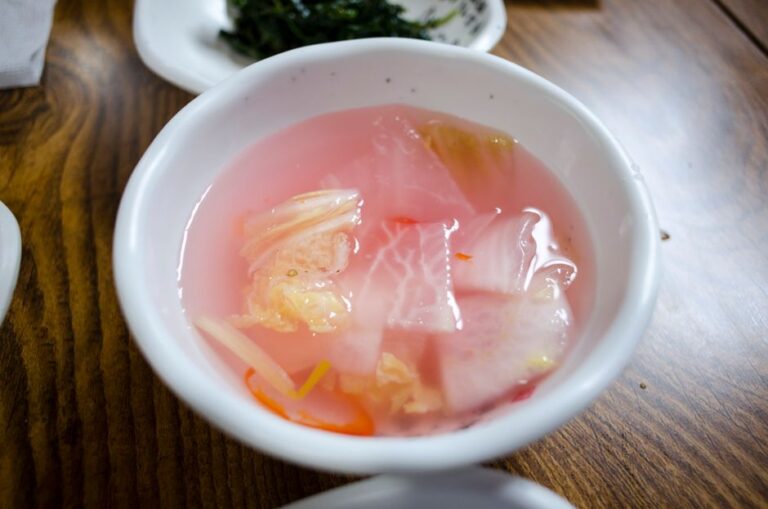
These kimchi are as much about the brine as the vegetables. Dongchimi is whole or large-cut radish in a clear, cold brine that turns gently fizzy and sweet-sour, and it is a classic broth for naengmyeon (cold noodles). Nabak kimchi uses thin-sliced radish and cabbage in a lightly pink brine. See our water kimchi article.
Mukeunji (Long-Aged Kimchi)
Kimchi left to ferment for many months, until it is deeply sour and soft. It is valued for cooking rather than thrown away. See Mukeunji.
Regional Variations
Regional styles are a big part of kimchi culture. Dolsan gat kimchi, made with mustard leaf, is tied to Dolsan Island in South Jeolla. Gaeseong-style bossam kimchi wraps a filling of chestnuts, pine nuts, jujubes, pear, and seafood inside cabbage leaves. In general, kimchi from the warmer south tends to be saltier and more strongly seasoned, while northern kimchi is milder and often has more brine.
Key Ingredients and What They Do
Napa cabbage supplies the sugars and fiber the bacteria feed on.
Salt draws out water, firms the vegetables, and gives salt-tolerant lactic acid bacteria an early advantage over spoilage organisms.
Garlic, ginger, and green onion carry much of the flavor, and they also bring their own bacteria into the mix.
Gochugaru gives color, heat, and a sweet, slightly smoky flavor.
Jeotgal or fish sauce adds salt and savory depth. Vegan kimchi replaces it, often with soy sauce, miso, or seaweed.
Rice paste (usually glutinous rice flour cooked with water) helps the seasoning cling to the leaves and gives the bacteria an easy early sugar source.
Kimchi and Health: What the Research Actually Shows
Disclaimer: This section is general education about fermentation science, not medical advice. Kimchi is a food, not a treatment. Human research on kimchi is still limited. If you have a medical condition, take medication, are pregnant or immunocompromised, or need to limit sodium, talk with a healthcare professional about your diet.
Fermented foods and the gut. In a 2021 Stanford trial, 36 healthy adults followed either a high-fiber diet or a diet rich in fermented foods for 10 weeks. The fermented-food group showed higher gut microbiome diversity and lower levels of a number of inflammatory proteins (Stanford Medicine). Participants chose their own fermented foods, including yogurt, kefir, kombucha, and kimchi, so the study cannot say anything about kimchi on its own. It was small and short.
Kimchi and IBS. A 2022 randomized trial in Food & Nutrition Research gave 90 adults with irritable bowel syndrome 210 grams a day of one of three kimchi preparations for 12 weeks. Symptoms and the inflammatory marker TNF-α improved in all three groups (PubMed). Because every group ate kimchi and there was no non-kimchi comparison group, the trial cannot show how much of the change came from kimchi itself.
The overall picture. A 2023 scoping review of randomized controlled trials on kimchi, published in the Journal of Ethnic Foods, found studies on blood lipids, blood sugar, body weight, gut bacteria, bowel function, and immune markers (Journal of Ethnic Foods). The trials are mostly small, short, and different from one another. The directions are interesting; the evidence is not conclusive.
Is kimchi a probiotic? Unpasteurized kimchi contains large numbers of live lactic acid bacteria. Calling a food “probiotic” in the scientific sense, though, requires a defined strain, at a known dose, with a health benefit shown in humans, and kimchi as a whole does not meet that bar yet. For why fermented foods may still matter even when the bacteria are dead, see Probiotics vs. Postbiotics.
Sodium. Kimchi is a salty food, and the salt content varies a lot between recipes and brands. If you are watching sodium, check the label and keep portions modest. Small side-dish servings are how kimchi is usually eaten in Korea anyway.
Storing Kimchi: From Onggi to the Kimchi Fridge
Onggi
For centuries kimchi was fermented and stored in onggi, breathable earthenware jars. Researchers at Georgia Tech compared kimchi fermented in onggi with kimchi in sealed glass jars and found that carbon dioxide levels in the onggi stayed at less than half those in glass, because the gas escapes slowly through the porous clay; the lactic acid bacteria in the onggi kimchi grew better as a result (Journal of the Royal Society Interface, 2023, via ScienceDaily). In winter, crocks were often partly buried in the ground, where the temperature stays cold and steady.
The Kimchi Refrigerator
Dedicated kimchi refrigerators went on sale in Korea in the mid-1990s and are now a common appliance in Korean homes. They hold a stable temperature just around freezing, with less opening and closing than a regular fridge, which slows fermentation a great deal. A regular refrigerator works too; the kimchi simply sours faster.
Practical Storage
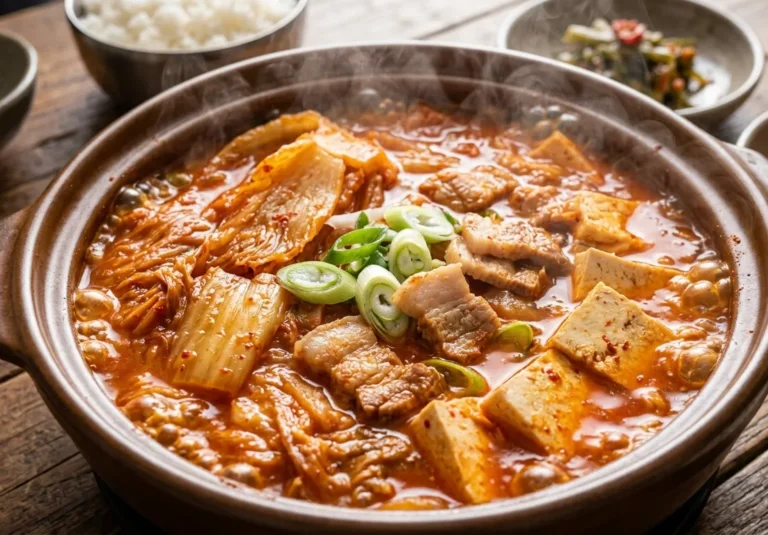
Keep the vegetables pressed down under the brine, use a clean utensil every time, and store kimchi cold. Expect it to keep getting more sour, which is normal. Very sour kimchi is ideal for kimchi jjigae, fried rice, and pancakes. For shelf life and containers, see How to Store Fermented Foods.
If vegetables are left exposed to air, a white film or fuzzy mold can grow on the surface. A thin white film of yeast is common in fermented vegetables, but fuzzy or colored mold is a different matter. If you see mold, do not rely on scraping it off; throw the kimchi away. For more on when mold matters in fermented foods, see Fermentation Molds.
Frequently Asked Questions About Kimchi
Why is my kimchi fizzy?
The fizz is carbon dioxide made by lactic acid bacteria during the early stage of fermentation. It is normal and a sign the kimchi is alive. It is also why a tightly closed container can bulge, so open it slowly over the sink.
Is kimchi vegan?
Traditional kimchi usually is not, because it contains jeotgal or fish sauce. Vegan versions are easy to make or buy. Researchers at Brown University found that vegan kimchi made with miso ended up with nearly the same bacterial community as traditional kimchi once fermentation was underway (Brown University, 2018). Check labels on store-bought kimchi.
Is kimchi gluten-free?
Often, but not always. Glutinous rice flour is gluten-free despite its name, but some recipes and commercial products use wheat flour or soy sauce made with wheat. If you need to avoid gluten, read the label.
Does cooking kill the bacteria in kimchi?
Yes. Stewing, stir-frying, or baking kills the live lactic acid bacteria. The acids and flavor compounds made during fermentation remain, which is why cooked sour kimchi still tastes so distinctive.
Do Koreans still eat kimchi every day?
Most do, but fewer than before. An analysis of Korea National Health and Nutrition Examination Survey data found that the share of people who ate no kimchi in the previous 24 hours rose from 11.7% in 2010 to 22.7% in 2024, with the biggest change among younger adults (Korea JoongAng Daily).
Sources
- UNESCO Intangible Cultural Heritage. Kimjang, making and sharing kimchi in the Republic of Korea (inscribed 2013).
- Wastyk HC, et al. Gut-microbiota-targeted diets modulate human immune status. Cell, 2021. Summary: Stanford Medicine.
- Kimchi improves irritable bowel syndrome: results of a randomized, double-blind placebo-controlled study. Food & Nutrition Research, 2022. PubMed 35721806.
- Effects of kimchi on human health: a scoping review of randomized controlled trials. Journal of Ethnic Foods, 2023. Article.
- Kim S, Hu DL. Onggi’s permeability to carbon dioxide accelerates kimchi fermentation. Journal of the Royal Society Interface, 2023. Summary: ScienceDaily.
- Zabat MA, et al. Vegan kimchi microbiome study. Food Microbiology, 2018. Summary: Brown University.
- Korea National Health and Nutrition Examination Survey analysis, 2010–2024. Reported by Korea JoongAng Daily.